


TL;TR
Glass skin is a skincare aesthetic rooted in Korean beauty that describes a complexion so smooth, evenly hydrated, and luminous that it reflects light like a pane of glass. The look depends on two biological conditions: adequate water content in the upper skin layers (the stratum corneum), and an intact lipid barrier that prevents that water from evaporating. No single product produces it. It results from a consistent routine centred on humectant and barrier-repair ingredients applied in layers — a practice long established in K-beauty and now mainstream worldwide.
In 2017, a post by Los Angeles-based makeup artist Ellie Choi went viral. Her selfies showed skin so smooth and luminous it looked translucent, like glass. The term stuck. What Choi was demonstrating was not a new product or a filter: it was the result of a layered K-beauty routine built around hydration and barrier care. Eight years later, the approach has reshaped how brands formulate and how consumers shop for skincare worldwide.
This article explains what glass skin actually is, where it comes from, and what drives the market trend behind it. For the formulation and ingredient detail, see our companion piece: Formulating for a glass-skin finish: choosing humectant, occlusive and active classes.
Interested in our products ?
Safic-Alcan distributes humectants, barrier lipids, brightening actives, and film-formers for cosmetic applications
What glass skin actually means
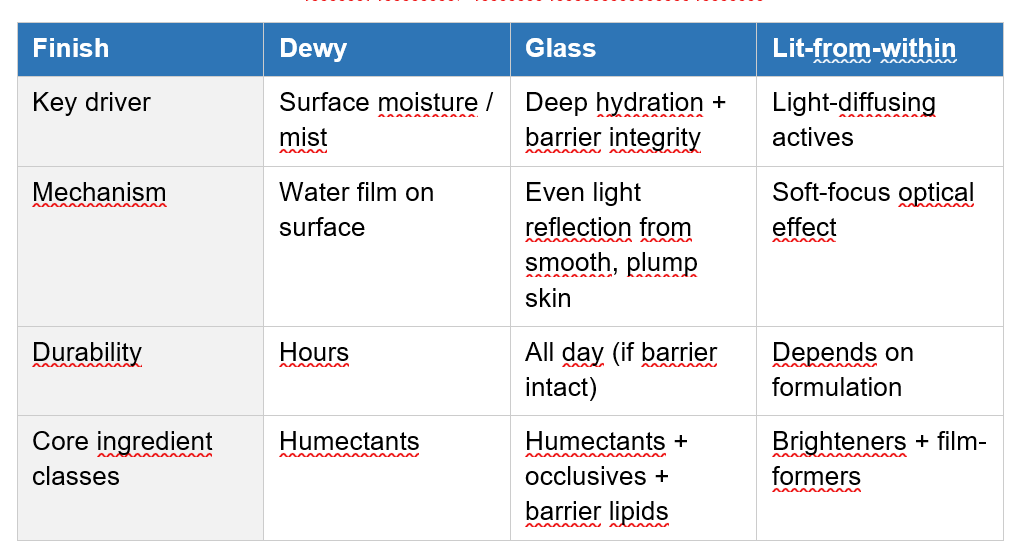
Glass skin describes a complexion that is deeply hydrated, smooth in texture, even in tone, and reflective enough to create a lit-from-within effect. The name is a visual metaphor: light hitting well-hydrated, intact skin reflects uniformly, the way it would off a polished surface.
It is not the same as dewy skin, which describes surface moisture that can be achieved with a spray or a highlighter and fades within hours. Glass skin is a condition of the skin itself, not a surface finish. As Alicia Yoon, founder of skincare brand Peach & Lily, has explained publicly, "glass skin is skin that's so healthy, there's a luminosity, smoothness, and clarity to it."
The distinction matters for formulators and brand teams because it shifts the conversation from cosmetic coverage to genuine skin function.
Dewy vs glass vs lit-from-within: what separates them
The Korean beauty roots of glass skin
Glass skin is an expression of a philosophy embedded in Korean skincare: prevention over correction, and long-term skin health over quick fixes. The K-beauty multi-step routine — double cleansing, essence layering, sheet masks, serums, moisturisers — is not about applying more product. It is about building hydration incrementally and maintaining the skin barrier so it can regulate moisture loss on its own.
This philosophy has roots in Korean cultural standards that have long prioritised clear, even-toned skin. The modern global version accelerated through K-pop and K-drama in the early 2010s, then went mainstream via social media. By 2017, when Choi's post circulated internationally, beauty editors had a name for what K-beauty had been practising for decades.
The glass skin cosmetics market was valued at approximately USD 2.5 billion in 2025 and is projected to reach USD 6.3 billion by 2035, with a compound annual growth rate of 9.6%, according to Fact.MR. Hyaluronic acid-based products are the fastest-growing segment within that market, at a projected CAGR of 10.6%.
The biology behind the look
Understanding what produces the glass skin appearance requires two concepts from skin physiology: hydration of the stratum corneum, and transepidermal water loss (TEWL).
The stratum corneum and why hydration matters
The outermost layer of the skin — the stratum corneum — acts as the primary physical and moisture barrier between the body and the environment. Its structure is often described as 'brick and mortar': the 'bricks' are flattened, protein-rich cells (corneocytes), and the 'mortar' is a lipid matrix composed primarily of ceramides, free fatty acids, and cholesterol.
Ceramides make up approximately 50% of this intercellular lipid content by mass, according to published data. When the lipid matrix is intact, it limits TEWL — the passive, continuous diffusion of water through the skin surface. When it is disrupted by environmental damage, harsh formulations, or ageing, TEWL rises and the skin appears dull, tight, and uneven in texture.
Why an intact barrier produces the glass skin appearance
When the stratum corneum is well-hydrated and the lipid barrier is functioning correctly, the skin surface is smooth rather than micro-rough. Smooth surfaces reflect light more uniformly, which is the optical mechanism behind the glass skin appearance. Uneven or dehydrated skin scatters light, creating a dull or matte finish regardless of what is applied on top.
A peer-reviewed study published in 2024 demonstrated that formulations containing ceramides and niacinamide produced significant improvement in TEWL and skin hydration after 28 days of use across 89 subjects with dry skin — providing clinical support for the ingredient classes most associated with the glass skin routine.
What is driving the market trend
Several convergent forces explain why glass skin has moved from a niche K-beauty concept to a mainstream formulation brief across Europe, North America, and Asia-Pacific.
Social media and search behaviour
Google search interest for glass skin-related queries has followed a consistently upward trajectory since 2017. TikTok and Instagram routines showing layered skincare steps have made the multi-step approach visible and replicable at scale. The global skincare market was valued at approximately USD 122 billion in 2025, with Asia-Pacific holding over 51% of market share, according to Fortune Business Insights.
The shift from colour cosmetics to skincare investment
One structural driver is a documented consumer shift: spending is moving from colour cosmetics (foundation, concealer) toward skincare that improves the skin's own appearance. Glass skin is the logical endpoint of this shift — the idea that healthy skin does not need coverage. This has pushed demand for functional ingredients: humectants, ceramides, barrier actives, and brighteners.
The clean beauty and ingredient-literate consumer
The clean beauty movement has produced a consumer base that reads ingredient lists and asks what an ingredient does mechanistically. Glass skin is a trend that rewards ingredient literacy: it is explained by science (TEWL, barrier function, light reflection) and achieved through specific ingredient classes rather than through concealment. This alignment with ingredient-educated consumers has made it durable as a trend rather than a passing aesthetic.
Premiumisation
Premium skincare is growing faster than the mass segment. Online skincare revenue is on track to reach approximately USD 50 billion in 2025, with premium lines growing at a CAGR of 7.2% versus 5.5% for mass-market products, according to Mordor Intelligence. Glass skin, positioned around science-backed ingredients and multi-step routines, sits naturally in the premium tier and justifies higher price points.
The ingredient class landscape at a glance
Glass skin is not produced by a single product. It results from layering ingredients across a routine, each serving a distinct function:
- Humectants draw water into the skin from the environment and the dermis below. Hyaluronic acid in its multiple molecular-weight forms is the reference class in glass skin formulations.
- Lightweight occlusives and emollients form a film over the surface that slows TEWL without a heavy or greasy feel. Squalane is a widely used example in this class.
- Barrier lipids — ceramides, cholesterol, and fatty acids — replenish the stratum corneum lipid matrix structurally, restoring barrier integrity rather than just adding moisture at the surface.
- Brightening actives address uneven tone and the appearance of pores. Niacinamide is the most widely cited in this context, with a secondary effect on barrier function.
- Film-formers and soft-focus agents contribute the optical effect: light diffusion and surface smoothing that creates the glass-like finish visible immediately after application.
For a detailed analysis of how to select and balance these classes in formulation — including grade, stability, and regulatory considerations — see Formulating for a glass-skin finish.
FAQ
Is glass skin achievable for all skin types?
The biological principle — well-hydrated, barrier-intact skin that reflects light evenly — applies to all skin types. The ingredient selection and formulation textures need to be adapted: for example, lighter emollients for oily skin or stronger ceramide concentrations for very dry or compromised barriers. The aesthetic outcome will also vary with skin tone, texture history, and age, which affects consumer expectations.
Is glass skin just dewy skin with better marketing?
No. Dewy skin refers to a surface finish that can be produced by topical sprays or highlights and fades during the day. Glass skin describes a condition of the skin that depends on genuine hydration and barrier integrity. The distinction has formulation consequences: products targeting glass skin need to deliver lasting changes to the stratum corneum, not just a temporary surface effect.
What has driven glass skin from a Korean niche to a global trend?
Three factors: the global reach of K-pop and K-drama from the early 2010s onward, which introduced K-beauty philosophies to non-Korean audiences; social media platforms that made step-by-step routines easy to share and replicate; and a structural consumer shift away from colour cosmetics toward skincare investment, which created demand for approaches that improve the skin itself rather than covering it.
How does hyaluronic acid contribute to the glass skin look?
Hyaluronic acid is a humectant that binds and holds water within the upper skin layers, increasing the water content of the stratum corneum. Higher water content produces plumper, smoother skin that reflects light more uniformly. Different molecular weights penetrate to different depths, which is why layered hyaluronic acid formulations are common in glass skin routines.
Why do ceramides matter in glass skin formulations?
Ceramides are the dominant lipid in the stratum corneum lipid matrix, comprising approximately 50% of its composition by mass. They regulate TEWL by maintaining the structural integrity of the barrier. When ceramide levels are reduced — through ageing, environmental exposure, or harsh formulations — the barrier becomes leaky, water content drops, and skin appears dull and rough. Topical ceramide classes replenish this matrix, improving barrier function and, consequently, the optical properties of the skin surface.
Find cosmetics ingredients in the Safic-Alcan catalogue
Interested in our products ?
Safic-Alcan distributes humectants, barrier lipids, brightening actives, and film-formers for cosmetic applications