


TL;DR — Sustainable perfume packaging
- Perfume packaging sustainability is often misleading. Glass is recyclable in theory but rarely recycled in practice because bottles contain mixed materials (metal collars, plastic caps, coatings).
- Consumers want both luxury and sustainability. Demand is rising for refillable systems, recycled materials, and transparent environmental claims.
- Three signals of genuinely sustainable packaging:
- What to ignore: minimalist packaging alone is not a sustainability strategy.
- Bottom line: the fragrance industry is improving, but the real progress comes from material innovation, refillable design, and verified certifications, not marketing language.
Here's What to Look For
Refillable bottles. Bio-based materials. Recycled packaging. The fragrance industry is full of sustainability claims right now — but how much of it is real, and how do you tell the difference in sustainable perfume packaging?
You care. But do the labels?
If you've ever stood in front of a shelf of perfume bottles and wondered whether any of it is actually better for the planet — you're not alone, and you're not wrong to wonder.
Fragrance packaging has a complicated relationship with sustainability. Glass, the category's default material, is endlessly recyclable in theory — but in practice, perfume bottles are rarely collected for recycling. They're too small, too coated, too mixed with metals and plastics in the cap and collar to go cleanly into most recycling streams. Most end up in landfill.
Meanwhile, the industry is launching a wave of 'eco' claims — refillable systems, bio-based materials, recycled content — that range from genuinely meaningful to essentially decorative. Knowing the difference matters, both for the planet and for your wallet.
What consumers are actually asking for
The data on this is unusually clear. Fragrance consumers — especially younger ones — are not asking brands to sacrifice aesthetics for sustainability. They're asking for both, simultaneously, and they're increasingly prepared to pay for it.
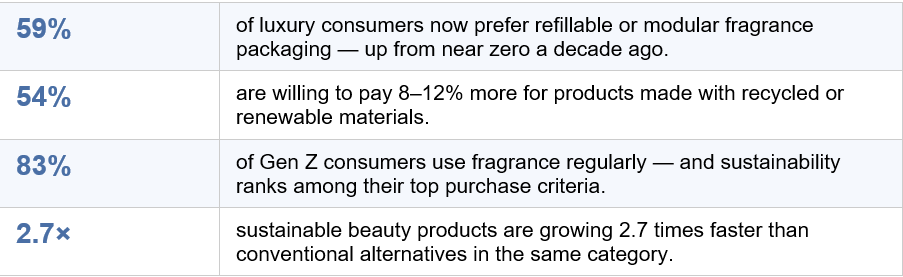
The direction of travel is consistent across every segment: from mass market to niche luxury, from Europe to Asia-Pacific. Refillable systems alone represent a market now valued at €1.5 billion globally, growing at 7% a year. This is not a niche trend. It is a structural shift in what people expect from the things they buy.
What 'good packaging' actually looks like in 2026
There are three things genuinely worth looking for when a brand makes sustainability claims about its packaging — and one thing that is mostly noise.
- 1. Refillability — but only if it's designed for it
Refillable packaging is the most visible sustainability move in fragrance right now, and when it's done properly, it works. Major houses across the luxury segment have redesigned their core lines around refill systems — bottles built from durable, scratch-resistant materials that hold their quality over years of use, paired with a refill format that costs less and uses significantly less packaging.
The distinction to watch for: a bottle that is technically refillable versus one that is designed to be refilled. The latter is built from materials tough enough to last, with a refill mechanism that's genuinely practical. If a brand offers refillability as an afterthought — a clunky pour-in format for a bottle that scratches after three months — it doesn't really count.
- 2. The material the bottle is actually made from
This is where things get genuinely interesting — and where the most meaningful innovation is happening right now.
The challenge for packaging designers has always been this: glass is beautiful and inert, but heavy, fragile, and carbon-intensive to produce and ship. Traditional plastics are light and durable, but carry enormous reputational and environmental baggage. For years, there was no clean answer.
The latest generation of high-performance packaging materials is changing that. Advanced polymers — developed originally for demanding applications like sports equipment and industrial coatings — are now being produced using bio-based feedstocks (think used cooking oil and agricultural by-products instead of fossil fuels) and via advanced chemical recycling that gives hard-to-recycle plastic waste a second functional life. The result is a material that looks and performs like premium glass, at roughly half the weight, made from inputs that don't deplete non-renewable resources.
Some of the most recognised names in fragrance are already using these materials. LVMH Beauty, for example, has partnered with materials science company Dow to incorporate bio-based and recycled-feedstock packaging across its perfume and cosmetics lines — a shift that is invisible to the consumer but significant in terms of the product's actual environmental footprint.
- 3. Third-party certification — the only claim worth trusting
This is the part most sustainability coverage skips over, and it's arguably the most important.
Any brand can print 'eco-friendly' or 'sustainable' on a box. The claims that carry real weight are the ones verified by independent certification bodies. In packaging materials, the standard to look for is ISCC PLUS — the International Sustainability and Carbon Certification — which verifies that bio-based or recycled content has been traced through the supply chain using a recognised mass balance methodology.
It is not glamorous. It doesn't look beautiful on a bottle. But it is the difference between a verified sustainability claim and a marketing assertion.
The one thing that is mostly noise
Minimalist packaging. Brands frequently position simpler, less decorated packaging as a sustainability statement — and while using fewer materials is genuinely better, a plain white box is not a sustainability strategy. Don't let aesthetic restraint substitute for material transparency.
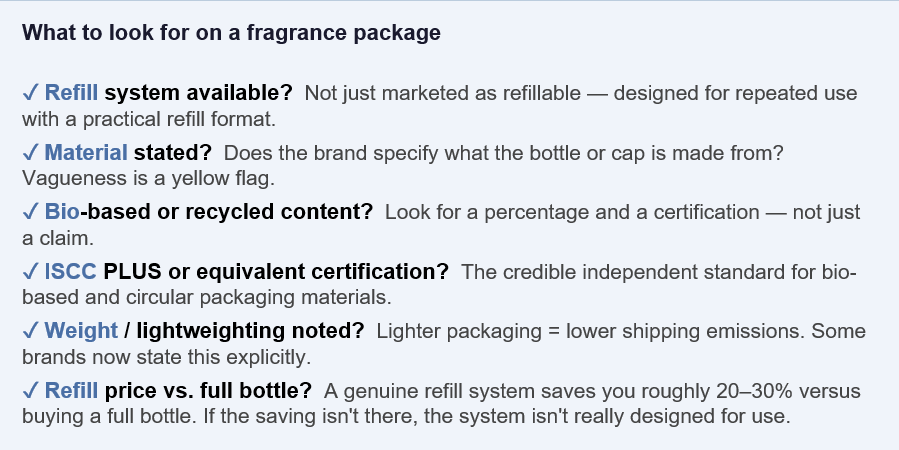
Your quick-reference guide at the shelf
The honest answer: it's getting better
Fragrance packaging is genuinely in transition. The industry's sustainability record five years ago was poor — heavy glass, non-recyclable components, no refill infrastructure, and essentially no transparency about materials. That is changing, driven by a combination of consumer pressure, tightening EU regulation, and real innovation in the materials available to packaging designers.
The brands leading this shift are not doing it by making their bottles look greener. They are doing it by rethinking what the bottle is made from, where those materials come from, and how long the object is designed to last. That's a harder story to tell on a label — but it's the one worth looking for.
The next time you pick up a fragrance, look past the bottle's shape and finish. Ask what it's made of, whether it's designed to last, and whether the brand can back up what it's claiming. The answers — or the absence of them — will tell you most of what you need to know.
Contact our experts and go beyond the trend
Get support from our technical teams