


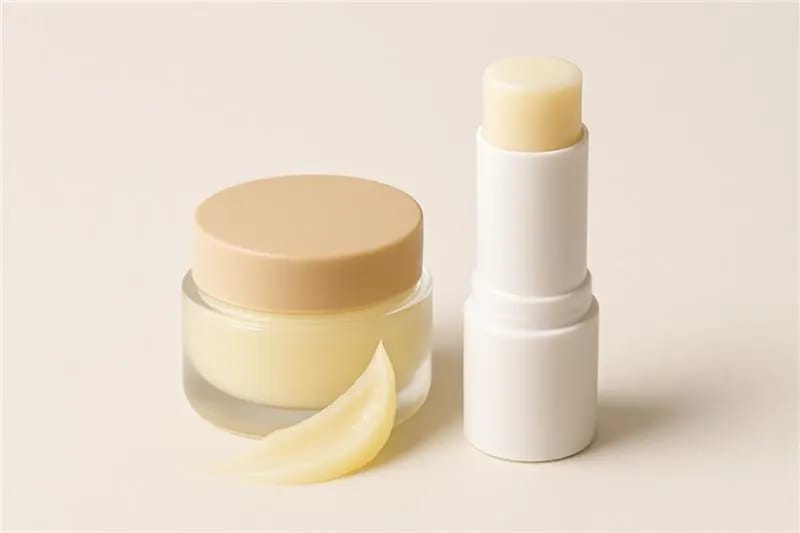
From deodorants and balms to sunscreens and colour cosmetics, stick formulations are widely used across personal care applications. Compact, portable and easy to apply, they are highly valued by consumers.
Yet for formulators, stick stability remains one of the most persistent challenges.
Cracking, blooming, oil exudation or softening at elevated temperatures often appear unexpectedly — sometimes after months of successful laboratory trials. Understanding why these failures occur requires looking beyond ingredients alone and examining the internal structure and processing of stick systems.
Understanding the Structure of Stick Formulations
Unlike emulsions, stick formulas are anhydrous systems composed mainly of waxes, oils, butters and, in some cases, polymers. Their apparent simplicity masks a delicate balance between crystalline and amorphous phases.
When this equilibrium is disturbed, several types of instability can appear:
- Oil exudation (syneresis): migration of liquid oils through the wax network
- Cracking or shrinkage: internal stress caused by excessive crystallisation during cooling
- Blooming or sweating: surface recrystallisation triggered by temperature cycling
- Graininess: formation of large, visible crystals
- Phase separation: incomplete compatibility between waxes and oils
Most failures result from mismatched melting points, incompatible polarity between ingredients, or insufficient structural reinforcement.
Designing the Right Wax–Oil Architecture
A stable stick starts with a coherent structural backbone. Waxes define hardness, melting behaviour and mechanical resistance, while also determining how oils are retained within the matrix.
Key formulation parameters include:
- Melting profile: combining high- and mid-melting waxes ensures gradual softening instead of brittle fracture
- Crystallisation kinetics: fast-crystallising waxes provide structure, while slower ones improve flexibility
- Oil compatibility: poor wax–oil affinity often leads to syneresis or blooming
At Safic-Alcan, formulators have access to a wide range of natural and synthetic waxes — including carnauba, candelilla, beeswax and microcrystalline waxes — allowing precise control of hardness, glide and thermal behaviour.
Natural emollients and butters, such as shea and illipe derivatives, further harmonise the wax matrix by adding suppleness and reducing brittleness, while supporting clean-label and sustainable sourcing requirements.
Selecting an Oil System with Compatible Polarity
One of the most common causes of stick instability is polarity mismatch between waxes and emollients. Each oil and wax has specific Hansen solubility parameters that describe dispersion forces, polarity and hydrogen bonding.
When these parameters differ too greatly, micro-domains form instead of a homogeneous matrix. Under heat stress or over time, these domains separate, leading to oil bleeding or surface sweating.
Using emollients with intermediate polarity helps bridge wax and oil phases, improving solubilisation and long-term stability. High-purity esters and structured emollients can act as molecular mediators, reinforcing cohesion within the system.
Reinforcing the Network with Polymers
While waxes form the skeleton of the stick, polymers define elasticity and mechanical memory. Oil-gelling polymers introduce a three-dimensional network that stabilises both polar and non-polar systems without relying solely on crystallisation.
This approach allows formulators to:
- Reduce total wax content
- Improve payoff and sensory feel
- Minimise graininess and thermal instability
Polymeric structuring agents are particularly valuable in high-oil systems such as anhydrous deodorants, lip balms and treatment sticks, where traditional wax-only systems often fail under heat stress.
Cooling Rate: The Often Overlooked Stability Factor
Even with an optimised ingredient system, processing conditions can determine success or failure. Cooling rate and filling temperature directly influence crystal morphology.
- Cooling too slowly: large crystals, surface bloom, rough texture
- Cooling too quickly: trapped internal stress leading to cracking
- Uneven mould temperature: shrinkage and deformation
Controlled cooling — typically around 1–2 °C per minute — combined with uniform mould temperature and gentle agitation before pouring helps create a stable and homogeneous structure.
Stability Is Not Luck — It’s Applied Science
Stable stick formulations are the result of deliberate structural design, ingredient compatibility and controlled processing. Every raw material contributes to the micro-architecture that determines how a stick behaves under mechanical and thermal stress.
By understanding structure–function relationships, formulators can anticipate failures and design sticks that remain stable throughout their shelf life.
At Safic-Alcan, our technical teams and laboratories support formulators in translating formulation theory into market-ready, robust stick solutions — including some of the most challenging systems, such as anhydrous deodorants.