


An anti foaming agent in pharmaceutical manufacture is either a component of your product or a process-related impurity in it. Most shortlists are drawn up before anyone decides which, and the documentation gap shows up at the worst possible moment.
An anti foaming agent for pharmaceutical manufacture is usually specified by a process engineer solving a foam problem, and it enters the plant as a consumable. Then a regulatory submission, a customer audit or an inspection asks a question the purchase order never anticipated: what is this material, what does it leave behind, and where is the evidence.
The question is legitimate and it has a settled basis. European guidance on quality documentation for biological investigational medicinal products explicitly names antifoam agents as an example of process-related impurities for which control is expected, and states that where only qualitative data are provided for certain impurities, this should be justified. Your antifoam is not an unlisted consumable in the eyes of an assessor. It is a named category of thing they expect you to control.
Excipient or processing aid: decide before you buy an anti-foaming agent for pharmaceutical use
The single question that determines everything downstream is what role the material plays.
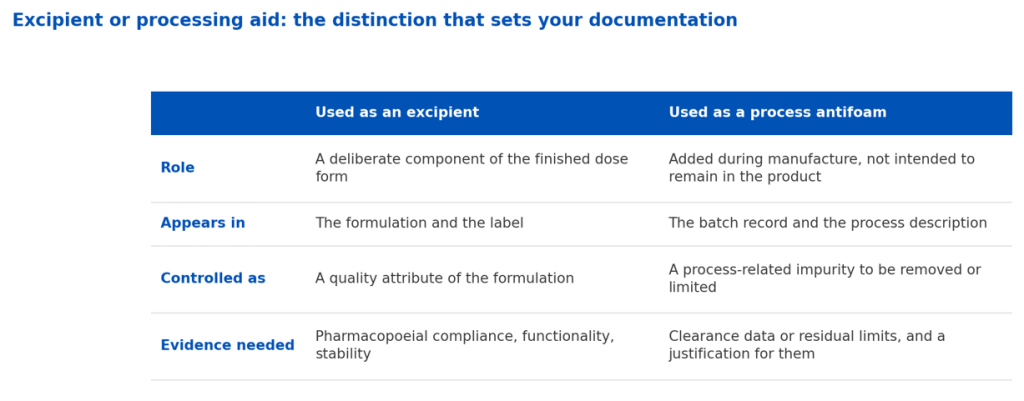
The distinction is not academic, and the same product can sit on either side of it. The wider difference between active pharmaceutical ingredients and excipients is worth reading alongside this, because an antifoam can fall into either category depending on use. The technical data sheet for BC Simethicone PD30S describes it as being used as an active ingredient in dose forms such as antacids, and also as a process antifoam or an excipient to control foaming in pharmaceutical products, noting that as a process antifoam it is suited to biopharmaceutical applications such as cell culture. One material, three regulatory roles, three different documentation files.
If you cannot state in one sentence which role your antifoam plays, that is the first thing to fix. Everything below depends on the answer.
Which pharmaceutical anti foaming agent grades carry a pharmacopoeial monograph?
Where a monograph exists, compliance with it is the most efficient piece of evidence you can hold, because it replaces a bespoke argument with a recognized standard.
Simethicone is the relevant case here. The United States Pharmacopeia carries a monograph for Simethicone, defined as a mixture of fully methylated linear siloxane polymers stabilized with trimethylsiloxy end-blocking units together with silicon dioxide, with content limits of not less than 90.5% and not more than 99.0% polydimethylsiloxane and 4.0% to 7.0% silicon dioxide. A separate monograph covers Simethicone Emulsion, which specifies a polydimethylsiloxane content of not less than 85.0% and not more than 110.0% of the labelled amount of simethicone.
Momentive's technical data sheet for BC Simethicone PD30S states that the product complies with the current monograph for Simethicone Emulsion USP. When you use that grade, pharmacopeial compliance is available to you as documented evidence rather than assertion.
Silicone and polyglycol-siloxane antifoam concentrates used purely as process aids generally have no equivalent monograph. That is not a deficiency, but it does shift the burden: with no compendial standard to point at, the control strategy must rest on supplier documentation, residual control and a justified rationale.
Where the GMP boundary actually sits
A common misunderstanding is that any anti foaming agent used in a pharmaceutical GMP process must itself be manufactured under GMP. That is not automatically true, and the answer depends again on role.
For active pharmaceutical ingredient manufacture, ICH Q7 sets the framework, covering materials management, supplier qualification, production controls and change control across the API supply chain. The ICH Q7 questions and answers document addresses many of the practical interpretation points that arise. It is the reference point an inspector will work from when asking how you qualified and controlled a material entering an API process. When used as process aid, antifoam must be sterilized before entering the process regardless of GMP status of the material.
Where an antifoam is itself an API, as simethicone is in antacid products, then GMP manufacture is directly relevant. The Basildon Chemical site at Abingdon, which manufactures the Esca and BC Simethicone ranges within the Momentive group, is described as certified to GMP standard for production of simethicone APIs, and to ISO 22000 for antifoams intended for food and beverage processing, alongside ISO 9001:2015 and ISO 14001:2015.
What matters for your file is specificity. A certificate covering a site, a scope and a date is evidence. A general statement that a supplier "works to GMP" is not. Ask which site made the batch you received, and under which certification.
The documentation pack to hold
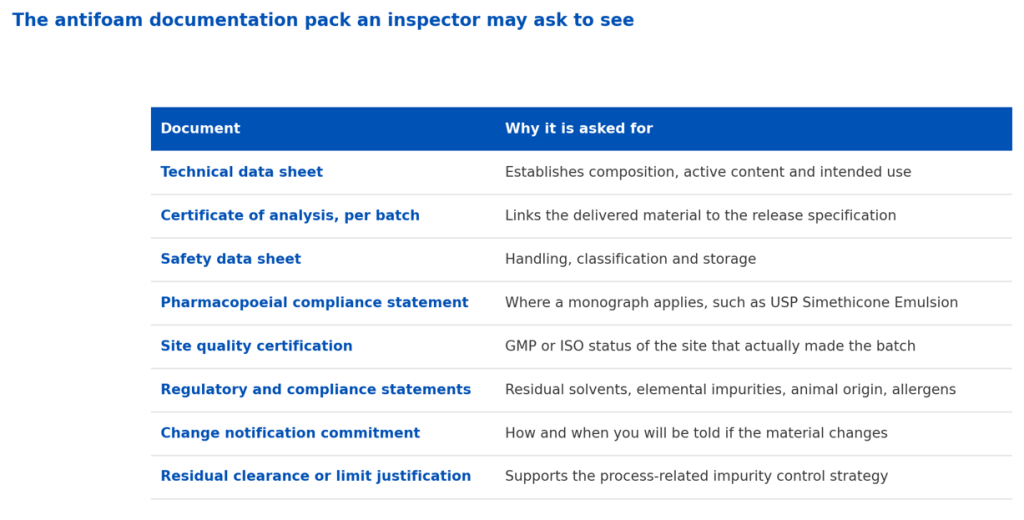
Two items on that list are the ones most often missing.
The change notification commitment. An antifoam reformulated by the supplier without your knowledge is a silent process change in a validated process. Whether you are told, how quickly, and with what notice period, should be agreed in writing at qualification rather than discovered afterwards.
The residual clearance or limit justification. If the material is a processing aid, the control strategy needs to explain what happens to it. Either the process clears it, and you can show that, or a residual limit applies and you can justify it. Silence on this point is exactly what the European guidance above anticipates when it asks for justification where only qualitative data are available.
What happens when you change grade
Substitution is where the cost of thin documentation becomes visible, because a change in a validated process reopens more than the purchasing decision.
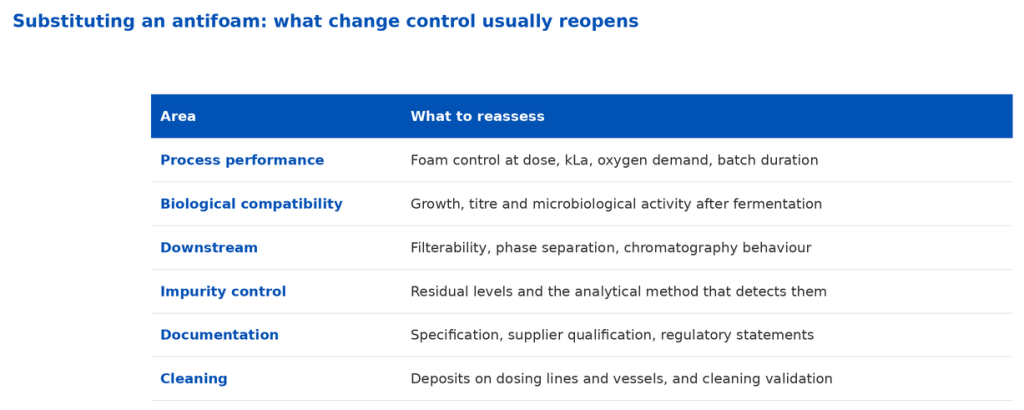
The biological line in that table is the one most often skipped. As covered in our companion article on antifoam agents in fermentation and in our overview of biopharma solutions from gene to final dosage form, the published literature shows antifoam effects on growth and productivity that vary by chemistry, dose, organism and medium. A grade change is therefore a biological change until you have demonstrated that it is not.
A practical sequence
- Define the role in writing. Excipient, processing aid, or active. One sentence, in the process description.
- Match the evidence to the role. Pharmacopoeial compliance where a monograph applies; a residual control strategy where it does not.
- Qualify the site, not the brand. Identify the manufacturing site and its certification scope for the grade you buy.
- Fix the dose and the mode of addition in the batch record, including top-ups during the run.
- Agree change notification before first supply, not at the first deviation.
- Keep it current. A technical data sheet from five years ago is not evidence about this year's batch.
Frequently asked questions
Is an antifoam an excipient or a processing aid?
It depends on how it is used. An antifoam deliberately included in the finished dose form is an excipient and is controlled as a quality attribute of the formulation. European guidance treats antifoam agents used in manufacture as process-related impurities requiring control. One added during manufacture and not intended to remain is a processing aid, and is controlled as a process-related impurity. The same product can be either, so the role must be stated explicitly.
Which antifoam grades comply with a pharmacopoeial monograph?
Simethicone-based grades can comply with the USP Simethicone or Simethicone Emulsion monographs. Momentive states that BC Simethicone PD30S complies with the current Simethicone Emulsion USP monograph. Silicone and polyglycol-siloxane process antifoams generally have no equivalent monograph and are supported by supplier documentation and a residual control strategy instead.
Does an antifoam used in API manufacture have to be made under GMP?
Not automatically. ICH Q7 governs GMP for active pharmaceutical ingredients, including materials management and supplier qualification, and your control of the antifoam has to satisfy that framework. Where the antifoam is itself an API, such as simethicone in an antacid, GMP manufacture of the material is directly relevant.
What documentation should we hold for an anti foaming agent used in pharmaceutical manufacture?
As a minimum: technical data sheet, batch certificate of analysis, safety data sheet, pharmacopoeial compliance statement where applicable, the manufacturing site's quality certification, regulatory statements covering residual solvents, elemental impurities, animal origin and allergens, a change notification commitment, and a justification for residual clearance or limits.
What is reassessed when we change antifoam grade?
Foam control performance at dose, oxygen transfer, biological compatibility with the production strain, downstream filterability and separation, residual impurity control and its analytical method, cleaning validation, and the full supplier documentation set.
Documentation support from Safic-Alcan
Safic-Alcan distributes the Momentive anti foaming agent range for pharmaceutical use across Europe and supplies the technical and regulatory documentation that customers need for qualification files and audits: technical data sheets, certificates of analysis, safety data sheets, pharmacopoeial compliance statements and site certification.
Request documentation for a specific grade
Sources
- European Medicines Agency. Guideline on the requirements for quality documentation concerning biological investigational medicinal products in clinical trials, EMA/CHMP/BWP/534898/2008 rev. 1.
- European Medicines Agency. ICH Q7, Good manufacturing practice for active pharmaceutical ingredients, scientific guideline.
- European Medicines Agency. ICH Q7 questions and answers, EMA/CHMP/ICH/468930/2015.
- United States Pharmacopeia. Simethicone monograph, USP-NF.
- United States Pharmacopeia. Simethicone Emulsion monograph, USP-NF.
- Momentive Performance Materials. BC Simethicone PD30S Antifoam, Technical Data Sheet.
- Basildon Chemical Co. Limited site and certification scope, as published in the Safic-Alcan product catalogue.