


Feeding a growing global population while limiting greenhouse gas emissions, ensuring animal welfare, and adapting to changing consumption patterns are among the major challenges facing modern agriculture.
To meet these challenges, the livestock sector must evolve and adopt innovative, sustainable nutritional solutions that support animal health and performance.
Future livestock production: what’s at stake?
The animal production sector is undergoing a profound transformation. One of the most critical issues today is antibiotic resistance, which poses a serious threat to both animal and human health.
As a result, reducing the use of antibiotics in livestock production has become a shared priority across the agricultural value chain. What is essential to remember is that antibiotic reduction — or even elimination — is possible while maintaining or improving zootechnical performance, thanks to functional feed additives such as probiotics.
What are probiotics?
Probiotics are living micro-organisms incorporated into animal feed as additives or supplements. When administered in adequate amounts, they provide beneficial effects to the host, mainly by:
- Improving intestinal health
- Supporting the balance of gut microbiota
- Enhancing zootechnical performance
Probiotics market in animal nutrition
The use of probiotics in animal nutrition has expanded significantly in recent years. Their role in improving animal health, welfare, and productivity makes them essential tools for meeting the growing demand for high-quality and sustainably produced food.
The global animal nutrition probiotics market is expected to reach USD 7.3 billion, with a compound annual growth rate (CAGR) of 8.8% between 2021 and 2026. Europe is one of the leading regions, representing approximately 35% of the global market share.
Risks of infections in livestock
Several factors can disrupt the intestinal ecosystem of animals and increase the risk of pathogenic infections. Monogastric animals are particularly sensitive to these disturbances.
- Piglets often experience diarrhea in the first weeks post-weaning due to feed transition and environmental changes.
- Poultry is commonly exposed to pathogens such as Escherichia coli, Salmonella, Campylobacter, Clostridium, and Eimeria.
Rather than relying on antibiotics, probiotics offer an effective alternative by regulating pathogenic activity and limiting its impact on animal health.
Probiotics: functional additives and alternatives to antibiotics
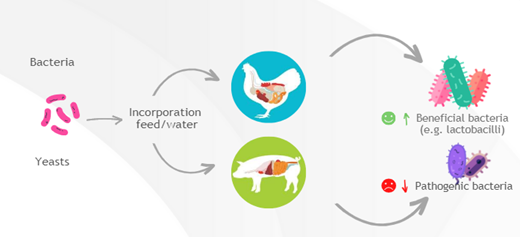
Probiotics act by enriching the diet and positively modifying the intestinal microbiota while strengthening the immune system.
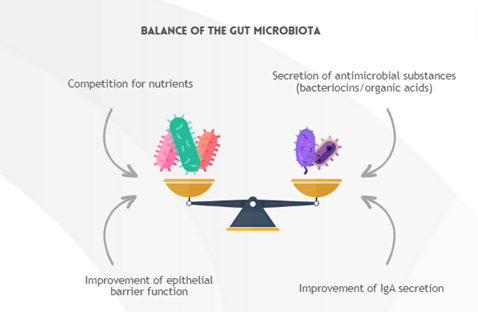
They promote the growth of beneficial microorganisms such as lactobacilli and bifidobacteria, which inhibit pathogenic bacteria through:
- Production of bacteriocins
- Secretion of organic acids
- Competitive exclusion mechanisms
This contributes to improved gut health and reduced disease pressure.
Selection criteria for probiotics in animal nutrition
Each probiotic strain has specific properties and modes of action. The main micro-organisms used include:
- Bacteria: Lactobacillus, Enterococcus, Pediococcus, Bacillus
- Microscopic fungi: yeasts such as Saccharomyces
Bacteria from the Bacillus genus are particularly valued for their ability to produce enzymes and antimicrobial substances. Their spores also withstand high temperatures and feed pelleting processes.
The selection of a probiotic strain is based on its efficacy, stability, and mode of action, highlighting the importance of biotechnology and applied research in identifying high-performance solutions.
Ecobiol® & Fecinor®: probiotics designed for performance and sustainability
EVONIK, a key player in the animal feed industry, offers probiotic solutions that combine animal health, sustainability, farmer profitability, and product quality.
Ecobiol® – Probiotics for poultry
Ecobiol® is designed to manage poultry intestinal microbiota and stabilize performance during intestinal challenges. It contains Bacillus amyloliquefaciens CECT 5940, a fast-growing natural strain capable of:
- Producing lactic acid
- Modulating bacterial interactions
- Tolerating gastric and biliary secretions
Its spore-forming ability ensures high stability during feed manufacturing. Ecobiol® has demonstrated consistent performance across diverse livestock environments worldwide.
Fecinor® – Probiotics for pigs
Fecinor® is a probiotic feed additive for pigs based on Enterococcus faecium CECT 4515. It supports intestinal health through lactic acid production and helps reduce bacterial pathogens without compromising productivity.
By improving gut health and performance, Fecinor® contributes to more sustainable, profitable, and high-quality pig production.
Conclusion
Probiotics play a crucial role in the transition toward antibiotic-free, sustainable animal production. While further communication and education are needed to accelerate adoption, probiotics already represent a key solution for the future of animal nutrition.
As a stakeholder in this industry, our responsibility is to provide innovative, high-value solutions, working closely with suppliers committed to sustainability and technical excellence — for the benefit of farmers, animals, and consumers alike.