


TL;DR: MbOCA (4,4'-methylene-bis(2-chloroaniline)) has been subject to EU REACH authorisation requirements since 2017. Any European processor still using it without a current, valid authorisation is operating outside the law — and authorisations are time-limited and increasingly difficult to obtain. Several REACH-compliant alternatives are now available, including MDI-based multi-component systems such as HYPERLAST™ 153 series by Dow. Transition support is available. The question is no longer whether to move — it is how.
For decades, MbOCA was the curative of choice for TDI-based cast polyurethane elastomers. First used in the 1950s, it became the dominant chain extender for TDI/PTMEG prepolymer systems across a wide range of industrial applications — mining equipment, rollers, wheels, seals, offshore components. The combination delivered reliable, high-performance elastomers that were easy to process and relatively tolerant of variation in casting conditions.
That era ended at the regulatory level in 2017, and MbOCA REACH compliance has been a live obligation for European processors ever since. Under the EU's REACH Regulation, MbOCA was placed on the Annex XIV Authorisation List as a substance of very high concern, with a sunset date of November 2017. Since then, its use in Europe without a granted authorisation has been prohibited. For processors who have not yet completed the transition, the regulatory, supply chain and commercial risk is real — and increasing.
This article explains the regulatory position clearly, what MbOCA actually is and why it was restricted, what reformulation involves in practice, and how the HYPERLAST™ & Diprane ranges from Dow provide a technically validated compliance route. For a broader overview of HYPERLAST™ and DIPRANE™ chemistry and applications, see our article on high performance elastomers. For the base chemistry context behind TDI/MbOCA and MDI systems, see our Polyether vs Polyester article.
What MbOCA is and why it was restricted
MbOCA — also written MOCA or MBOCA, formally 4,4'-methylene-bis(2-chloroaniline), CAS number 101-14-4 — is an aromatic diamine curative. When mixed with a TDI prepolymer, it reacts with the free isocyanate groups to crosslink the polymer chains, producing the hard segments that give cast polyurethane its mechanical strength. Estimates for MbOCA consumption in the European cast PU industry ranged from 4,500 to 8,000 metric tonnes annually at the time of the regulatory review.
The restriction derives from its toxicological profile. MbOCA is structurally similar to benzidine, a known human bladder carcinogen, and has been shown in animal studies to cause tumours of the liver, lung, urinary bladder and mammary glands. It is classified as a proven human carcinogen on the WHO/IARC Group 1 list, with a workplace threshold limit value of 0.01 ppm. ECHA identified MbOCA as a substance of very high concern (SVHC) and included it on the Candidate List for authorisation, before progressing it to Annex XIV.
For processors, the principal occupational exposure route is skin absorption during the casting and mould trimming operations — not inhalation. This made exposure control through engineering measures difficult to guarantee consistently across production environments, which contributed to the regulatory decision to require authorisation rather than simply set tighter workplace limits.
MbOCA REACH compliance: what the regulatory position means in practice
Under REACH Regulation (EC) No 1907/2006, Annex XIV lists substances that cannot be placed on the EU market or used after their sunset date unless a company has applied for and received a formal authorisation from the European Commission. MbOCA's sunset date was set at 22 November 2017.
- 2011: MbOCA added to ECHA Candidate List as a substance of very high concern (SVHC).
- 2013: MbOCA included in REACH Annex XIV Authorisation List.
- May 2016: Latest application date — processors using ≥ 1 tonne/year had to have submitted an authorisation application to continue use after the sunset date.
- Nov 2017: Sunset date. Use of MbOCA in the EU without a granted authorisation becomes illegal.
- 2017–present: A limited number of processors obtained time-limited authorisations for specific uses. These are subject to review and may not be renewed indefinitely. Processors without authorisation who are still using MbOCA are operating outside REACH.
Authorisation is not the same as compliance. Even processors who obtained a REACH authorisation in 2017 operate under a time-limited, use-specific permission that must be reviewed before it expires. An authorisation granted for one application does not cover a new or modified use. The correct long-term compliance position is reformulation to an MbOCA-free system.
ECHA's own substitution plan analysis found that, prior to the sunset date, many processors had already tested alternative systems including MDI/BDO, MDI/MCDEA and TDI. The transition is technically achievable — but it is not trivial, and it requires support from a prepolymer supplier with validated systems and formulation expertise.
Why MbOCA is hard to replace — and why processor inertia is understandable
Understanding why so many processors remained on MbOCA well past the regulatory pressure requires acknowledging the real technical challenges involved in replacing it.
Industry experts have confirmed that no perfect drop-in replacement for MbOCA exists in TDI-based systems. Its combination of properties was genuinely difficult to match: long pot life, wide processing latitude, tolerance of ratio variation, and the ability to produce consistently high-quality parts across a wide hardness range. Alternative curative systems with TDI prepolymers were tested extensively by many processors, but many did not meet hardness requirements, had unacceptably short pot life, or failed dynamic test evaluations.
The leading diamine alternatives for TDI systems are DMTDA (dimethylthiotoluenediamine) and MCDEA (4,4'-methylenebis(3-chloro-2,6-diethylaniline)). DMTDA offers processing characteristics that are reasonably close to MbOCA and has been successfully adopted by a number of processors, particularly in applications where pot life management and formulation flexibility are priorities. As with any curative transition, specific formulation parameters require validation for each application and process setup. MCDEA offers good dynamic properties and abrasion resistance but exhibits higher reactivity than MbOCA — producing shorter pot lives with TDI prepolymers — and requires careful temperature management around its 87–90°C melting point.
Both routes are technically viable and in active industrial use. The right choice depends on the processor's existing equipment, target applications, and supply chain context.
The second route is a move away from TDI altogether. The shift from TDI/MbOCA to MDI requires investment in adapted equipment and process adjustment, since MDI formulations are more sensitive to moisture and require greater precision in ratio control. But MDI-based systems paired with diol curatives such as BDO (1,4-butanediol) or HQEE produce REACH-compliant elastomers with properties that match or exceed TDI/MbOCA performance across a wide range of applications.
The HYPERLAST™ 153 series: the validated compliance route
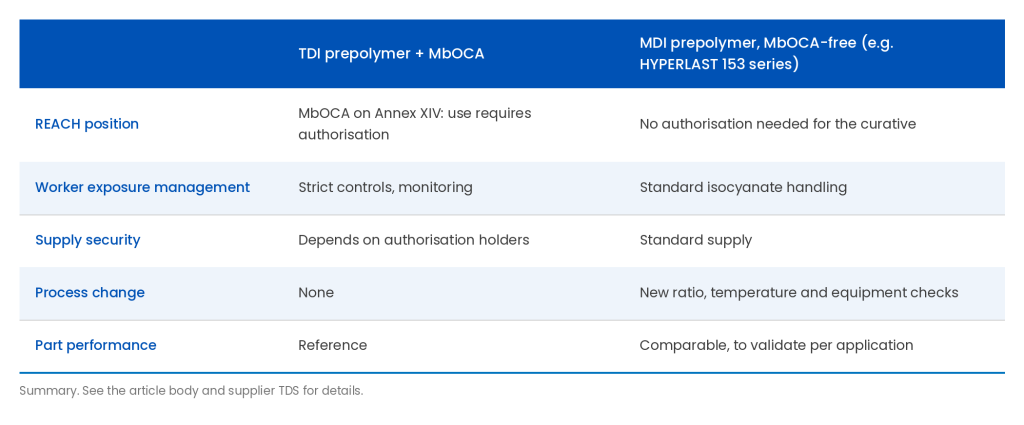
Dow developed the HYPERLAST™ 153 series specifically to address the MbOCA transition for European cast PU processors. The system does not contain a mercury catalyst, does not require MbOCA as a curative, and is REACH-compliant.
Key technical characteristics of the HYPERLAST™ 153 series:
- Hardness range: 55 Shore A to 75 Shore D with a four-component system — covering the full application range previously served by TDI/MbOCA formulations.
- Processing temperatures: System components are processed at lower temperatures than full prepolymer countertypes, enabling energy savings in production.
- Processing control: Designed to give processors control over pot life and demould time, with flexibility for both small and large part production.
- Proven applications: Validated in demanding applications including dynamic offshore bend stiffeners, pipeline scrapers, mining screens, timing belts, rollers and tooling components.
- No mercury catalyst: The system removes organo-mercury compounds — historically used to catalyse MDI/polyol reactions — addressing an additional regulatory risk under REACH.
The broader HYPERLAST™ and DIPRANE™ ranges from Dow include additional MDI-based systems validated for MbOCA-free operation. MDI-based technologies within the HYPERLAST and DIPRANE ranges have demonstrated wear resistance equal to or better than TDI/MbOCA in demanding applications such as pipeline scrapers and mining screens.
What the reformulation process involves
Transitioning from TDI/MbOCA to an MDI-based system is a formulation project, not a simple curative swap. The degree of process change required depends on the current casting setup and the parts being produced, but three areas consistently require attention:
Equipment and process temperature management.
MDI-based systems require more precise temperature control than TDI/MbOCA. Raw material temperatures, mold temperatures and mix ratios all need validation. For processors running manual casting, this typically means tighter operating procedures; for machine-casting operations, it may require calibration or equipment adjustment.
Ratio precision.
MDI/diol systems require tighter stoichiometric control than TDI/MbOCA. Where TDI/MbOCA tolerates a ±3% variation in curative ratio without significant effect on part quality, MDI systems are more sensitive. Processors transitioning from manual to machine-assisted dispensing often see this as an opportunity to improve consistency alongside compliance.
Part validation and customer sign-off. Many industrial components are specified with reference to a particular curative system — sometimes explicitly on part drawings. A reformulation requires re-qualification testing and, in some cases, customer acceptance of the new chemistry. This is a supply chain management exercise as much as a technical one, and Safic-Alcan's polyurethane technical team can support both the testing and the documentation required. For the TCO case that makes the reformulation investment worthwhile, see the our article on TCO & Material ROI. For REACH documentation and sourcing requirements in Europe, see the article on EU Sourcing & Distribution.
The supply chain risk of remaining on MbOCA
Beyond the legal position, processors who have obtained authorisations and are still running TDI/MbOCA face a structural supply chain risk that goes beyond regulatory compliance. As the number of authorised users in Europe decreases, supply availability for MbOCA narrows. Suppliers reducing production volumes introduce minimum order requirements or price volatility. A processor dependent on MbOCA availability is exposed to a supply disruption risk that is not present for processors running fully available, non-restricted MDI-based alternatives.
The transition, while requiring upfront investment in validation, eliminates this ongoing exposure entirely — while also removing the administrative burden of authorisation renewals, annual employee exposure monitoring, and the associated documentation requirements under REACH.
Still running TDI/MbOCA?
Our polyurethane technical team can assess your current formulation, identify the closest HYPERLAST or DIPRANE equivalent, and support the trial and re-qualification work. REACH documentation included.
Frequently asked questions
What is MbOCA and why is it being phased out in Europe?
MbOCA (4,4'-methylene-bis(2-chloroaniline), also known as MOCA or MBOCA) is an aromatic diamine curative widely used for decades in TDI-based cast polyurethane elastomers. It was placed on the EU REACH Annex XIV Authorisation List because it is classified as a proven human carcinogen — structurally related to benzidine and shown in multiple animal studies to cause tumours of the liver, lung, bladder and mammary glands. Its sunset date under REACH was 22 November 2017, after which its use in Europe without a specific granted authorisation is prohibited.
Is MbOCA banned in Europe?
MbOCA is not an outright ban in the sense of a complete prohibition — it is subject to the EU REACH authorisation regime under Annex XIV. This means it cannot be used after its 2017 sunset date unless a company has applied for and received a specific authorisation from the European Commission for each use. Authorisations are time-limited, use-specific, and subject to review. In practice, obtaining and maintaining authorisation is increasingly difficult, and the recommended long-term position is reformulation to a REACH-compliant alternative.
What are the REACH-compliant alternatives to MbOCA in cast polyurethane?
Two main compliance routes exist: switching to MDI-based prepolymer systems cured with diol chain extenders such as BDO or HQEE, or using alternative aromatic diamine curatives within TDI-based systems, primarily DMTDA or MCDEA — both of which are in active industrial use as REACH-compliant chain extenders. The HYPERLAST™ 153 series by Dow provides a validated, REACH-compliant MDI-based multi-component system covering a hardness range from 55 Shore A to 75 Shore D, available through Safic-Alcan across Europe.
What is the HYPERLAST™ 153 series and how does it replace MbOCA?
HYPERLAST™ 153 is a polyether-based, MDI multi-component polyurethane elastomer system developed by Dow specifically to enable European processors to reformulate away from MbOCA. It contains no mercury catalyst and requires no MbOCA curative. The four-component system produces tough, durable elastomers from 55 Shore A to 75 Shore D, is processed at lower temperatures than full prepolymer equivalents (allowing energy savings), and gives processors control over pot life and demould time. It has been validated in demanding applications including offshore bend stiffeners, pipeline scrapers, mining screens and industrial rollers. It is available through Safic-Alcan across Europe.
What is the REACH Annex XIV Authorisation List?
REACH Annex XIV — the Authorisation List — is the list of substances of very high concern (SVHCs) that cannot be placed on the EU market or used after their specified sunset date, unless a company has applied for and received a formal authorisation from the European Commission for each specific use. Authorisations are granted for a review period (typically four to seven years) and are not automatically renewed. MbOCA is included on Annex XIV with a sunset date of November 2017.
Does switching from TDI/MbOCA to an MDI system affect part performance?
In most applications, MDI-based systems validated for MbOCA substitution deliver equivalent or better performance than TDI/MbOCA formulations. Dow's data on HYPERLAST™ and DIPRANE™ MDI-based systems shows wear resistance equal to or better than TDI/MbOCA in demanding applications such as pipeline scrapers and mining screens. The transition does require process adaptation — MDI systems need tighter ratio control and temperature management — but with proper formulation support and trial validation, parts consistently meeting original specifications are achievable.
Where can I get technical support for MbOCA reformulation in Europe?
Safic-Alcan, as the authorised European distributor of Dow Polyurethanes, provides formulation guidance, sample supply and full REACH documentation support for the HYPERLAST™ 153 and broader Dow PU range across France, UK, Benelux, DACH, the Nordics, Spain, Portugal and most CEE countries. Contact the local Safic-Alcan technical team for a reformulation assessment.
What is an SVHC under REACH?
A substance of very high concern (SVHC) is a chemical identified by ECHA as posing serious risks to human health or the environment — typically because it is carcinogenic, mutagenic or toxic to reproduction (CMR), persistent and bioaccumulative, or of equivalent concern. SVHCs are first added to the REACH Candidate List, which triggers notification and communication obligations in supply chains. The most critical SVHCs may be progressively included in the Annex XIV Authorisation List, limiting their use after a sunset date unless authorisation is granted.
REFERENCES
MbOCA substance information — ECHA
REACH Annex XIV Authorisation List — ECHA
Polyurethane makers prepare for MbOCA phase-out — C&EN / ACS · EU MbOCA sunset: industry report — Urethanes Technology International ·
Dow launches HYPERLAST™ 153 — Interplas Insights ·
Dow HYPERLAST™ 153 range — Urethanes Technology International ·