



Quick answer
A factory-applied, no-intentionally-added-PFAS anti-graffiti coating is qualified by cleanability performance under the German TL/TP AGS Beton and Gütegemeinschaft Anti-Graffiti e.V. framework, not by a water-repellency or freeze-thaw standard. Applying it during production rather than after installation gives manufacturers documented, batch-controlled coverage instead of a variable site application, and any service-life figure attached to the coating should be sourced to a written technical data sheet before it appears in a customer-facing document. For a more detailed view on PFAS, you can read our guide to the EU PFAS restriction for anti-graffiti coatings.
Qualifying a factory-applied coating?
The PFAS transition fguide covers the restriction calendar, the type of formulations concerned, the technical path and a tender clause specification example.
Graffiti-resistant wall finishes for public infrastructure: which system to choose
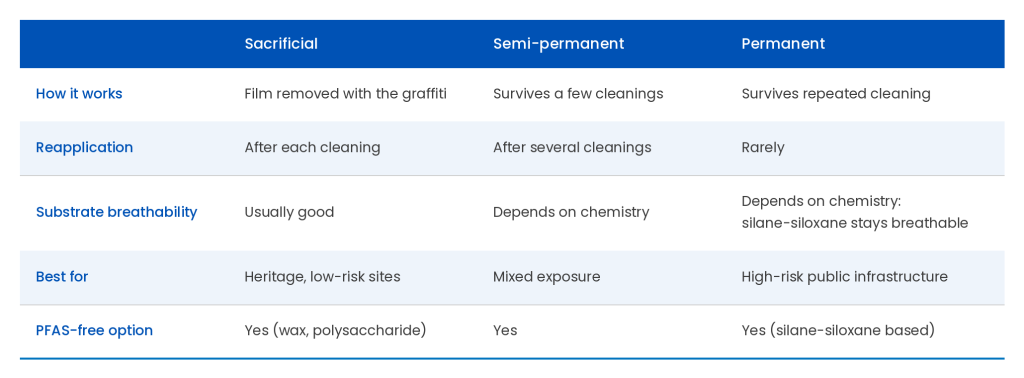
Public infrastructure (underpasses, bridges, noise barriers, stations) needs protection that survives repeated cleaning without damaging the substrate. The choice is between three families of anti-graffiti systems: sacrificial, semi-permanent and permanent.
Silane-siloxane based systems penetrate mineral substrates, keep them breathable and reduce the adhesion of paint, which makes cleaning easier. They are a PFAS-free route that fits the EU restriction direction.
What "factory-applied" means for an anti-graffiti coating, and why it matters
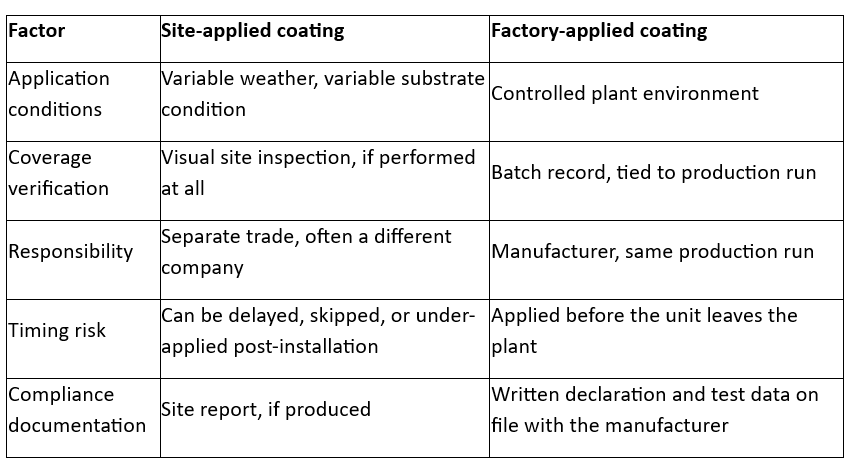
A factory-applied anti-graffiti coating is applied to the concrete tile, precast element, or facade panel during production, before the unit leaves the plant, rather than sprayed on afterwards by a separate applicator once the piece is installed. That distinction matters for three practical reasons: the substrate's condition at the moment of coating is known and consistent, coverage can be verified against a batch record rather than a site inspection, and the coating step becomes part of the manufacturer's own production control rather than a separate scope that a downstream contractor can skip, under-apply, or delay. It also changes who can answer a customer's compliance question. A factory-applied coating means the manufacturer, not an installer three steps removed, can state exactly what was applied and confirm the declaration that goes with it.
Why this matters for concrete, precast and facade panel manufacturers specifically
Anti-graffiti protection on precast and facade elements has traditionally relied on fluoropolymer and fluorosilane chemistry, precisely the category the EU's PFAS restriction targets. Manufacturers who supply into public-sector projects, schools, transit infrastructure, are already seeing procurement questionnaires ask for a PFAS declaration that didn't exist two years ago, and the qualification work (which coating, which test standard, which declaration wording) takes longer to complete than most manufacturers expect. Doing it once at the plant level, rather than leaving it to be handled per project by whichever contractor applies the finish on site, is the more defensible position going into a tender process.
Which standard actually applies to a factory-applied anti-graffiti coating
A water-repellency or freeze-thaw standard does not measure what an anti-graffiti coating is designed to do, and citing one on a technical data sheet for this product category is a substrate and application mismatch worth avoiding before it reaches a customer's compliance file. The framework that actually applies is the German TL/TP AGS Beton standard (BASt) together with the Gütegemeinschaft Anti-Graffiti e.V. (Quality Association Anti-Graffiti) requirements, not ISO 11998, which measures wet-scrub resistance for wall coatings rather than the cleanability of an impregnation system. Substrates are coated with three defined paint systems, cleaned with an approved graffiti cleaner, and the cleaning is repeated ten times on the same spot, with a Ci value recording the degree of paint removal. A durability data sheet built on this framework, rather than one borrowed from a different application, is the one that holds up under a customer's technical review.
What to verify before quoting a service-life figure
This is the step worth being disciplined about before anything goes into a data sheet or a customer-facing article. Evonik's Protectosil® range includes both deep-penetrating fluorosilane sealers, which can extend a substrate's service life well beyond a decade, and non-penetrating, fluorine-free surface coatings like ECO-TRETE ANTIGRAFFITI, which is a different product built for a different purpose and does not carry the same service-life figures. The two should never be quoted interchangeably. A service life belongs on paper as a tested, written figure tied to the specific product and test method, not as a number carried over from a related product in the same supplier's range.
Why factory application is a genuine quality-control advantage
Precast manufacturing already runs under controlled plant conditions for temperature, curing, and mix consistency, the core quality argument the precast industry makes for itself over site-cast concrete. Extending that same controlled environment to the anti-graffiti coating step means the manufacturer, not a downstream contractor, controls the variables that determine whether the coating performs as tested: substrate condition, ambient conditions during application, and coverage rate. A site-applied coating depends on a separate trade reading the same instructions correctly, months after the panel left the factory floor, with no batch record tying the application back to a specific test report.
Which chemistry is available for factory application
Evonik's Protectosil® ECO-TRETE ANTIGRAFFITI, distributed through Safic-Alcan's coatings portfolio, is a surface-applied, non-penetrating, fluorine-free anti-graffiti coating that does not contain intentionally added PFAS, per its technical data sheet, suited to factory application on concrete tiles, precast elements and facade panels. It should be specified and tested against the TL/TP AGS Beton and Gütegemeinschaft Anti-Graffiti requirements for cleanability, not against a water-repellency or freeze-thaw standard written for a different category of treatment.
Factory-applied vs site-applied anti-graffiti coating
FAQ
Which standard tests an anti-graffiti coating's performance for concrete or precast elements?
The German TL/TP AGS Beton standard (BASt) together with the Gütegemeinschaft Anti-Graffiti e.V. requirements, not ISO 11998, which measures wet-scrub resistance for wall coatings rather than the cleanability of an impregnation system. Water-repellency or freeze-thaw standards test a different property and don't apply to this coating category either.
Can a manufacturer use the same service-life figure across an entire Protectosil range?
No. Penetrating fluorosilane sealers and non-penetrating, fluorine-free surface coatings like ECO-TRETE ANTIGRAFFITI work through different mechanisms and carry different tested service-life figures. Each product's figure should be sourced to its own written test data.
What is the advantage of a factory-applied coating over a site-applied one?
Controlled application conditions and batch-level documentation tied to the manufacturer's own production control, rather than a separate site-based application step carried out by a different contractor after installation.
What is the best anti-graffiti coating for concrete?
For high-risk sites, a permanent system that keeps concrete breathable. Silane-siloxane based systems combine easy cleaning with a PFAS-free formulation.
Does a factory-applied coating change what a manufacturer can tell customers about PFAS compliance?
Yes. A manufacturer who applies the coating in-house can state exactly what was used and provide the declaration directly, rather than relying on a downstream installer to know or communicate that information correctly.