


TL;DR
- Carbomer (Carbopol) is the most widely used rheology modifier in cosmetics — but regulatory pressure and clean-label demand are pushing formulators to explore alternatives.
- No single drop-in replacement exists. The right alternative depends on your target texture, pH range, electrolyte tolerance, and sustainability claims.
- Four main families are gaining ground: natural gums (xanthan, sclerotium), cellulose derivatives (HPMC, HEC), polyacrylate crosspolymers, and clay-based minerals.
- EU Regulation (EU) 2023/2055 on microplastics introduces phase-out timelines for certain synthetic polymers in cosmetics — rinse-off products by 2027, leave-on by 2029.
What Is Carbomer — and Why Are Formulators Reconsidering It?
Carbomer is a synthetic polymer of crosslinked polyacrylic acid. When dispersed in water and neutralized (typically with NaOH or triethanolamine), it forms a three-dimensional network that delivers high viscosity, excellent clarity, and shear-thinning behaviour at very low use levels — typically 0.1–0.5%.
It is used in face gels, serums, moisturizers, hand sanitizers, hair gels, and sunscreens. The INCI name "Carbomer" covers a family of grades (Carbopol 940, 980, Ultrez 10, Ultrez 21, etc.), each with distinct rheological profiles.
Three converging pressures are driving reformulation:
1. Microplastics regulation. Commission Regulation (EU) 2023/2055, which entered into force on 17 October 2023, introduces a phased restriction on synthetic polymer microparticles intentionally added to products. For cosmetics, the key deadlines are: rinse-off products by 17 October 2027, leave-on products (creams, gels, serums) by 17 October 2029. Whether carbomer falls within scope depends on particle size and solubility — formulators should verify with their regulatory team. The ECHA microplastics hub provides the latest guidance.
2. Clean-label and consumer perception. Consumers and health practitioners increasingly scrutinize ingredient lists. Polyacrylic acid polymers face reputational risk in natural and Ecocert-certified product lines, even when compliant.
3. Electrolyte sensitivity. Carbomers are highly sensitive to electrolytes — salts, cationic actives, and high-mineral water can collapse the polymer network and dramatically reduce viscosity. This is a real formulation constraint in high-active or multi-functional products.
The Four Main Families of Carbomer Alternatives
1. Natural Gums
The most widely discussed alternatives. They are biodegradable, consumer-friendly, and compatible with natural and organic certifications (Ecocert, COSMOS).
- Xanthan gum is the most commonly used natural-based thickener. It offers excellent salt tolerance, good suspending properties, and stability across a wide pH and temperature range. However, it requires a significantly higher use level than carbomer to reach equivalent viscosity — typically 1–2% vs. 0.1–0.5% for carbomer — and produces a longer, more stringy flow that some consumers find less elegant.
- Sclerotium gum (produced by fermentation of Sclerotium rolfsii) delivers a smooth, short-flow texture closer to carbomer, with good transparency and Ecocert compatibility. It is increasingly used in premium natural formulations.
- Gellan gum (with sodium salts) produces a strongly shear-thinning gel with short flow — one of the closest rheological profiles to carbomer among natural alternatives.
- Tara gum and guar gum are better suited to opaque, high-viscosity systems (creams, masks) where transparency is not required.
Formulator's note: Natural gums can show batch-to-batch variability in colour and viscosity. Shelf stability of emulsions formulated with natural-only systems can be a challenge — major brands typically require 3+ years of stability.
2. Cellulose Derivatives
Semi-synthetic, derived from plant cellulose. They offer a middle ground between natural origin and technical performance.
Hydroxyethyl cellulose (HEC) is a non-ionic thickener, compatible with electrolytes and cationic actives — a key advantage over carbomer. It is a standard choice for shampoos, conditioners, and cleansing gels. Hydroxypropyl methylcellulose (HPMC) forms films well and works in both cosmetic and pharmaceutical topical products. Unlike many gelling agents, it is pH-independent and gels on heating rather than cooling. Carboxymethyl cellulose (CMC / cellulose gum) is anionic, compatible with transparent systems, and a reliable suspending agent all the while being also Ecocert-approved.
Other cellulose derivatives have lower electrolyte resistance than HEC, though still higher than carbomer.
3. Polyacrylate Crosspolymers (Next-Generation Acrylics)
For formulators who need carbomer-like performance without the limitations, next-generation acrylate copolymers offer a compelling option.
- Acrylates/C10-30 Alkyl Acrylate Crosspolymer (e.g., Pemulen, Ultrez 21) is an associative thickener that provides thickening in high-electrolyte media, acts synergistically with surfactants, and facilitates dispersion of fillers — addressing carbomer's main weakness.
- Polyacrylate Crosspolymer-6 (e.g., SEPIMAX Zen by Seppic) is a pre-neutralized, cold-process thickener with outstanding electrolyte resistance. A 2% dispersion with 2% salt reaches ~45,000 cps. It requires no pH adjustment and you can add it at the end of the process.
- Sodium carbomer (pre-neutralized) delivers a lighter, smoother texture than conventional carbomer, with greater process flexibility — no neutralization step required.
These next-generation polyacrylates are not natural, but they address the electrolyte sensitivity and process complexity issues of carbomer. Their regulatory status under (EU) 2023/2055 should be verified on a case-by-case basis.
4. Clay and Mineral-Based Thickeners
On the one hand, magnesium aluminum silicate (e.g., Veegum) is a natural mineral thickener with strong synergy with anionic polymers (xanthan gum, CMC) and provides high yield value and good suspension properties, particularly in rinse-off and colour cosmetic systems.
On the other hand, Laponite (synthetic hectorite clay) delivers excellent transparency and thixotropy in water-based gels. It is compatible with electrolytes and provides a unique "gel-in-gel" texture.
The Regulatory Context: EU Microplastics Restriction
A Commission Regulation (EU) 2023/2055 restricts synthetic polymer microparticles (SPM) intentionally added to products. However, it is not a blanket ban on all synthetic polymers as applicability depends on particle size, solubility, and biodegradability criteria defined in Annex XVII, Entry 78 of REACH.
How to Choose the Right Alternative
Unfortunately, there is no universal drop-in for carbomer. The selection depends on five parameters:
- Target texture. Gellan gum and polyacrylate crosspolymers give short, firm gels. For something longer and more fluid, xanthan gum or HEC is the better fit.
- Electrolyte content. High-salt and high-active formulas call for HEC, xanthan gum, or next-generation acrylate
crosspolymers. Conventional carbomer will not hold up. - pH range. Carbomer needs to be activated at pH 5-10, so it is off the table for acidic formulas. HEC and xanthan
gum have no such constraint, which is why they tend to dominate in the pH 3-5 range. - Sustainability claims. COSMOS/Ecocert certification narrows the options to xanthan gum, sclerotium gum, cellulose
gum, and magnesium aluminum silicate. For clean-label positioning without formal certification, cellulose derivatives
or bio-attributed acrylics are reasonable alternatives. - Process constraints. Cold process? SEPIMAX Zen (Polyacrylate Crosspolymer-6), pre-neutralized sodium carbomer, and
xanthan gum all work without heat. HPMC is the exception: it requires heat to hydrate properly.
For a broader overview of rheology modifier selection across industries, see our article on rheology modifiers in cosmetics and coatings.
Natural Hydrocolloids: A Growing Formulation Tool
Natural gums belong to the broader family of hydrocolloids which are hydrophilic biopolymers capable of absorbing water and forming viscous solutions, pseudogels, or true gels.
Beyond thickening, they help stabilize emulsions, suspend particles, and create textures that meet modern expectations for naturality and sensory performance.
The demand for natural hydrocolloids continues to grow as brands seek clean-label, sensory-rich, and environmentally responsible alternatives. For a deeper dive into how to formulate with them, see our article on natural hydrocolloids and innovative textures in cosmetics.
What Is NOT Changing
- Carbomer remains approved under the EU Cosmetics Regulation (EC) No 1223/2009. There is no current ban on its use in cosmetics.
- The microplastics restriction is phased. Transitional periods give formulators time to reformulate.
- Performance remains the primary criterion. As noted at In-Cosmetics Global 2025, biobased alternatives have struggled with long-term stability — major brands require 3+ years of shelf life, which remains a challenge for purely natural systems.
- Blending strategies are valid. Many formulators combine two or more thickeners (e.g., xanthan + HEC, or sclerotium + magnesium aluminum silicate) to achieve the target rheological profile while meeting sustainability claims.
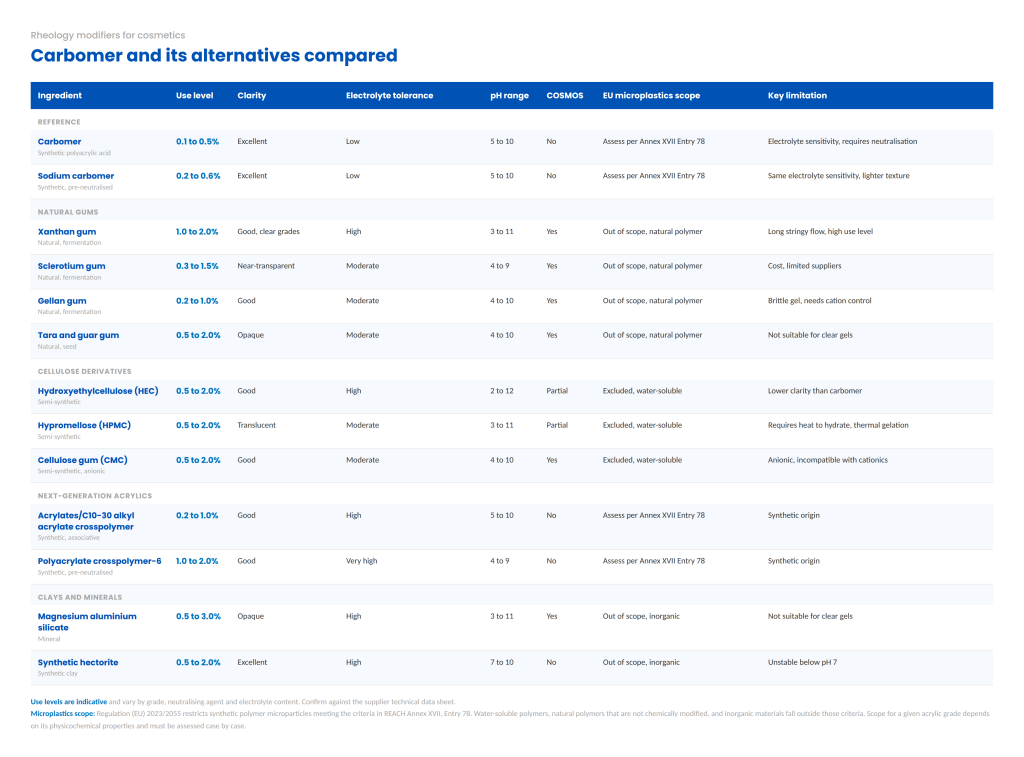
Use levels are indicative and vary by grade. Microplastics scope must be assessed per REACH Annex XVII, Entry 78.FAQ
What is carbomer used for in cosmetics?
Carbomer is a synthetic polymer of crosslinked polyacrylic acid used as a rheology modifier — it thickens, gels, stabilizes emulsions, and suspends particles. It is found in face gels, serums, moisturizers, hand sanitizers, and hair gels, typically at 0.1–0.5%.
Is carbomer banned in the EU?
No. Carbomer is not banned under the EU Cosmetics Regulation (EC) No 1223/2009. However, Commission Regulation (EU) 2023/2055 on microplastics introduces phased restrictions on certain synthetic polymer microparticles. Whether specific carbomer grades fall within scope depends on their physicochemical properties — formulators should assess this on a case-by-case basis with regulatory support.
What is the best natural alternative to carbomer?
There is no single best alternative. Xanthan gum is the most widely used natural thickener — it offers excellent electrolyte tolerance and Ecocert compatibility, but requires higher use levels and produces a longer flow than carbomer. Sclerotium gum delivers a smoother, shorter texture closer to carbomer. The right choice depends on your target texture, pH, and formulation constraints.
Can I replace carbomer 1:1 with xanthan gum?
No. Natural thickeners cannot be used as direct weight-for-weight replacements. To achieve the same viscosity as 0.2% carbomer, approximately 2% xanthan gum is typically required. Texture and skin feel will also differ — natural gums produce a longer, more stringy flow compared to carbomer's short, firm gel.
Are polyacrylate crosspolymers subject to the EU microplastics restriction?
It depends on the specific polymer, its particle size, solubility, and biodegradability. The restriction targets synthetic polymer microparticles meeting specific criteria defined in Annex XVII, Entry 78 of REACH. Water-soluble polymers are excluded. Formulators should verify each ingredient against the ECHA guidance before drawing conclusions.
How does electrolyte sensitivity affect carbomer performance?
Carbomers build viscosity through electrostatic repulsion between carboxylate groups. In the presence of electrolytes (salts, cationic actives), this repulsion is reduced — the polymer chains contract, viscosity drops, and the gel can collapse. This is why high-salt or high-active formulas typically require electrolyte-tolerant alternatives such as HEC, xanthan gum, or next-generation acrylate crosspolymers.