



Quick answer: Sourcing specialty chemicals in Europe involves three decisions: identifying the right product group and grade for your application, choosing between direct manufacturer access and working through a distributor, and ensuring full compliance with REACH and CLP before first delivery. For most B2B formulators, a specialty distributor with technical expertise, multi-market logistics, and documented supply chain compliance offers the fastest path to a qualified, regulatory-ready source of supply.
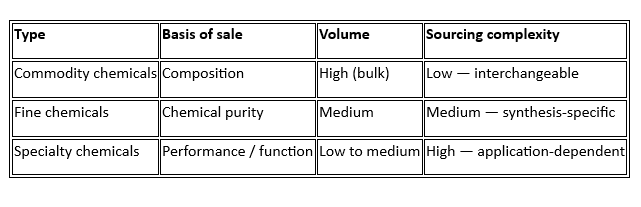
Specialty chemicals are, by definition, sold on the basis of their performance rather than their composition. They are produced in smaller quantities than commodity or petrochemicals and cater to specific, high-value applications such as additives, adhesives, dyes, and coatings. That distinction matters for procurement: buying a specialty chemical means buying a function, not just a molecule, and the sourcing process must account for technical fit, regulatory status, and supply continuity, not just price.
The European market for specialty chemicals was valued at around USD 95 billion in 2025, with a projected compound annual growth rate of roughly 4% through 2034. Demand is driven by the automotive, construction, personal care, and pharmaceutical sectors, and increasingly shaped by EU sustainability policy. For buyers entering this market or expanding their supplier base, the structure of the European supply chain, the regulatory framework, and the criteria for selecting a sourcing partner all require specific attention.
What Are Specialty Chemicals? A Working Definition
The distinction between commodity chemicals and specialty chemicals is functional. Commodity chemicals such as sulfuric acid or ethylene are interchangeable between suppliers and priced accordingly. Specialty chemicals, by contrast, deliver a defined performance effect in a given application: a rheology modifier that controls viscosity in a coating, a surfactant that determines foam texture in a shampoo, or a flame retardant that meets a specific UL 94 rating in a polymer compound.
Because performance, not composition, is the purchase criterion, the sourcing process is more complex than for bulk chemicals. Grade selection, application testing, technical data sheets, and regulatory documentation all need to align before a supplier can be qualified. In regulated sectors such as cosmetics, pharmaceuticals, or food contact materials, that qualification process is not optional and often takes several months.
The European Specialty Chemicals Supply Chain
The European supply chain for specialty chemicals has two main sourcing routes: direct purchase from the manufacturer, and purchase through a distributor. Both have legitimate uses, and the right choice depends on volume, technical complexity, regulatory requirements, and the number of markets involved.
Direct from manufacturer
Large-volume buyers with established supplier relationships and dedicated procurement and regulatory teams often source directly from producers. This route works well when volumes justify dedicated contracts and when the buyer has the internal capacity to manage REACH compliance, safety data sheet verification, and import logistics independently. It is typically reserved for anchor ingredients used at scale, not for the broader portfolio of specialty additives, excipients, and performance ingredients that formulators routinely require.
Through a specialty distributor
For most B2B formulators, a specialty distributor is the primary sourcing interface. According to BCG, distributors add value by consolidating a wide product range from multiple manufacturers, managing logistics and customs, providing regulatory compliance support, and offering technical expertise at the point of selection. In Europe, where regulatory complexity under REACH is a significant operational burden, distributors often act as the first technical contact before any product is selected.
Under REACH (Regulation (EC) No 1907/2006), distributors are classified either as downstream users or as importers, depending on their position in the supply chain. A distributor already active in the EU absorbs a significant part of the registration and compliance burden, which means the buyer can rely on pre-qualified supply rather than managing dossier compliance independently.
The practical advantages are clearest in four situations: when the buyer sources across multiple product families, when the required quantities are too small to negotiate directly with a producer, when the buyer operates across several European markets with different national requirements, and when time-to-qualification is a constraint.
Understanding the REACH Framework Before You Source
Any company sourcing chemicals into the EU needs to understand its position under REACH, the EU regulation that governs the manufacture and import of chemical substances. REACH requires that chemical substances manufactured or imported into the EU in quantities of one tonne or more per year are registered with the ECHA.
For buyers sourcing from outside the EU, for example from China or the US, the default position is that the EU importer is the registrant. That obligation moves to an Only Representative only where the non-EU manufacturer has appointed one. Confirm whether an Only Representative exists before the first shipment, because if none does, the registration obligation is yours. Working with an EU-established distributor that already holds the relevant registrations removes the question entirely.
For buyers sourcing from outside the EU (for example, from China or the US), the obligation to register shifts to an Only Representative (OR) established in the EU, appointed by the non-EU manufacturer. In practice, working with an EU-established distributor that holds its own REACH registrations is often simpler than managing OR arrangements independently.
REACH and CLP interact. A substance that is REACH-registered may still be classified under CLP (Regulation (EC) No 1272/2008) in a way that restricts its use in certain end products. Both frameworks need to be checked before qualifying a new raw material.
Key Product Families and Their Sourcing Considerations
Specialty chemicals cover a wide range of product families, each with specific sourcing constraints. The following overview covers the families most relevant to formulators working in industrial and consumer applications across Europe.
Surfactants
Surfactants are among the most widely sourced specialty chemicals, used in detergents, personal care products, agrochemical formulations, and industrial cleaners. Sourcing surfactants in Europe requires attention to the Detergents Regulation, which requires ultimate aerobic biodegradability for surfactants placed on the EU market. For rinse-off products targeting EU Ecolabel certification, surfactants must also meet anaerobic biodegradability requirements.
The product range available in Europe spans anionic, cationic, non-ionic, and amphoteric surfactants. Grade selection depends on the application (foam profile, cleaning efficacy, skin compatibility, compatibility with other actives) and the regulatory framework of the end product. Our cosmetics catalogue and coatings and construction catalogues cover the most widely used surfactant families for those applications.
What changes under Regulation (EU) 2026/405
Regulation (EC) No 648/2004 was replaced by Regulation (EU) 2026/405, which entered into force on 22 March 2026 and applies from 23 September 2029. Three changes affect sourcing decisions taken now.
The derogation allowing surfactants that fail ultimate aerobic biodegradation to be used in industrial and institutional detergents on the basis of primary biodegradability is removed. Any surfactant currently relying on it will need to be replaced before 2029.An explicit animal-testing ban applies across the supply chain, including to ingredient suppliers, and digital product passports and digital labelling are introduced.
Formulations being developed today will still be on the market in 2029. Screening surfactant candidates against the new requirements now avoids a second reformulation cycle later.
Rheology modifiers and thickeners
Rheology control agents are critical functional ingredients in paints, adhesives, sealants, personal care formulations, and agrochemical suspensions. The sourcing landscape includes associative thickeners (HEUR, HASE), cellulose ethers, carbomers and carbomer alternatives, clays, and fumed silica, each suited to different formulation pH, shear profiles, and electrolyte tolerance. Grade differences within a single product family can significantly affect formulation performance, which makes technical pre-screening by the distributor an important part of the sourcing process.
UV stabilisers and light absorbers
UV stabilisers, including hindered amine light stabilisers (HALS) and UV absorbers, are used in coatings, plastics, adhesives, and personal care products to prevent photodegradation. Sourcing in Europe requires checking registration status under REACH and classification under CLP, as several HALS compounds have specific use restrictions in food contact materials governed by EU Regulation 10/2011. Where a UV absorber is used in a cosmetic product to protect the formulation rather than the skin, it is treated as an ordinary ingredient and must be checked against Annexes II and III of Regulation (EC) No 1223/2009. Annex VI, which lists permitted UV filters and their maximum concentrations, applies to substances used for sun protection and is a separate question.
Flame retardants
The European flame retardant market has undergone significant regulatory change under REACH, with a number of halogenated compounds now restricted or subject to authorisation. Sourcing flame retardants for the EU market requires systematic screening against REACH Annex XIV and Annex XVII restrictions, as well as monitoring ECHA's ongoing substance evaluation work. Phosphorus-based, mineral, and intumescent alternatives have expanded their market share as a result. Buyers should confirm that the intended application is covered as an identified use in the supplier's registration dossier. See our plastics portfolio for flame retardant options in polymer applications.
Preservatives and biocides
Preservatives used in cosmetics are regulated under Annex V of the EU Cosmetics Regulation (EC) No 1223/2009, which limits permitted compounds, their maximum concentrations, and any restrictions on use (for example, rinse-off only, or prohibition in products intended for children under three). Preservatives used in other industrial formulations such as paints, adhesives, or metalworking fluids fall under the Biocidal Products Regulation (EU) No 528/2012, which requires active substance approval and product authorisation before placing on the EU market. The two frameworks operate independently and should not be confused during sourcing.
How to Select a Specialty Chemical Distributor in Europe
The criteria for selecting a distributor differ from those used to select a commodity chemical supplier. Price per kilogram matters, but it is not the primary variable. The following table summarises the criteria that experienced buyers apply when evaluating a specialty distributor for the European market.
In practice, the clearest differentiator between distributors is the depth of technical support they can provide at the application stage, before a product is selected. A distributor whose technical team can co-develop a shortlist of candidates for a specific formulation challenge adds value that goes well beyond logistics. For regulated sectors, the ability to provide complete regulatory dossiers, handle customs documentation, and manage SDS updates across markets is equally critical.
Find the right ingredient for your formulations
Sourcing Specialty Chemicals Outside the EU for the European Market
When the source of supply is outside the EU, particularly from China, the United States, or South Korea, additional compliance steps apply. Under REACH, the importer into the EU is responsible for registering the substance. If the non-EU manufacturer appoints an Only Representative, the OR takes on that responsibility and the EU distributor or buyer is classified as a downstream user rather than an importer.
From a practical standpoint, buyers importing specialty chemicals from non-EU sources should verify the following before the first shipment: that a valid REACH registration exists for the substance at the relevant tonnage band, that an SDS compliant with Regulation (EU) 2020/878 has been provided, and that customs classification (CN code) and any applicable import duties or anti-dumping measures have been identified.
Working with a European distributor that already manages these requirements for a given product is often the most efficient route, particularly for buyers without dedicated import compliance teams.
Sustainability and Green Chemistry in European Sourcing
European sourcing decisions are increasingly shaped by sustainability requirements, both regulatory and commercial. The EU's Green Deal and the Chemicals Strategy for Sustainability directly affect the specialty chemicals supply chain by accelerating substance restrictions under REACH, pushing demand toward bio-based and readily biodegradable alternatives, and increasing the importance of environmental product documentation in procurement decisions.
For buyers, the practical implications are threefold. First, procurement teams need to anticipate regulatory changes: substances currently on the SVHC candidate list may be added to the authorisation list or restricted, requiring reformulation. Second, commercial sustainability requirements from customers, particularly in consumer goods and food sectors, increasingly require that raw materials come with biodegradability data, RSPO or other sustainable sourcing certificates, or evidence of reduced process emissions. Third, EU public procurement increasingly specifies environmental criteria, including EU Ecolabel certification, as award conditions for cleaning products, personal care, and related categories.
A distributor that tracks the regulatory pipeline and proactively signals substance risk is therefore a sourcing asset, not just a logistics intermediary.
Frequently Asked Questions
What is the difference between a specialty chemical and a commodity chemical?
Commodity chemicals are sold on the basis of composition and are largely interchangeable between suppliers. Specialty chemicals are sold on the basis of the performance function they deliver in a specific application.
Do I need to register a specialty chemical under REACH if I am buying it, not manufacturing it?
If you are an EU-based buyer purchasing from an EU-based supplier, the registration obligation lies with the manufacturer or importer further up the supply chain. Your obligation as a downstream user under REACH is to verify that your intended use is covered as an identified use in the supplier's registration dossier, and to implement any risk management measures indicated in the safety data sheet. If you import directly from outside the EU, you become the importer and the registration obligation applies to you.
How long does it typically take to qualify a new specialty chemical supplier in Europe?
Qualification timelines vary by sector and by the complexity of the product. In regulated sectors such as cosmetics, pharmaceuticals, or food contact materials, supplier qualification including REACH documentation review, sample testing, stability assessment, and internal approval typically takes between three and twelve months. Working with a distributor that already holds the regulatory documentation for the product can reduce this timeline significantly.
What is an Only Representative (OR) under REACH, and when do I need one?
An Only Representative is a legal entity established in the EU, appointed by a non-EU manufacturer to fulfil the registration obligations of an importer. If you source a specialty chemical from a non-EU manufacturer and the manufacturer has appointed an OR, you are classified as a downstream user rather than an importer, and the OR manages the REACH registration. If no OR has been appointed and no EU-based entity has registered the substance, you as the importer carry the registration obligation.
How do I know whether a substance is restricted or under authorisation in the EU?
ECHA maintains publicly accessible databases for both restrictions (REACH Annex XVII) and substances subject to authorisation (REACH Annex XIV). Both are searchable by substance name or CAS number on the ECHA website. The SVHC candidate list, updated twice yearly, identifies substances under consideration for future inclusion in Annex XIV. A distributor with a dedicated regulatory team should be able to provide this status as part of product qualification.
Can I source specialty chemicals from a non-European distributor for use in an EU product?
Yes, but the substance must be REACH-registered for import into the EU at the relevant tonnage band. If the non-EU distributor's manufacturer has appointed an OR, that obligation is covered. If not, you as the importer into the EU become the registrant. In practice, it is typically more efficient to source through an EU-established distributor that has already managed these obligations.