


Choosing the right surfactant for a home care formulation is not simply a matter of picking a "good cleaner." It requires matching the chemistry, charge, and physical properties of the surfactant to the soil type, substrate, application conditions, and regulatory requirements of the product. This guide explains the underlying science and the selection logic formulators use in practice.
1. What a surfactant actually does — and why it matters for home care
A surfactant (surface-active agent) is an amphiphilic molecule: one end of the molecule is hydrophilic (water-loving), the other is hydrophobic (oil-loving). This dual character allows surfactants to position themselves at the interface between water and dirt, oil, or air, dramatically reducing the energy cost of that interface — a phenomenon measured as surface tension.
At sufficiently low concentrations, surfactant molecules distribute between the air–water surface and the bulk solution. As concentration increases, the surface becomes saturated and further molecules self-assemble into micelles — spherical aggregates with their hydrophobic tails hidden from water. The concentration at which this transition occurs is the critical micelle concentration (CMC). Below the CMC, surface tension continues to drop; above it, surface tension is essentially constant while micelles accumulate in the bulk, solubilising oils and particulates.
This mechanism underpins every cleaning action in home care: laundry detergents, dishwashing liquids, all-purpose cleaners, and toilet-bowl formulations all rely on surfactants to wet substrates, emulsify greasy soils, suspend particulates, and facilitate rinsing.
Key concept — CMC and formulation efficiencyBecause the CMC sets the threshold at which cleaning performance becomes available, a lower CMC means a surfactant delivers its action at lower dose. Surfactant blends routinely exploit synergistic mixtures to depress the CMC of the system below that of any individual component, improving efficiency while reducing cost and environmental load.
2. The four charge classes and their cleaning roles
2.1 Anionic surfactants — the workhorse of laundry and hard-surface cleaning
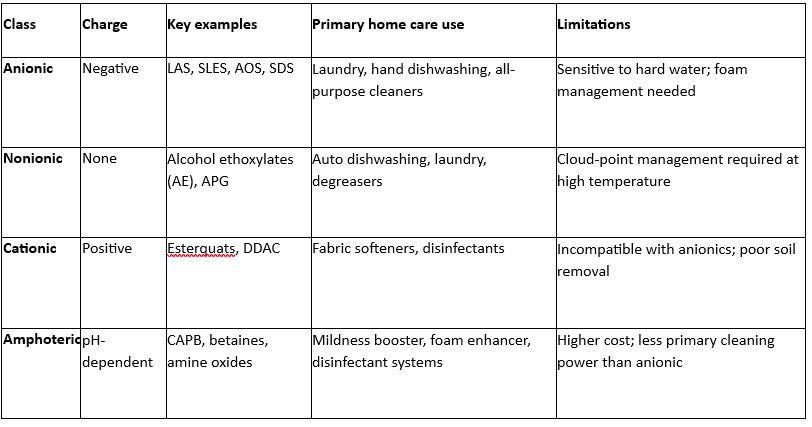
Anionic surfactants carry a negative charge. The most commercially important examples are linear alkylbenzene sulfonates (LAS), sodium lauryl ether sulfate (SLES), and alpha-olefin sulfonates (AOS). They account for the largest share of global surfactant production.
Their primary strength is soil removal from particulate and hydrophilic soils: the negative charge repels soils from negatively charged fabric and hard surfaces, while the hydrophobic tail lifts oily deposits. Anionic surfactants are also generally strong foamers — a property valued in hand-dishwashing but managed carefully in automatic washing machines or front-loaders where excess foam impairs mechanical action.
A key sensitivity is water hardness. Calcium and magnesium ions form insoluble salts with sulfonates and sulfates, reducing active concentration in the wash liquor. Formulations for hard-water markets typically compensate with builders (zeolites, citrates) or pair anionic surfactants with nonionic or amphoteric co-surfactants that tolerate divalent ions better.
2.2 Nonionic surfactants — versatile, low-foam, hardness-tolerant
Nonionic surfactants carry no formal charge. The dominant category in home care is alcohol ethoxylates (AE) — C10–C16 fatty alcohols reacted with varying numbers of ethylene oxide units. The degree of ethoxylation controls hydrophilicity and determines the HLB value (hydrophilic-lipophilic balance), the primary selection parameter for emulsification applications.
Nonionics are insensitive to water hardness because they bear no charge to interact with calcium or magnesium. They excel at oil and grease removal and are used extensively in automatic dishwashing detergents precisely because their low foaming characteristics — some alcohol ethoxylates actually depress foam — avoid interference with spray-arm mechanics. Nonionic surfactants also exhibit a cloud point: above a characteristic temperature they lose solubility and phase-separate. For machine dishwashing, formulations are designed so that the cloud point lies within the washing temperature range, since the momentary phase separation coincides with enhanced soil-release performance.
2.3 Cationic surfactants — conditioning and antimicrobial action
Cationic surfactants, most commonly quaternary ammonium compounds ("quats"), carry a positive charge. Because negatively charged surfaces — skin, hair, fabrics — attract positively charged molecules, quats adsorb strongly and durably. This makes them the primary active in fabric softeners (esterquats) and disinfectant sprays, where substantivity to the surface is desirable.
Cationics are generally incompatible with anionics at the same pH in the same phase (they form insoluble ion pairs). Their use in cleaning formulations is therefore mainly in rinse-cycle products (fabric conditioners) or in disinfectant systems where they serve as both wetting agents and antimicrobial actives.
2.4 Amphoteric (zwitterionic) surfactants — mildness and synergy
Amphoteric surfactants carry both a positive and a negative charge, with overall charge behavior depending on pH. Cocamidopropyl betaine (CAPB) is the most widely used example in home and personal care. At typical wash pH values (6–8), betaines are essentially zwitterionic.
Their main roles in home care formulations are to boost and stabilise the foam of anionic co-surfactants, reduce skin irritation compared to pure anionic systems, and improve compatibility across a broad pH range. Research on dishwashing liquids has confirmed that adding CAPB to anionic SLES/AOS systems lowers CMC and improves cleaning performance in mixed-micelle systems, while also improving the dermatological profile of the final product.
3. The HLB framework — matching surfactant to function
The hydrophilic-lipophilic balance (HLB), introduced by Griffin in 1954, assigns a numerical value to nonionic surfactants that reflects how hydrophilic or lipophilic the molecule is. HLB values run from 0 (completely lipophilic) to 20 (completely hydrophilic).
In practice, HLB ranges map to specific formulation tasks. Values of 4–6 correspond to water-in-oil emulsifiers; 8–16 to oil-in-water emulsifiers; above 13–15 to solubilisers and detergents. A formulator selecting an alcohol ethoxylate for a hard-surface cleaning spray targets a high HLB (above 12–13) to ensure complete water solubility and maximum wetting. The same base alcohol ethoxylated to a lower degree of EO, giving a lower HLB, might be used as a defoamer or rinse-aid in automatic dishwashing.
Blends of two nonionic surfactants with different HLB values produce a blend HLB that is the weight-averaged mean, giving formulators a practical route to fine-tune performance without developing new chemistries. The more recent hydrophilic-lipophilic deviation (HLD) model extends this logic to ionic surfactants and includes temperature, oil type, and salinity as variables, reducing the number of empirical phase-behavior experiments required to optimise a system.
4. Application-by-application selection logic
4.1 Laundry detergents (powder, liquid, unit dose)
Most laundry products use anionic/nonionic blends as their surfactant core. Anionic surfactants (typically LAS or SLES) provide primary cleaning power and foam; nonionics (C12–C15 alcohol ethoxylates with 5–7 EO units) contribute greasy-soil removal and water-hardness tolerance. Mixing the two depresses the CMC of the system below either individual component, allowing effective cleaning at lower total surfactant doses.
Anionic surfactants display excellent removal of particulate and proteinaceous soils, while nonionic surfactants can emulsify lipid-based soils that anionics struggle with at lower temperatures. This complementarity is why cold-wash formulations particularly lean on a higher nonionic fraction — cold water does not provide the thermal energy that helps anionics overcome wax and grease deposits.
4.2 Automatic dishwashing detergents
Automatic dishwashing is one of the most demanding home care applications for surfactant selection. The primary constraint is foam control: excess foam physically blocks spray arms, severely degrading wash performance. Short-chain, low-EO alcohol ethoxylates (sometimes combined with silicone or hydrocarbon defoamers) are the standard choice. They provide greasy-soil emulsification while generating minimal foam.
Water hardness is a secondary constraint: dishwasher water is typically softened by on-board exchange resins, reducing the need for hardness-tolerant surfactants. Enzyme packages (proteases, amylases, lipases) are often more critical than the surfactant selection for starch and protein soil removal, with the surfactant function narrowing to wetting and grease emulsification.
4.3 Hard-surface cleaners and all-purpose sprays
All-purpose cleaners require a surfactant system that provides broad wetting across diverse substrates — glass, ceramic tile, plastic, painted surfaces — while being safe for surfaces and leaving minimal residue after wiping. Nonionic alcohol ethoxylates at high HLB, sometimes combined with a small proportion of an amphoteric, are the predominant choice. pH is often adjusted to alkaline (pH 9–11) for enhanced grease cutting, which favors LAS or amine oxides over sulfate-based surfactants that may hydrolyse.
4.4 Fabric softeners and rinse-cycle products
Fabric softeners function by depositing a thin, durable cationic film on fibers. The active ingredient is almost exclusively a dialkyl esterquat — a quaternary ammonium compound with ester linkages in the alkyl chains. The ester groups are introduced specifically to accelerate biodegradation: they hydrolyse to fatty acids and choline derivatives in the environment.
Because esterquats are incompatible with anionic surfactants, fabric softener systems use a completely separate phase chemistry from the rest of the product range, delivered as concentrated liquid emulsions or unit-dose sheets.
5. Bio-based and green surfactants — from trend to formulation reality
Consumer and regulatory pressure is driving a measurable shift toward bio-based surfactants in home care. Two categories have reached broad commercial adoption: alkyl polyglucosides (APG) and methyl ester sulfonates (MES). Biosurfactants of microbial origin (rhamnolipids, sophorolipids, surfactin) are at an earlier stage of commercialisation.
5.1 Alkyl polyglucosides (APG)
APGs are nonionic surfactants synthesised from renewable glucose (corn or cassava starch) and fatty alcohols (coconut or palm kernel origin). They are readily biodegradable, exhibit low toxicity, are non-irritating to skin and eyes, and show excellent compatibility with other surfactant classes — including both anionics and cationics, an unusual property that opens formulation options unavailable to conventional nonionics.
Their HLB range (10–16, tunable by chain length and degree of polymerisation) makes them suitable for detergent, emulsification, and wetting applications. APGs are stable across a very wide pH range and show good tolerance to high electrolyte concentrations. Their primary formulation challenge is foam — APGs generally produce abundant, stable foam, which must be managed in auto-dishwashing applications.
The APG market was valued at approximately $1.1 billion in 2023 and is projected to grow at a CAGR of around 6–9% through the early 2030s, driven by home care and personal care adoption.
5.2 Biosurfactants — performance with caveats
Microbially produced surfactants — notably rhamnolipids (from Pseudomonas) and sophorolipids (from Starmerella bombicola) — offer genuine biodegradability advantages and unique surface-active profiles. Sophorolipids, for example, achieve surface tensions below 30 mN/m at very low concentrations. Surfactin, a lipopeptide, can stabilise emulsions for extended periods.
The commercialisation hurdle for biosurfactants remains production cost. Fermentation-derived surfactants are still significantly more expensive per kilogram than petrochemical or oleochemical equivalents, though prices are falling as scale increases and downstream processing improves. Their incorporation in home care is currently concentrated in premium and sustainability-positioned product tiers.
6. Regulatory and environmental considerations
In Europe, Regulation (EC) No 648/2004 on detergents mandates ultimate aerobic biodegradability for all surfactants used in detergent products. The regulation defines both primary biodegradation (structural modification) and ultimate biodegradation (complete mineralisation to CO₂, water, and biomass), with the latter required for compliance.
Beyond mandatory biodegradability, surfactant selection is increasingly influenced by voluntary frameworks. The US EPA's Safer Choice program recognises APGs and certain amine oxide and betaine chemistries as meeting its criteria for low toxicity and biodegradability. The EU Ecolabel for cleaning products limits the use of ethoxylated surfactants with high residual ethylene oxide content and restricts certain quaternary ammonium compounds.
Aquatic toxicity is the primary environmental concern for surfactants that reach the aquatic compartment after wastewater treatment. Anionic surfactants are the most produced class and their environmental fate — particularly LAS — is well-studied. LAS undergoes rapid primary biodegradation in activated sludge, though complete mineralisation takes longer under some conditions. Surfactants in general can disrupt cellular membranes of aquatic organisms and reduce dissolved oxygen by stabilising foam on water surfaces.Formulator's regulatory checklist(1) Verify ultimate biodegradability under EC No 648/2004 or equivalent market requirement. (2) Check substance restrictions under REACH for high-volume surfactant ingredients. (3) Review Ecolabel or Safer Choice criteria if a certification claim is intended. (4) Assess aquatic hazard classification (H400/H410) for all surfactant inputs — relevant for SDS labelling and ingredient disclosure requirements
7. Practical selection criteria — a decision framework
The following questions structure surfactant selection from first principles. Working through them sequentially avoids the common failure mode of selecting a surfactant based on cost alone, only to discover formulation incompatibilities or regulatory gaps late in development.
1. What is the primary soil type? Hydrophilic particulate soils (clay, mineral dust): anionic preferred. Lipophilic soils (fats, oils, waxes): nonionic or anionic/nonionic blend. Proteinaceous soils: enzyme + any compatible surfactant. Mixed soils: blended anionic/nonionic system.
2. What is the washing medium and temperature? Hot water (above 60 °C): most surfactants stable; manage cloud-point of short-EO nonionics. Cold water (below 30 °C): favor higher nonionic fraction; LAS performance drops below its Krafft temperature. Hard water: avoid pure anionic systems without a builder; include nonionic or amphoteric component.
3. Is foam a performance feature or a liability? High foam desired (hand dishwashing, manual cleaners): anionic or anionic/amphoteric blend. Low foam required (auto dishwashing, front-load laundry): low-EO nonionic or defoamer-loaded system.
4. What substrate is being cleaned? Textiles: avoid hard-surface defoamers; prioritise fabric-safe pH range. Hard surfaces: prioritise wetting and residue-free drying. Skin-contact products: minimise anionic concentration; favor amphoteric or nonionic for irritation reduction.
5. What are the sustainability and regulatory targets? If bio-based origin is required: APG, sucrose esters, or biosurfactants. If EU Ecolabel targeted: check restricted EO adduct content and quat restrictions. If US Safer Choice certification is targeted: use EPA-approved surfactant palette.
Frequently asked questions
What is the difference between anionic and nonionic surfactants in cleaning?
Anionic surfactants carry a negative charge and excel at removing particulate and hydrophilic soils, especially at higher temperatures, but they are sensitive to water hardness. Nonionic surfactants carry no charge, tolerate hard water well, and are particularly effective against oily and greasy soils. Most modern laundry and cleaning formulations combine both types to exploit their complementary strengths.
What does HLB mean in surfactant selection?
HLB (hydrophilic-lipophilic balance) is a numerical scale from 0 to 20 that quantifies how hydrophilic or lipophilic a nonionic surfactant is. High HLB values (above 13) indicate good water solubility and suitability for wetting and detergent applications. Low HLB values (below 6) indicate lipophilicity, suited to water-in-oil emulsification. Formulators blend surfactants to achieve a target HLB for their application.
Why do automatic dishwashing detergents use different surfactants than hand dishwashing liquids?
Automatic dishwashers rely on mechanical spray action for cleaning. Excess foam from high-foaming surfactants physically blocks the spray arms and dramatically reduces cleaning efficiency. Low-foaming nonionic surfactants (typically short-chain alcohol ethoxylates) are therefore used in auto dishwashing formulations, whereas hand dishwashing liquids exploit the sensory appeal of high, stable foam from anionic/amphoteric blends.
Are alkyl polyglucosides (APG) as effective as conventional surfactants?
APGs deliver comparable wetting, emulsification, and cleaning performance to conventional nonionic surfactants in most home care applications, with the additional advantages of biodegradability, low ecotoxicity, and excellent tolerance of ionic environments. Their main formulation challenge is high and stable foam, which requires management in low-foam applications such as automatic dishwashing. They are fully compatible with anionic, cationic, and amphoteric co-surfactants.
What is the CMC and why does it matter for formulation?
The critical micelle concentration (CMC) is the surfactant concentration above which molecules self-assemble into micelles. Below the CMC, the surfactant lowers surface tension but cannot solubilise oily soils efficiently. Above the CMC, micelles trap oil droplets and particulates, enabling cleaning. Formulating above the CMC is necessary for effective performance; formulating significantly above it adds cost without proportional benefit. Synergistic surfactant blends achieve a lower CMC than any single component, improving efficiency.
Key takeaways for formulators
- Surfactant charge class (anionic, nonionic, cationic, amphoteric) determines compatibility, foam behavior, and primary soil affinity. Selection begins with understanding the soil and substrate.
- The CMC is the operative threshold for cleaning performance. Blending anionic and nonionic surfactants synergistically depresses CMC below either individual value, improving efficiency and allowing dose reduction.
- HLB governs nonionic surfactant behavior in emulsification and wetting; the HLD model extends this to ionic surfactants and multi-variable systems.
- Foam is a critical functional variable: a benefit in hand-dishwashing, a liability in automatic dishwashing and front-load laundry. Surfactant selection must address foam explicitly.
- APGs represent the most commercially mature bio-based option for home care: they offer genuine biodegradability, broad compatibility, and comparable cleaning performance at commercially viable cost.
- European Regulation EC 648/2004 mandates ultimate aerobic biodegradability for all detergent surfactants. Regulatory mapping should occur at the ingredient selection stage, not after formulation.