



Hydroxypropyl methylcellulose (HPMC), also called hypromellose, is one of the most extensively studied and widely used cellulose-derived excipients in pharmaceutical formulation. Among the viscosity grades available, the K200M designation. It is characterized by a nominal viscosity of 200,000 mPa·s in a 2% aqueous solution at 20°C and occupies a specific position in controlled-release applications where prolonged drug release and robust gel layer formation are required. BENECEL™ K200M PHARM is a pharmaceutical-grade hypromellose manufactured to meet the purity and consistency standards demanded by oral solid dosage development.
Chemical Identity and Regulatory Status
Hypromellose is a semi-synthetic, non-ionic cellulose ether produced by etherification of cellulose, through which hydroxyl groups in the native cellulose structure are replaced with hydroxypropyl and methyl groups. This chemical modification improves water solubility and introduces viscoelastic properties that are central to its function as a matrix-forming excipient. The CAS number for hypromellose is 9004-65-3. In pharmacopeial nomenclature, the substitution type is encoded in a four-digit suffix: the first two digits indicate the approximate percentage content of methoxy groups (–OCH₃), and the last two digits refer to the hydroxypropoxy content (–OCH₂CH(OH)CH₃), calculated on a dry basis.
HPMC is listed in the United States Pharmacopeia/National Formulary (USP/NF), the European Pharmacopoeia (Ph. Eur.), and the Japanese Pharmacopoeia (JP). It holds GRAS (Generally Recognized as Safe) status with the U.S. FDA, and its use in pharmaceutical products is accepted by both the FDA and the EMA. Toxicological studies have consistently demonstrated an absence of significant adverse effects at therapeutic dosage levels, with no evidence of carcinogenicity, mutagenicity, or allergenicity under standard conditions of use, as reviewed in published safety assessments. As a non-ionic polymer, HPMC is chemically inert: it does not interact with metal salts or ionic substances, which reduces the risk of drug-excipient interaction in complex formulations.
Physicochemical Properties Relevant to Drug Formulation
The physicochemical behavior of HPMC in aqueous conditions is directly related to its functional role as a controlled-release excipient. In the dry state, HPMC is a white to off-white odorless and tasteless powder. When hydrated, it forms a viscoelastic gel whose strength and thickness scale with the molecular weight and viscosity grade of the polymer. HPMC solutions are stable across a wide pH range (approximately pH 3–11), and the polymer's viscosity is pH-independent in this interval — a property that makes it well-suited for oral solid dosage forms, where the drug product encounters varying gastrointestinal pH conditions as it transits from the stomach to the intestine.
A key physicochemical characteristic of HPMC is its reversible thermal gelation: aqueous solutions undergo a sol-gel transition upon heating, which can be exploited in certain wet granulation processes. Storage conditions should avoid excessive moisture and elevated temperature to maintain the excipient's viscosity specifications, as moisture sensitivity can affect batch-to-batch performance. For pharmaceutical manufacturers, consistent viscosity is a critical quality attribute: published research has shown that variability in HPMC viscosity directly influences drug release profiles and can cause interbatch variability in dissolution testing, making tightly controlled viscosity specifications an essential condition for robust formulation development.
Mechanism of Drug Release from HPMC K200M Matrices
The controlled-release mechanism of HPMC hydrophilic matrices has been the subject of extensive mechanistic investigation over several decades. When a matrix tablet containing HPMC K200M contacts aqueous media, water penetrates the tablet surface and hydrates the polymer chains. This hydration produces a swollen gel layer that progressively expands inward, establishing three moving fronts observable in vitro: a swelling front (separating the dry core from the hydrated gel), a diffusion front (within the gel, from which dissolved drug diffuses outward), and an erosion front (at the tablet-medium interface, where the polymer disentangles and is released). Research published in Pharmaceutical Research demonstrated that gel layer thickness increases continuously irrespective of the polymer viscosity grade or drug loading, because the rate of swelling solvent penetration exceeds the rate of polymer dissolution under standard in vitro conditions.
Drug release from HPMC K200M matrices operates through a combination of diffusion and erosion. For water-soluble drugs, diffusion through the gel layer is the dominant mechanism; for sparingly soluble drugs, erosion of the matrix plays a proportionally greater role, since the slower dissolution rate in the gel allows drug particles to be transported toward the erosion front by polymer swelling. A study published in the Journal of Controlled Release established that drug translocation in the gel layer due to polymer swelling is a non-negligible contribution to overall drug release when drug solubility is low, a finding with direct practical implications for API selection and formulation strategy. The gel layer of swollen HPMC K200M tablets exhibits predominantly elastic behavior, and the viscoelastic properties of this gel have been shown to correlate directly with in vitro drug release rates.
The high molecular weight of the K200M grade — reflected in its nominal viscosity of 200,000 mPa·s — produces a denser, more cohesive gel than lower-viscosity HPMC grades. This results in a more tortuous diffusion path and slower drug release kinetics. A study on metformin hydrochloride sustained-release tablets found that HPMC K200M at 26% concentration sustained drug release over 12 hours, following Higuchi quasi-Fickian diffusion kinetics, with no chemical interaction detected between the drug and the excipient by FTIR or DSC. This illustrates the practical dosage potential of the K200M grade for once-daily or twice-daily dosing regimens requiring extended-release coverage over 8–12 hours.
Role of Viscosity Grade in Controlling Release Profile
HPMC is available in multiple viscosity grades — from low-viscosity grades used as binders or coating agents to ultra-high-viscosity grades for specialized controlled-release applications. The K200M grade is positioned at the high end of the viscosity spectrum, making it appropriate for formulations where a slow, sustained release profile is required. Research has confirmed that higher-viscosity HPMC grades produce slower polymer release from the matrix (polymer release preceding complete drug release in high-viscosity formulations), with high-viscosity HPMC tablets showing slower HPMC release than drug release, which sustains the gel layer integrity over longer periods and prevents dose dumping.
The ratio of drug to HPMC K200M in the tablet formulation is a primary formulation variable controlling release kinetics, alongside particle size distribution of the polymer. Published data indicate that HPMC particle size can significantly affect drug release: formulations where less than 50% of the HPMC passed through a 230-mesh (63 µm) screen showed faster drug release and a shift in release mechanism compared to finer particle populations, as demonstrated in a systematic study across six model drugs and four viscosity grades. This reinforces the importance of controlling excipient specifications at the source to ensure reproducible dosage performance.
A recent study using carvedilol as a model drug demonstrated through optimized multilinear regression analysis that HPMC viscosity and lactose content interact significantly in governing release kinetics, underscoring that formulation design must consider excipient interactions rather than evaluating polymer concentration in isolation.
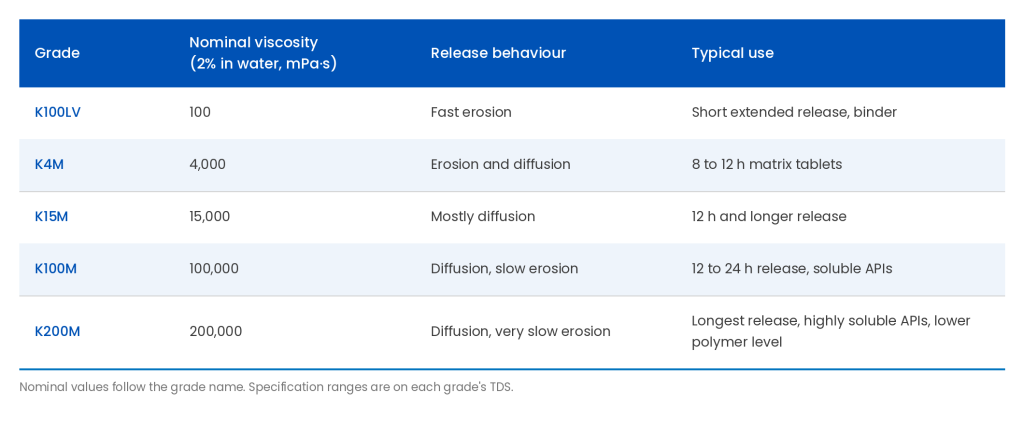
HPMC viscosity grades compared: where K200M sits
HPMC K grades share the same substitution type (USP 2208) and differ mainly by molecular weight, which drives the viscosity of the gel layer that forms when the tablet is hydrated. The higher the viscosity, the stronger and slower-eroding the gel barrier, and the more the release shifts from erosion to diffusion.
K200M sits at the top of the range. It is chosen when a formulation needs the longest release duration, when a highly soluble drug must be held back, or when a lower polymer level is wanted for the same release profile. Always confirm the specification range on the current TDS before formulating.
Pharmaceutical Applications
In oral solid dosage forms, HPMC K200M serves primarily as the matrix-forming polymer for extended-release and modified-release tablets. Hydrophilic HPMC matrices are among the most widely used controlled-release platforms globally, valued for their regulatory acceptance, broad compatibility with APIs, and the fact that they can be manufactured by conventional tablet compression techniques (direct compression or wet granulation) without specialized equipment. This manufacturing simplicity translates into a lower cost of goods relative to more complex controlled-release technologies, an advantage that remains relevant in the development of generic extended-release drug products.
Beyond controlled-release matrices, high-viscosity HPMC grades find application as tablet binders at lower concentrations, where they contribute to granule strength and content uniformity in wet granulation processes. HPMC is also used as a film-coating polymer, a suspending agent in liquid pharmaceutical dosage forms, a viscosity modifier in ophthalmic solutions, and as an ingredient in mucoadhesive formulations. Its non-animal origin makes it a preferred excipient in vegetarian and vegan pharmaceutical products.
The K200M grade is specifically indicated in formulations requiring a slow-onset, prolonged release profile, and in cases where the API has a short biological half-life that makes controlled release therapeutically beneficial. The pH-independent release behavior of HPMC K200M — a direct consequence of its non-ionic character — is particularly valuable for drugs whose gastrointestinal absorption is sensitive to local pH variation, as it provides a predictable release profile independent of whether the tablet is in the acidic stomach environment or the more alkaline intestinal conditions.
Need documentation?
Safic-Alcan distributes BENECEL™ K200M PHARM for pharmaceutical applications. For technical information and sourcing, don't hesitate to ask !
Safety Considerations and Handling
HPMC is considered a non-toxic, non-irritant, and pharmacologically inert excipient. It is not systemically absorbed following oral administration in humans and does not cause significant adverse effects at therapeutic dosage levels used in pharmaceutical formulations. Healthcare professionals and patients should be aware that hypersensitivity reactions to HPMC, while extremely rare, have been reported anecdotally, and any unusual symptom or allergic reaction following administration of a product containing hypromellose should be reported to the prescribing physician. Patients should not change the dose or modify the release characteristics of extended-release tablets (e.g., by crushing or chewing) without medical instruction, as this may cause rapid release of the full drug dose and increase the risk of adverse effects.
In occupational settings, inhalation of dry HPMC powder should be avoided. Handling should occur in well-ventilated conditions, consistent with standard pharmaceutical manufacturing practices. The substance is stable under recommended storage conditions (dry, temperature-controlled environment) and does not present unusual hazards. For any medical concern related to a drug product containing HPMC as an excipient, patients should tell their doctor or healthcare provider and, where applicable, may report side effects to the FDA via MedWatch or equivalent national pharmacovigilance programs.
FAQ
What is the difference between HPMC K4M, K15M, K100M and K200M?
All are HPMC substitution type 2208. The number gives the nominal viscosity of a 2% aqueous solution in thousands of mPa.s. Higher viscosity forms a stronger gel layer and slows drug release.
When should I choose K200M instead of K100M?
When you need a longer release duration, when the API is highly soluble, or when you want to reach the same release profile with less polymer.
Where can I get BENECEL K200M PHARM samples and documentation in Europe?
Safic-Alcan distributes BENECEL K200M PHARM. You can download the TDS and request a sample from the product page
Conclusion
HPMC K200M represents a well-characterized, regulatory-compliant cellulose ether excipient with a robust scientific basis for its use in controlled-release oral pharmaceutical formulations. Its gel-forming mechanism, pH-independent viscosity, chemical inertness, and compatibility with a broad range of APIs make it a technically versatile ingredient for formulation scientists developing extended-release solid dosage forms. BENECEL™ K200M PHARM combines these established scientific properties with the manufacturing consistency and regulatory documentation required for pharmaceutical development and commercial production.