


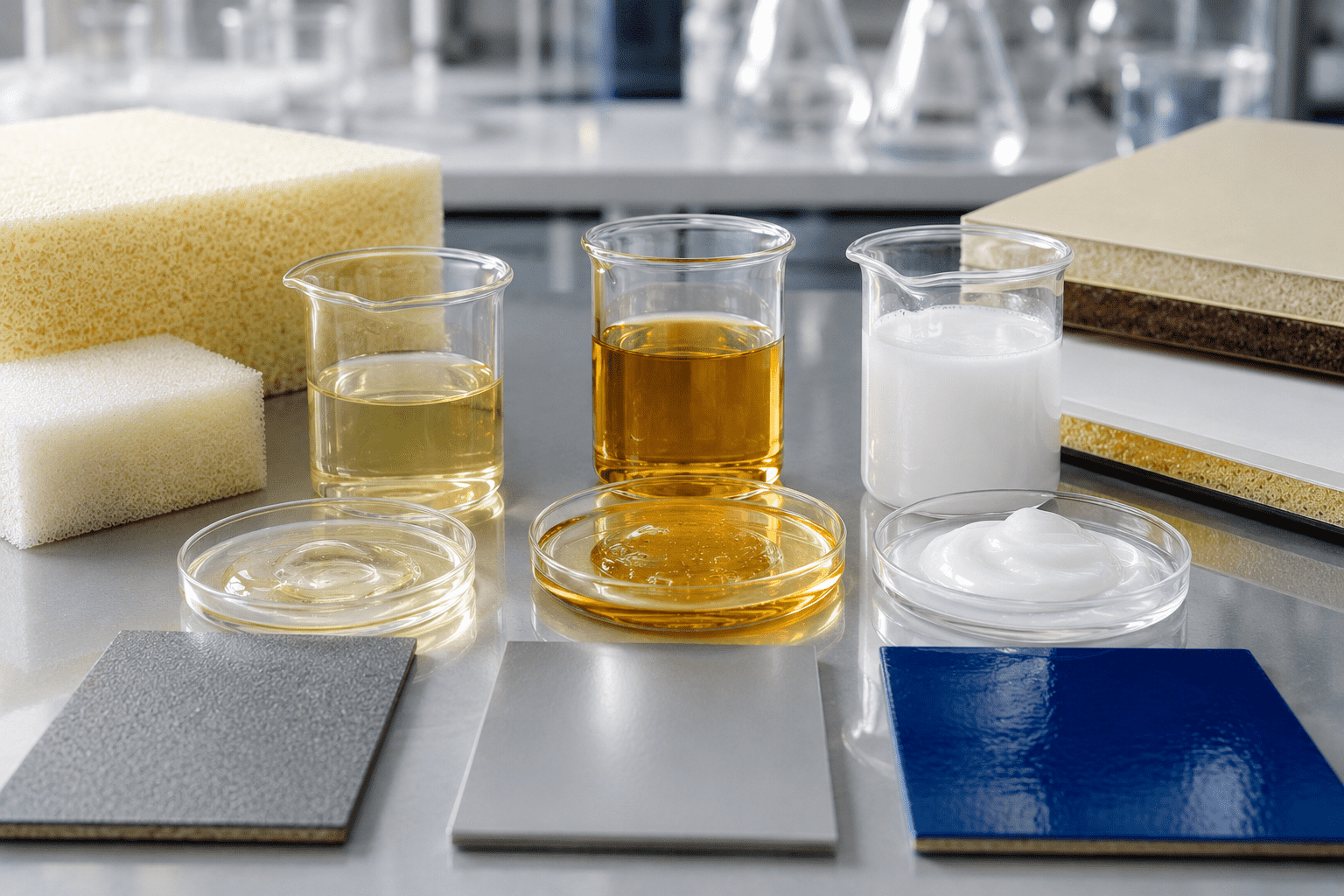
TL; DR : MDI (methylene diphenyl diisocyanate) is the dominant isocyanate for rigid foam, elastomers and structural applications, offering lower vapour pressure and better mechanical performance than TDI. TDI (toluene diisocyanate) remains the standard for flexible slabstock foam. Waterborne polyurethane dispersions (WPU/PUD) replace both in coatings and adhesives when VOC compliance or worker safety constraints apply. The choice depends on the end-use foam type, toxicity constraints, and regulatory environment.
Find the right polyurethane system for your application
Our technical team helps you identify the most suitable solution from Safic-Alcan's portfolio
What is MDI and what is it used for?
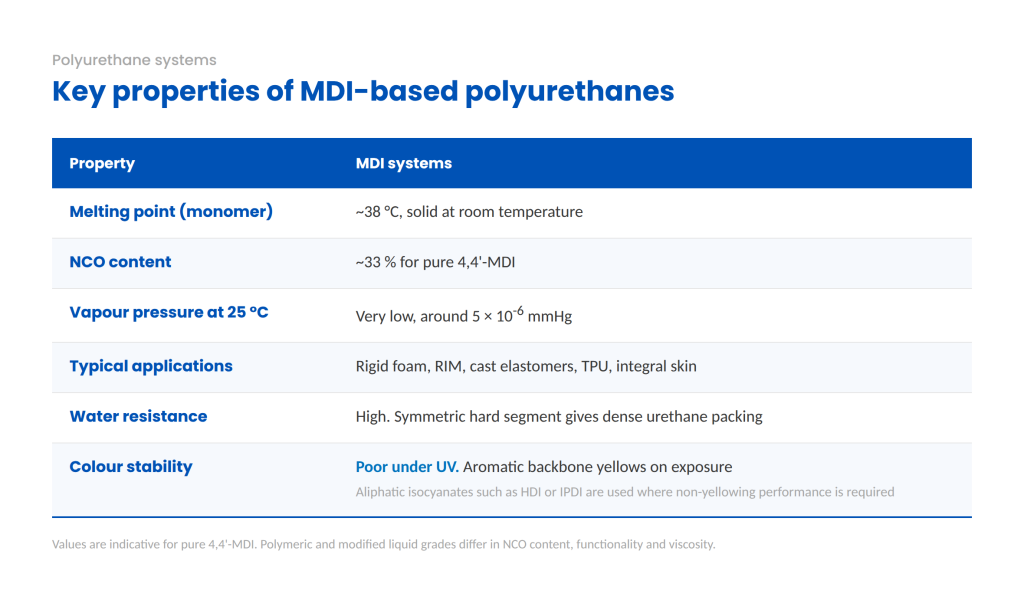
MDI (4,4‑diphenylmethane diisocyanate) is an aromatic diisocyanate that exists as a solid at room temperature, with a melting point of approximately 38 °C. Its symmetrical molecular structure produces highly regular urethane hard segments, which translate into superior microphase separation and, consequently, high tensile strength and abrasion resistance in the final polymer.
MDI comes in three main forms: pure monomeric MDI (4,4‑MDI), polymeric MDI (pMDI, a mixture of oligomers), and modified liquid MDI grades (carbodiimide-modified, uretonimine-modified) designed to remain liquid at ambient temperature for easier processing.
Its primary application is rigid polyurethane foam for thermal insulation, which accounted for approximately 36.8 % of global MDI demand in 2025. More than 1.2 billion square metres of building surfaces were insulated with MDI-based materials in 2024. MDI also dominates reaction injection moulding (RIM), cast elastomers, thermoplastic polyurethanes (TPU), and integral skin mouldings.
A key handling advantage is its low vapour pressure compared to TDI, which matters in industrial hygiene contexts.
NIOSH sets a recommended exposure limit for MDI of 0.005 ppm as an 8-hour TWA, with a 10-minute ceiling of 0.020 ppm. OSHA sets a ceiling of 0.02 ppm for both TDI and MDI. The practical difference between the two isocyanates is not the limit value but the ease of reaching it: MDI's vapour pressure is roughly three orders of magnitude lower than TDI's at ambient temperature, so airborne concentrations build far more slowly in normal handling.
Key properties of MDI-based polyurethanes
What is TDI and where is it used?
TDI (toluene diisocyanate) is an asymmetric aromatic diisocyanate commercially produced as a 80:20 mixture of 2,4-TDI and 2,6-TDI isomers. Its melting point is approximately 14 °C, meaning it is a liquid at room temperature. This makes it easy to handle without heating, but its higher NCO content and higher vapour pressure present a more significant inhalation hazard than MDI.
TDI is used almost exclusively to produce flexible polyurethane slabstock foam, the foam used in mattresses, upholstered furniture, automotive seating, and bedding. Flexible foam held approximately 58.7 % of the global polyurethane foam market by revenue in 2023. TDI also finds some use in coatings, sealants, and elastomers, though MDI has progressively replaced it in applications where lower volatility is required.
Because of its asymmetric reactivity (the 2,4 isomer has different NCO group reactivities at the 4- and 2-positions), TDI produces polyurethane networks with distinct microphase structures compared to MDI. Mixed TDI/MDI systems are used to tune microphase separation and mechanical properties: when the molar ratio of TDI drops below 50 %, the molecular chain regularity increasingly reflects the MDI system and microphase separation improves.
TDI toxicity and regulatory status
The OSHA permissible exposure limit for TDI in air is a ceiling of 0.02 ppm (0.14 mg/m³). TDI has been classified as a Group 2B possible human carcinogen by IARC. It is a leading cause of chemically induced occupational asthma: sensitised workers can react to concentrations as low as 1 % of the 8-hour TLV (5 ppb). Consumer products containing uncured TDI have progressively been reformulated with MDI or waterborne alternatives.
Reformulating away from TDI?
Our polyurethane team can help you evaluate MDI grades and
waterborne alternatives for your application.
What are waterborne polyurethane dispersions (WPU/PUD)?
A waterborne polyurethane dispersion (WPU or PUD) is a colloidal system in which polyurethane particles are dispersed in water rather than in an organic solvent. Hydrophilic groups, typically carboxylate groups derived from dimethylolpropionic acid (DMPA), are incorporated into the polymer backbone and provide colloidal stability once neutralised with a triethylamine or similar base.
WPU combines the mechanical robustness and chemical versatility of polyurethane chemistry with significantly reduced VOC emissions, making them essential for coatings, adhesives, synthetic leather, and biomedical applications. Unlike solvent-borne systems, they are non-flammable, low-odour, and align with EPA and EU VOC regulations.
The waterborne polyurethane dispersions market was estimated at USD 16.4 billion in 2022 and is projected to reach USD 26.5 billion by 2032, with a CAGR of 4.92 %. Regulatory pressure, particularly regarding VOC emission limits from the EPA and EU Directive 2004/42/EC, is the primary market driver alongside end-user adoption in automotive OEM coatings, wood coatings, textile finishing, and packaging.
How WPU performs versus solvent-borne systems
The main trade-offs compared to MDI or TDI solvent-borne systems are: WPU typically has lower solids content, is more sensitive to application temperature (substrates must be dry, and coalescence is temperature-dependent), and can have inferior water resistance if the hydrophilic stabilisation groups are not well-sequestered in the hard segment. MDI-based waterborne systems show better water resistance than TDI-based WPU products, because the symmetric MDI hard segment produces denser urethane packing.
Particle morphology depends heavily on water addition rate and polyol molecular weight during synthesis. Polyols with molecular weights of 1,000–2,000 g/mol produce spherical nanoparticles when dispersed in water, which is the preferred morphology for film formation and surface coating applications.
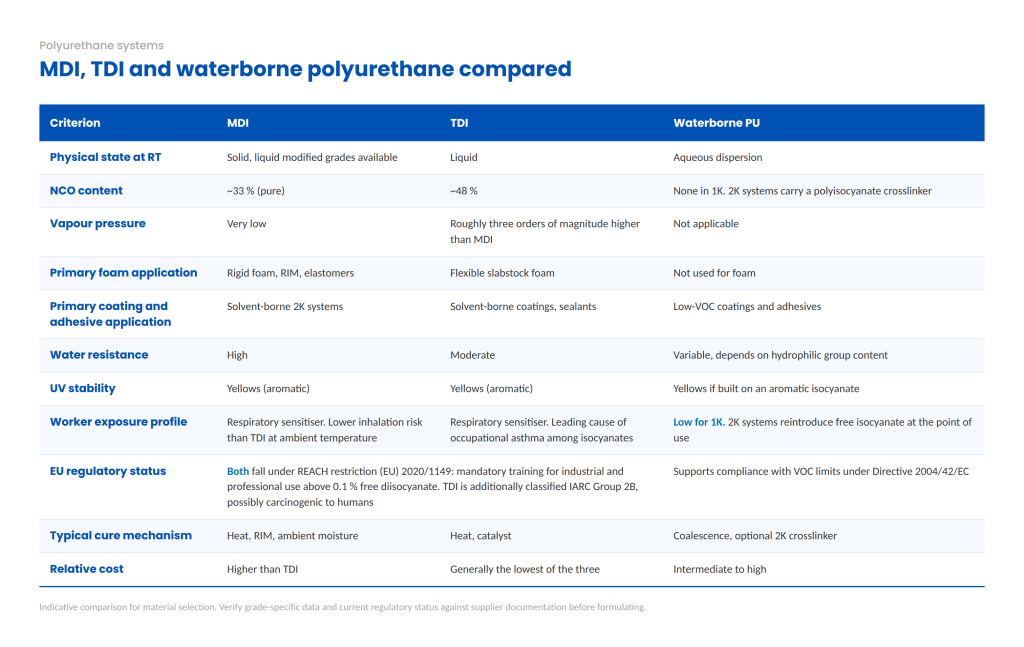
MDI vs TDI vs Waterborne: comparative table
When to use MDI instead of TDI
Processors move from TDI to MDI mainly for handling and exposure reasons: MDI has a much lower vapour pressure than TDI, so less isocyanate becomes airborne at room temperature. MDI systems also give higher hardness potential and better thermal stability.
The switch makes most sense when you need to reduce worker exposure, when you want an MbOCA-free cast elastomer route, or when the part needs higher hardness and heat resistance. TDI remains relevant where low viscosity, long pot life and dynamic performance are the priority.
Plan trials: ratio, processing temperature and cure schedule change with MDI.
Which polyurethane system should you choose?
For thermal insulation and structural applications
MDI, and specifically polymeric MDI (pMDI), is the standard for rigid foam panels used in construction, refrigeration, and pipe insulation. Building and construction accounted for 39.8 % of the global rigid polyurethane foam market in 2023, and MDI-based materials insulated over 1.2 billion square metres of building surface in 2024. Low-emission MDI grades grew by approximately 30 % between 2023 and 2025 in response to tighter worker safety requirements.
For flexible foam (bedding, furniture, automotive seating)
TDI remains the dominant isocyanate for flexible slabstock foam manufacturing. The asymmetric reactivity of its isomers allows control over network formation. Flexible foam represented approximately 58.7 % of the market by revenue in 2023. In consumer goods where residual monomer migration is a concern, the industry has been progressively substituting TDI with MDI variants.
For coatings, adhesives and finishes with VOC constraints
Waterborne polyurethane dispersions are the preferred choice where VOC limits apply, whether in automotive refinish coatings, wood floor lacquers, or textile finishes. The construction sector alone represented over 35 % of the waterborne PU resin market in 2024. Two-component waterborne systems (2K-WPU, using a hydrophilic polyisocyanate crosslinker) narrow the performance gap with solvent-borne systems, particularly for abrasion resistance and chemical resistance on floor coatings.
Sourcing isocyanates, polyols or PU dispersions?
Browse our polyurethane portfolio by application.
Frequently asked questions
What is the difference between MDI and TDI in polyurethane chemistry?
MDI and TDI are both aromatic diisocyanates used to make polyurethane, but they differ in molecular structure, physical state, vapour pressure, and primary applications. MDI is a larger, symmetric molecule that is solid at room temperature with very low vapour pressure, preferred for rigid foam, elastomers and structural applications. TDI is an asymmetric liquid isocyanate with higher vapour pressure and higher NCO content, used primarily for flexible slabstock foam.
Are waterborne polyurethanes as strong as solvent-borne systems?
Not in all cases, but the gap has closed significantly. Modern waterborne dispersions, particularly those based on MDI hard segments and crosslinked with hydrophilic polyisocyanate curing agents, deliver tensile strength, chemical resistance, and abrasion resistance comparable to many solvent-borne coatings. Their main limitation remains sensitivity to low-temperature application and substrate moisture.
Why is TDI considered more hazardous than MDI?
TDI has a higher vapour pressure, meaning it becomes airborne more easily at room temperature. Both TDI and MDI are respiratory sensitisers and can cause occupational asthma, but TDI carries an additional carcinogen classification (IARC Group 2B). Consumer products containing uncured TDI have progressively been replaced by MDI-based or waterborne alternatives.
What isocyanate is used in waterborne polyurethane?
WPU can be based on either MDI or TDI as the starting isocyanate in the prepolymer synthesis stage, but the final dispersion contains no free isocyanate. MDI-based WPU typically shows better water resistance than TDI-based products due to denser hard segment packing. Some high-performance 2K waterborne coatings use aliphatic isocyanates (HDI, IPDI) for UV stability.
What does VOC compliance mean for polyurethane coatings?
VOC (volatile organic compound) content is regulated by directives such as EU Directive 2004/42/EC and EPA standards in the US. Solvent-borne MDI and TDI coatings can exceed these limits. Waterborne polyurethane dispersions contain water as the primary carrier and typically comply with near-zero VOC requirements, which is why sectors such as automotive OEM coatings, wood floor finishes, and textile coatings have shifted substantially toward WPU.
Can MDI replace TDI in polyurethane?
In many foams, coatings and cast elastomers, yes, with reformulation of ratio, temperature and cure. Trials are needed to confirm part performance.