


What Precipitated Silica Is
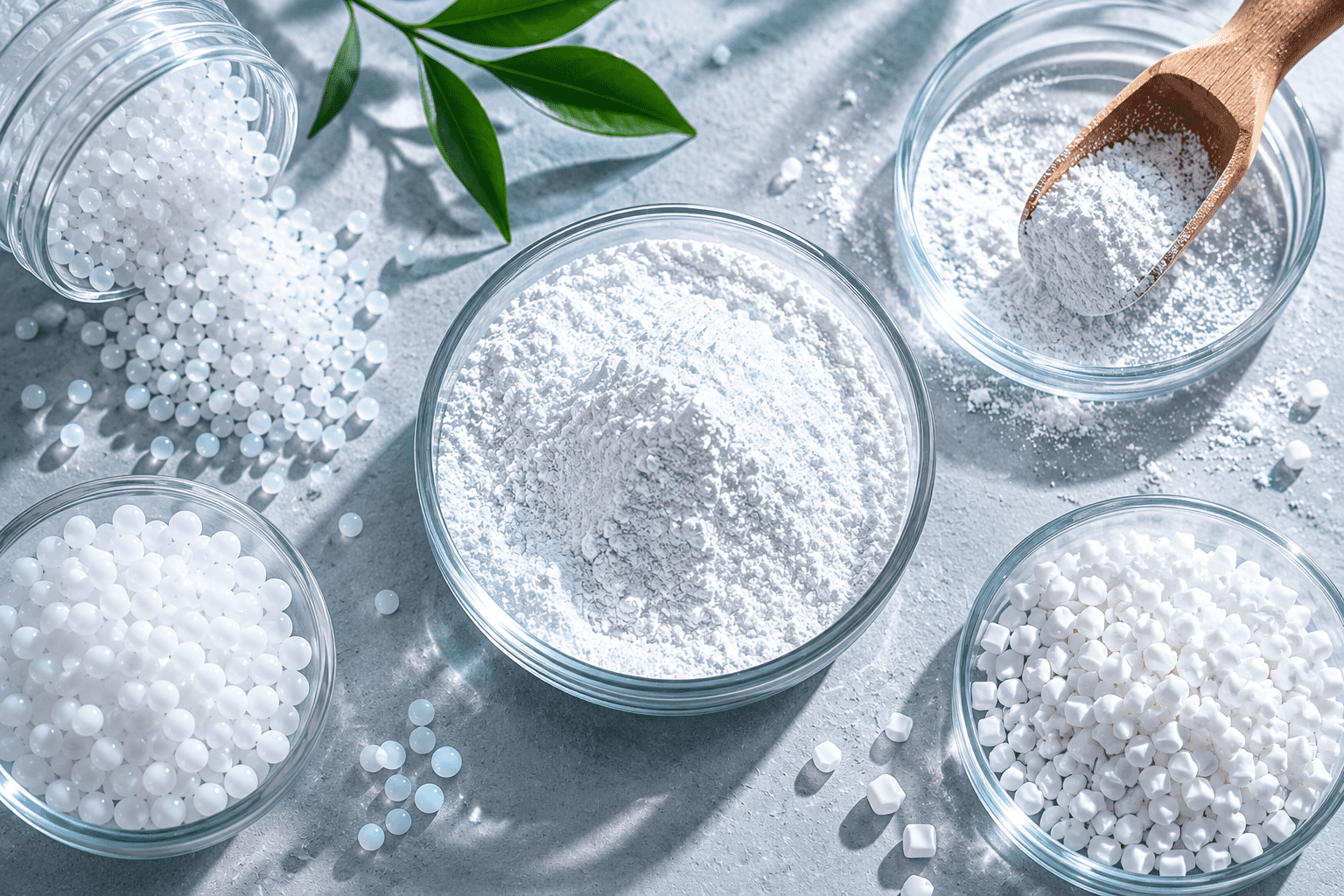
Precipitated silica is a synthetic amorphous form of silicon dioxide (SiO2) produced by a wet chemical process. It appears as a white, free-flowing powder with a porous structure and a high specific surface area — properties that make it a functional additive across a broad spectrum of industries, from rubber and tire manufacturing to oral care, coatings, plastics, and food processing.
Precipitated silica holds the largest commercial significance among the three main types of synthetic amorphous silica — pyrogenic (fumed) silica and silica gel being the other two. Global market value for amorphous precipitated silica is approximately $3.5 billion, with tires and rubber applications accounting for around 57% of demand. The rest is distributed across oral care, coatings and inks, adhesives and sealants, food and feed, and plastics.
For a technical overview of fumed silica and its specific properties, and for context on how silica fits within broader rheology modifiers for industrial applications, see our dedicated resources on each topic.
Interested in our products?
Reach out to us to our team today!
The Manufacturing Process
From sodium silicate to precipitated silica
Precipitated silica is produced industrially by reacting sodium silicate (waterglass, 3SiO2·Na2O) with a mineral acid — typically sulfuric acid, though hydrochloric acid and carbon dioxide are also used — under controlled aqueous conditions. The overall reaction with sulfuric acid:
Na2SiO3 + H2SO4 → SiO2 + Na2SO4 + H2O
The sodium silicate raw material is itself produced by fusing quartz sand and soda ash at high temperature. The choice of acid influences by-product salts and the electrical conductivity of the reaction medium, which affects silica particle morphology.
The manufacturing process comprises four critical stages:
- Precipitation. The sodium silicate solution is fed into a reaction vessel along with the acid under controlled agitation, temperature (typically 70–160°C), and pH. The pH profile during precipitation — whether acid addition is progressive, simultaneous, or in phases — directly controls the primary particle size, aggregate structure, porosity, and specific surface area of the resulting silica. An initial stock at near-neutral or alkaline pH favors nucleation; continued acid addition causes silica to precipitate onto existing particles.
- Filtration and washing. The silica suspension is filtered using filter presses to separate the silica cake from the sodium sulfate solution. The cake is washed to remove residual salts. The sodium sulfate concentration remaining in the product is a direct quality indicator.
- Drying. The filter cake contains 60–80% water after filtration. Drying by spray drying, flash drying, or rotary dryer depends on the target product form. Spray drying yields a granular product with lower dust; flash drying produces a finer powder. The final moisture content in precipitated silica products is typically 3–7%, comprising free water (removed at 105°C), adsorbed water (removed at 200°C), and constitutional water — hydroxyl groups that condense at 700–900°C.
- Milling and classification. The dried silica is milled to the target particle size distribution and compacted to balance the absence of visible particles against dustiness during rubber and plastics mixing.
Process variables that control silica properties
The precipitation conditions — concentrations of reactants, rate of acid addition, temperature, pH, agitation, and the presence of electrolytes — are the primary levers controlling the physicochemical characteristics of precipitated silica. This is why a single manufacturing route produces a wide range of silica grades with different surface areas, oil absorption values, pore structures, and aggregate sizes. Formulators selecting a precipitated silica grade are, in effect, selecting a specific combination of these properties matched to their application.
Key Properties and How They Are Measured
BET specific surface area (SSA): measured by nitrogen adsorption, expressing total surface area per gram including internal pore surfaces. Values range from 35 to 350 m²/g. For rubber reinforcement, high-performance grades fall between 150 and 250 m²/g.
CTAB surface area: measured by adsorption of cetyltrimethylammonium bromide at pH 9, capturing only the external surface accessible to large molecules. Typically 10–20 m²/g lower than BET values and the preferred metric for predicting reinforcing performance in rubber, as it correlates better with filler-rubber interfacial contact.
Oil absorption (DBP value): expressed in cm³ per 100 g of silica, this measures the aggregate structure's capacity to absorb dibutyl phthalate — a proxy for void volume within the aggregate network, directly related to compound viscosity and processing behavior during mixing. DBP values typically range from 150 to 310 cm³/100 g.
Porosity: precipitated silica has a porous structure with average pore sizes above 30 nm and pore volumes between 1.6 and 3.4 ml/g. The distribution of pore sizes affects coupling agent penetration in rubber compounds and absorption of liquids in food and feed applications.
Aggregate size and particle size: silica particles exist as primary particles (5–100 nm), which sinter during drying into aggregates (the smallest indivisible unit, 100–500 nm), which in turn form agglomerates in a size range of 1–40 µm held together by weak van der Waals forces. The aggregate size and particle size distribution govern dispersibility in rubber and plastic matrices.
Fumed Silica vs. Precipitated Silica
Although both fumed silica and precipitated silica are synthetic amorphous forms of silicon dioxide, they are produced by fundamentally different processes and have distinct properties that make each suited to specific applications.
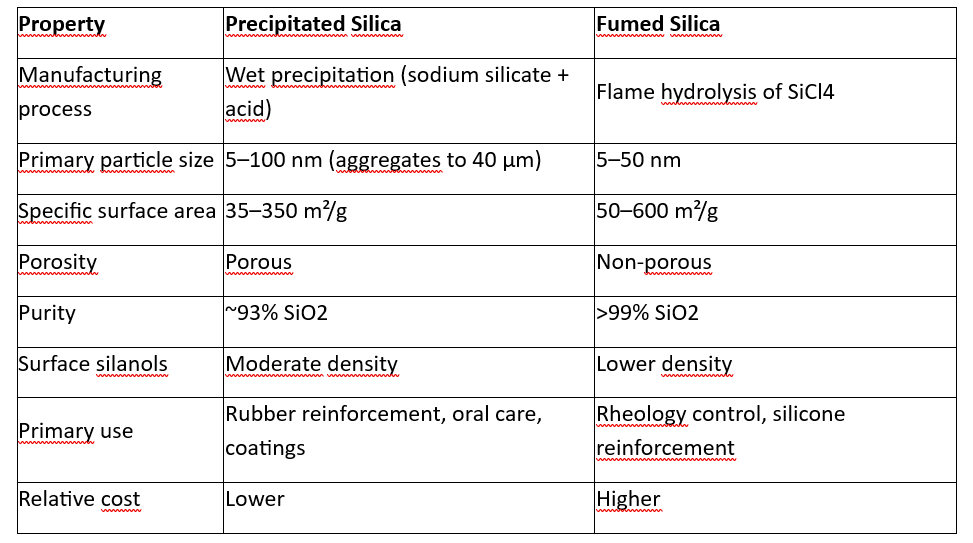
Fumed silica is produced by the high-temperature flame hydrolysis of silicon tetrachloride (SiCl4) in a hydrogen-oxygen flame, or by vaporization of quartz sand in an electric arc at approximately 3000°C. The resulting silica particles are non-porous, extremely fine (5–50 nm), and fuse into branched three-dimensional chain-like secondary particles. Fumed silica has higher surface area and purity than precipitated silica but a far lower bulk density.
The practical implications for formulators are significant. Fumed silica's non-porous surface and very fine primary particle size make it the preferred choice for rheological control in high-value systems — sealants, adhesives, coatings, silicone elastomers — where the thickening effect must be consistent and predictable. Precipitated silica's porous structure and higher oil absorption make it the cost-effective reinforcing filler in large-volume rubber applications, and its controlled abrasion profile makes it indispensable in oral care. The two silica families are not direct substitutes: their structure-property relationships differ fundamentally.
For applications involving fumed silica as a rheology modifier, the distinct surface chemistry and particle morphology described above must be factored into formulation design independently from precipitated silica selection criteria.
Applications of Precipitated Silica
Rubber and tire reinforcement
Tires represent the largest single application for precipitated silica, driven by the material's ability to simultaneously improve wet traction, reduce rolling resistance, and maintain wear resistance — the "magic triangle" of tire performance that carbon black alone cannot optimally satisfy.
In a tire tread compound, precipitated silica acts as a reinforcing filler through its interaction with the elastomer matrix. The silanol groups (Si-OH) on the silica surface provide reactive sites for bonding with bifunctional silane coupling agents — most commonly TESPT (bis(triethoxysilylpropyl)tetrasulfide) — which bridge between the silica surface and the rubber polymer chains during mixing. This silica-silane-rubber coupling converts the precipitated silica particles from simple fillers into a reinforcing network capable of improving modulus, tensile strength, and abrasion resistance. Without coupling agents, silica-silica hydrogen bonding dominates over silica-rubber interaction, and reinforcing efficiency is poor.
Research on silane reinforcement of precipitated silica in rubber compounds confirms that the CTAB surface area is the key parameter controlling reinforcement behavior: higher CTAB surface area increases the number of silica-rubber bonds but also raises mixing complexity and compound viscosity. High-performance silica grades for passenger car radial tire treads typically carry CTAB values in the 160–230 m²/g range. Highly dispersible silica (HDS) research from 2023 shows that grades with CTAB of 230 m²/g and no agglomerates above 23 µm achieve measurable improvements in wet traction and rolling resistance predictors compared to conventional silica grades.
Beyond tires, precipitated silica reinforces industrial rubber goods: footwear soles (where abrasion resistance and wet grip matter), conveyor belts, seals, and anti-vibration mounts. In footwear, precipitated silica has largely replaced carbon black in transparent and light-colored formulations where appearance is a constraint.
Oral care: toothpaste and dental formulations
Oral care is the second most important application segment. Two distinct functional grades are used in toothpaste: abrasive silica and thickening silica.
Abrasive precipitated silica provides the cleaning and polishing action. Abrasion levels — measured by the Radioactive Dentine Abrasion (RDA) index and the Pellicle Cleaning Ratio (PCR) — are controlled by silica particle size and morphology. Higher abrasion grades are used in whitening toothpaste; low-abrasion grades serve sensitive formulations. The silica is inert in the oral matrix, non-toxic, and approved for cosmetic and oral use.
Thickening precipitated silica builds the viscosity and texture of the toothpaste gel. Its porous structure and high oil absorption allow it to absorb water and polar liquid components, controlling the rheological behavior of the final formulation.
Coatings, paints, and inks
In liquid coating systems, precipitated silica serves as a matting agent, anti-settling additive, and viscosity modifier. The matting effect results from light scattering by silica particles at the coating surface — as the film dries, silica concentrates at the surface and reduces specular gloss. Matting efficiency depends on silica particle size, film thickness, and concentration. In inks, smaller particle size gives better flow and anti-settling properties, while oil absorption values influence spreading behavior on the substrate.
Plastics and polymer applications
In plastics, precipitated silica functions as a reinforcing filler and as a processing aid depending on the application. It improves stiffness, dimensional stability, and scratch resistance in thermoplastics and thermosets. In thin polymer films, it acts as an anti-blocking additive at low concentrations, separating film layers that would otherwise fuse on contact under pressure. Surface-treated silica grades — modified with organosilanes or fatty acids to improve hydrophobicity — are standard in plastics applications where compatibility with the polymer matrix and processability during compounding are both requirements.
Food and feed applications
Food-grade precipitated silica is used as an anti-caking additive in powdered food products, spices, and powdered flavors, and as an inert carrier for liquid active ingredients — vitamins, micronutrients, and flavors — in animal feed. Its high porosity and absorption capacity allow it to absorb significant volumes of liquid while maintaining a free-flowing powder form. Food-grade precipitated silica is permitted under EU Regulation 1333/2008 as additive E551 (silicon dioxide) and must meet purity standards for heavy metal content and residual sodium sulfate.
Selecting Precipitated Silica: Matching Grade to Application
Precipitated silica grades are not interchangeable across applications. The selection process requires matching specific surface area, oil absorption, aggregate structure, particle size distribution, and surface chemistry to the functional requirements of the end use.
For rubber reinforcement, CTAB surface area is the primary selection criterion. Highly dispersible silica grades are preferred in complex elastomer compounds where conventional silica dispersion is a bottleneck. The DBP oil absorption value predicts compound viscosity impact during mixing.
For oral care, abrasive grade selection is governed by RDA and PCR targets aligned with the product category. Thickening grade selection depends on the target viscosity and the syneresis behavior of the toothpaste gel.
For coatings and inks, particle size distribution is the key variable for matting efficiency and anti-settling performance. Surface-treated hydrophobic grades are preferred in systems where moisture sensitivity of untreated silica would affect stability.
For food and feed applications, regulatory compliance (E551, specific heavy metal limits, purity), along with absorption capacity and particle size distribution for consistent dispersion, drive grade selection.