


Quick answer: Silicone alternatives in cosmetics are bio-based or biodegradable ingredients — primarily plant-derived esters, alkanes, and natural oils — that replicate the emollient, film-forming, and sensory properties of silicones without the environmental persistence associated with cyclic siloxanes (D4, D5, D6). Regulatory pressure in the EU is accelerating reformulation: D4 has been banned in cosmetics since January 2022, and D5/D6 are restricted to 0.1% maximum concentration in both rinse-off and leave-on products from June 2026 and June 2027 respectively.
What silicones do in cosmetic formulations
Silicones are a family of organosilicon polymers characterized by a Si–O backbone with methyl side groups. In cosmetics, they serve four main functional roles:
- Emollient: dimethicone and cyclopentasiloxane (D5) reduce friction on skin and hair, producing the characteristic smooth, non-greasy after-feel associated with premium skincare and hair care.
- Film-forming: trimethylsiloxysilicate and dimethicone copolyol form thin, water-resistant films that improve wear resistance in color cosmetics and sun care.
- Volatile carrier: cyclic siloxanes (D5 in particular) evaporate after application, delivering actives without residue and improving spreadability.
- Texture modifier: silicone elastomers and crosspolymers provide unique powdery, bouncy, or silky textures in primers, foundations, and skin care.
Silicones moisturize effectively, their thermal stability, hydrophobicity, low surface tension, and compatibility with most cosmetic ingredients made them ubiquitous: by the early 2010s, D5 alone was present in an estimated 50% of leave-on facial foundations globally.
Why clean beauty brands are moving away from silicones
Environmental persistence and regulatory restrictions
The central environmental concern with cyclic volatile methyl siloxanes (cVMS) is their persistence. Classified as vPvB, and D4 is additionally classified as suspected of damaging fertility (reproductive toxicant). D5 bioconcentration data, though field studies have not confirmed biomagnification in most food webs. The science on risk magnitude is contested; the regulatory trajectory is not.
The EU timeline is as follows:
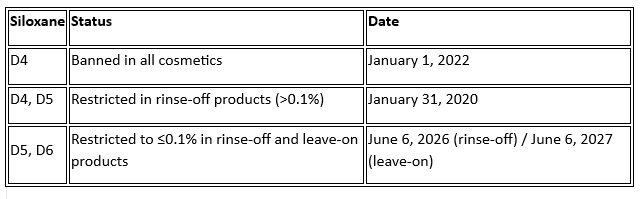
Commission Regulation (EU) 2024/1328 of May 16, 2024 is projected to 90% emission cut. For formulators, this effectively eliminates cyclopentasiloxane (D5) as a practical formulation tool in the EU from 2026 onward.
Consumer perception and clean beauty positioning
Beyond regulation, clean beauty brands face consumer pressure independently of legal requirements. Ingredient transparency tools, citizen science platforms, and retailer "no list" policies have made silicone content a common point of consumer scrutiny. The challenge for formulators is that consumer perception does not always track scientific consensus: dimethicone, a linear silicone and one of the most studied cosmetic ingredients, has a strong safety record and contested aquatic toxicity. Nevertheless, clean beauty positioning in many markets treats all silicones as undesirable — regulatory or not.
The main silicone alternative chemistries
1. Plant-derived esters
Synthetic esters derived from vegetable fatty acids and fatty alcohols are the most scientifically developed class of silicone alternatives. Effective bio-based replacement requires understanding the molecular emollience origin: the key parameters are spreading coefficient, evaporation rate, viscosity, and surface tension — all tunable by varying chain length and branching.
A 2024 study in Chemical Engineering Journal tested six biosynthesized esters — heptyl heptanoate, heptyl octanoate, heptyl decanoate, decyl heptanoate, decyl octanoate, and decyl decanoate — as substitutes for cyclopentasiloxane. The compounds were produced by lipase-catalyzed solvent-free synthesis and characterized for pH, viscosity, surface tension, spreadability, decomposition temperature, and cytotoxicity before incorporation into a cosmetic formulation. All six showed promise as silicone alternatives, effectively matching several key properties of D5.
A parallel study in Industrial & Engineering Chemistry Research (2024, open access) benchmarked esters vs silicones — three commercial cyclopentasiloxane, dimethicone 5, and dimethicone 10 cst — in terms of rheology, texture, spreadability, contact angle, and physicochemical properties, confirming that medium-chain esters are viable functional replacements for low-viscosity silicones.
According to a PMC review, medium-chain esters are a proven solution for silicone replacement, matching their sensorial properties. Branched-chain structures — trimethylolpropane tricaprate, neopentyl glycol diheptanoate, cetyl ethylhexanoate — provide good fluidity-to-molecular-weight balance and are established in formulation practice.
Key trade-off: esters are biodegradable and bio-sourced, but they do not evaporate after application the way D5 does. Matching the volatile carrier function of cyclopentasiloxane requires either alkane-based alternatives or blended systems.
2. Bio-based alkanes
Short-chain alkanes — undecane, tridecane, isohexadecane — are the main alternatives for replacing volatile silicone carrier functions. A plant-based undecane/tridecane blend was evaluated in an alkane replacement study in a tinted day care fluid; it matched the original D5 formulation for mechanical smear resistance, rain resistance, gloss kinetics, blemish coverage, and color homogeneity.
Synergistic mixtures of alkanes and esters demonstrate improved sensory performance beyond what either class achieves alone. Clean beauty reformulations that target both the volatile and non-volatile silicone functions in a single product typically require a blended approach: an alkane for dry-down aesthetics and an ester for residual emolliency.
3. Natural oils and oil derivatives
Plant oils — jojoba, squalane (from sugarcane), moringa, olive — and their hydrogenated or fractionated derivatives are the most consumer-recognizable silicone alternatives. They are readily COSMOS- or NATRUE-certifiable and carry strong clean beauty credentials.
A 2024 study on an olive-derived ester published in Personal Care Magazine showed a similar sensory profile to cyclopentasiloxane in consumer assessment, improving manageability, ease of wet and dry combing, and shine on UV-damaged hair.
The main limitations of natural oils relative to silicones are higher oxidative instability (particularly for polyunsaturated oils), potentially heavier skin feel at equivalent use concentrations, and higher batch-to-batch variability requiring standardization.
4. Plant-based homopolymers and biopolymers
A 2025 clinical study published in PMC evaluated plant-based homopolymers as emollients in topical emulsions, comparing their physicochemical, sensory, biophysical, and neurosensory properties against traditional emollients in a participant cohort (UNIFESP, Research Ethics Committee No. 0086/2023). The study confirmed performance equivalence in skin hydration and sensory attributes, providing clinical-level evidence that bio-based emollient systems can match silicone-containing formulations.
Application-specific reformulation considerations
Skin care (leave-on)
Leave-on skin care — moisturizers, serums, primers, SPF — is where the D5/D6 restriction has the broadest practical impact, since these are the products where cyclic siloxanes have historically been used at highest concentrations. The key sensory targets to replicate are: dry skin feel, non-tackiness, and film continuity without occlusion.
Medium-chain esters (C8–C12) combined with squalane or undecane provide a close sensory match in most emulsion systems. Silicone elastomers — which create the powdery, blurring effect in primers — are harder to replace; biopolymer particles and silica-based alternatives are the current options, each with performance trade-offs.
Hair care (rinse-off and leave-on)
Hair care is the largest volume application for silicones in cosmetics. Dimethicone and cyclopentasiloxane are used in conditioners, serums, and smoothing treatments for detangling, shine, and heat protection. Plant-based emollients have shown competitive hair performance against dimethicone 5 cst, with less greasiness and tackiness on the hair fiber. The D5 in fish bioconcentration data is the specific reason rinse-off restrictions preceded leave-on restrictions in the EU timeline: aquatic release via drainage is the primary exposure pathway for hair care products.
Color cosmetics
Studies indicate that 50% of foundations contained at least one cyclosiloxane before the current wave of restrictions. In foundations, volatile silicone provides the transfer-resistant, breathable film that is difficult to replicate with conventional emollients. Alkane blends have demonstrated equivalent performance in transfer and rain resistance. In mascara and eyeliner, trimethylsiloxysilicate film formers present a harder replacement challenge — polyacrylate and natural film-forming polymers are the main alternatives under active development.
Formulation challenges: what silicone alternatives cannot yet match
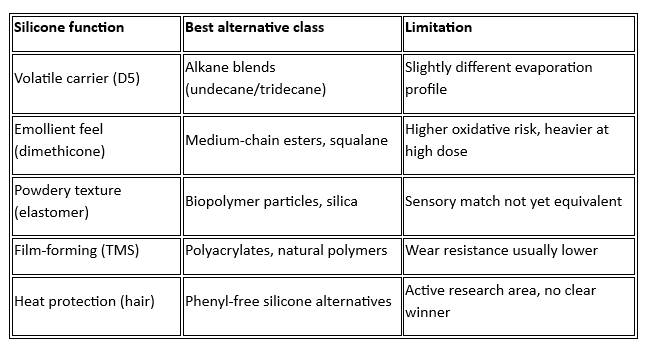
The scientific literature is unambiguous that replication challenges. The 2024 ester studies show meaningful progress, but formulators should expect sensory trade-offs in at least one performance dimension for most replacement exercises. Comprehensive sensory panel evaluation is required before any silicone-free claim is made.
Frequently asked questions
Are all silicones being banned in the EU?
No. The EU restrictions apply specifically to cyclic volatile methyl siloxanes D4, D5, and D6. Linear silicones like dimethicone are not currently restricted under REACH, though D4 is also banned under Annex II of the EU Cosmetics Regulation due to suspected reproductive toxicity. Non-volatile silicones (dimethicone, phenyl trimethicone) remain usable in most markets, including the EU.
What is the difference between dimethicone and cyclopentasiloxane?
Dimethicone is a linear polydimethylsiloxane (PDMS) used as a non-volatile emollient and conditioning agent. Cyclopentasiloxane (D5) is a cyclic volatile siloxane that evaporates after application, providing a dry-touch skin feel and acting as a carrier solvent for other ingredients. They serve different functional roles and require different replacement strategies.
Can plant-derived esters fully replace silicones in all formulations?
Not in all cases. Studies on biosynthesized esters show they match several silicone properties but not universally across all dimensions. Esters replicate emolliency and spreadability effectively; they do not replicate the volatile carrier function or silicone elastomer texture. Multi-function silicones typically require multi-ingredient replacement systems.
What does "silicone-free" mean on a cosmetic label?
There is no harmonized EU or FDA definition for "silicone-free" on cosmetic labels. In practice, it typically means the formulation contains no INCI-named silicone ingredients (dimethicone, cyclopentasiloxane, phenyl trimethicone, dimethicone copolyol, etc.). Since D4 is already prohibited and D5/D6 will be at 0.1% maximum from 2026, most EU cosmetics will effectively be at the threshold regardless of their marketing position.
Is silicone harmful to skin?
No significant evidence supports skin harm from cosmetic-grade silicones at use concentrations. Dimethicone is well-tolerated dermally and its film-forming properties are considered protective. The primary driver for silicone-free reformulation is environmental, not dermatological.
Safic-Alcan's cosmetics ingredients portfolio
Safic-Alcan distributes bio-based emollients, plant-derived esters, squalane, natural oils, and sustainable texture agents for clean beauty reformulation across skin care, hair care, and color cosmetics.
Explore our cosmetics catalog for silicone-free emollient and texture solutions, or contact our formulation team to discuss reformulation strategy for D5/D6-impacted products. See also our article on controversial ingredients for broader context on EU cosmetics regulatory developments.