


Key takeaway: A material's abrasion resistance figure — expressed as volume loss under ISO 4649 / DIN 53516 — tells you how fast a component will wear down, but only under controlled conditions. Understanding what the data actually measures, and how base chemistry drives wear performance in real environments, is what separates a well-specified component from one that fails ahead of schedule.
When an industrial component fails because of wear, the cost is rarely the replacement part alone. It is the unplanned downtime, the maintenance labour, and the disruption to production schedules. For engineers and procurement teams specifying elastomeric components — rollers, conveyor linings, seals, screen panels, wear protection layers — abrasion resistance is not a secondary specification detail. It is the variable that determines how often the failure cycle repeats.
Cast polyurethane elastomers are now the material of choice across a growing range of wear-intensive industrial applications. But choosing the right prepolymer system requires more than selecting the product with the best-looking number on a datasheet. It requires understanding what abrasion test data actually measures, which base chemistry drives performance under which conditions, and how to match material selection to the specific failure mode you are trying to prevent.
This article covers that decision framework. For a full comparison of cast PU prepolymer systems — including hardness selector, REACH compliance checklist and application-by-application recommendations — see our guide to selecting high-performance elastomers for demanding environments. The base chemistry decision behind each system is covered separately, in our comparison of polyether and polyester base chemistry.
How abrasion resistance is measured
The standard method for quantifying abrasion resistance in rubber and elastomers is the rotary drum abrasion test, defined today under ISO 4649 — which superseded the widely-referenced DIN 53516 standard. Both methods work on the same principle: a cylindrical specimen (16 mm diameter) is pressed against a rotating drum covered with standardised abrasive paper under a 10 N load, and traverses a total path of 40 metres. The result is expressed as volume loss in cubic millimeters. The lower the number, the better the wear resistance.
This method provides reliable comparative data for material selection and quality control. However, it does not directly predict field service life — because real components face combinations of stress (temperature, chemical exposure, dynamic load, impact) that laboratory testing does not fully replicate. A material that performs well in an ISO 4649 test will not necessarily outperform another in every application. Context matters.
A secondary metric worth understanding alongside volume loss is rebound resilience — the ratio of energy returned during elastic recovery to energy absorbed during deformation. High resilience values (60–80%) indicate low hysteresis and minimal heat build-up under dynamic cycling — critical for high-speed rollers, where heat accumulation is itself a failure mechanism. A material with excellent ISO 4649 results but poor resilience may still overheat and degrade rapidly under dynamic load.
Why cast polyurethane outperforms rubber in abrasion-intensive applications
The performance advantage of cast polyurethane elastomers over conventional rubber compounds in abrasive environments is well documented. Independent testing consistently shows polyurethane elastomers resisting abrasive wear 3 to 10 times better than conventional rubber compounds. In conveyor skirting applications within mining operations, service lives of 10 to 15 times those of rubber equivalents have been recorded.
The reason lies in the chemistry. Unlike rubber, where compounding adjustments offer limited performance range, cast polyurethane can be engineered at the molecular level — by selecting the polyol base, the isocyanate, and the curative — to optimise specifically for the dominant failure mode. The result is a material that can be hard where hardness is needed, resilient where resilience matters, and chemically stable where chemical exposure is the threat.
Polyurethane rollers, for example, on average last up to four times longer than rubber equivalents in continuous operation — sometimes exceeding 4,000 hours before requiring replacement. For procurement teams calculating total cost of ownership, the higher unit cost of a cast PU component is routinely offset by fewer replacements and reduced maintenance intervals.
Base chemistry and abrasion: the polyester vs polyether distinction
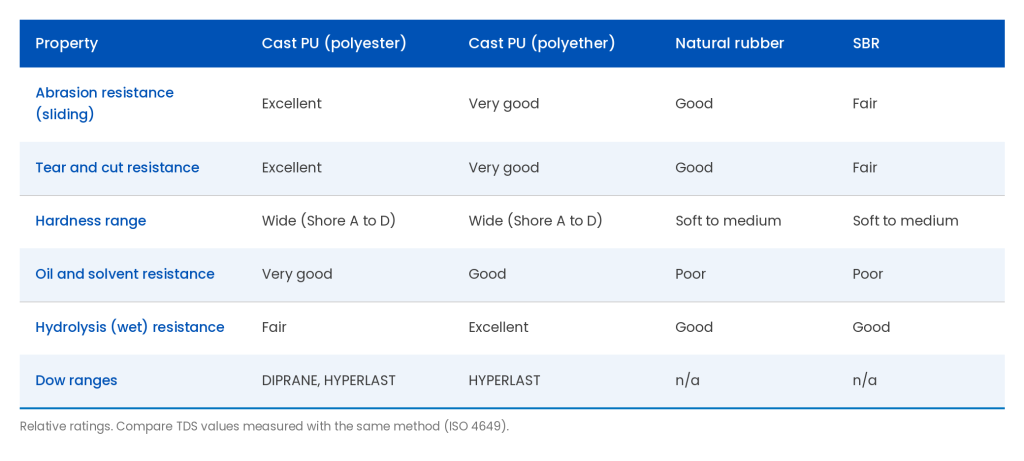
Polyester-based systems — and those built on polycaprolactone, a closely related chemistry — consistently deliver the highest scores in abrasion resistance tests under dry or controlled conditions. In three-body abrasion testing, polyester-based polyurethane approaches the wear resistance of D2 tool steel while weighing a fraction as much. Combined with superior cut and tear resistance, these systems are the preferred specification for the most abrasion-intensive industrial applications: mining equipment, wheels, conveyor rollers, screening panels, and scrapers operating in dry environments.
The DIPRANE™ prepolymer range by Dow is built on this chemistry. DIPRANE™ systems produce tough, durable elastomers with excellent resistance to wear and tear, cuts, flex fatigue and organic chemicals. They cover a wide hardness range — from soft Shore A grades suitable for impact absorption to hard Shore D grades for maximum load-bearing — and can be formulated to achieve excellent solvent resistance where chemical exposure is also a concern.
Polyether-based systems
Polyether-based systems trade some dry abrasion performance for a set of properties that matter enormously in wet, cold or dynamically demanding environments: outstanding hydrolysis resistance, excellent low-temperature flexibility, and strong dynamic resilience. In applications combining abrasion with sustained moisture exposure — pipe and pump linings, offshore components, subsea wear protection, hydrocyclones — polyether formulations typically outperform polyester grades whose hydrolytic stability limits their service life in wet conditions.
The HYPERLAST™ prepolymer range by Dow is built predominantly on polyether polyols combined with TDI. HYPERLAST systems produce elastomers with strong dynamic performance, resilience, hydrolysis resistance and performance at low temperatures — making them the preferred specification for high-speed, high-load-bearing applications in cold or wet environments.
What the data does not tell you: translating lab results to field conditions
The ISO 4649 test is a standardised controlled environment — a single abrasive surface, a fixed load, a fixed distance. Real industrial components operate under more complex conditions simultaneously. Three practical points follow from this:
- Hardness interacts with abrasion resistance in application-specific ways. Harder formulations generally score better on ISO 4649 under low-impact, sliding contact conditions. But in impact-abrasion environments — where particles strike the surface at speed before sliding — softer, more resilient grades can outperform harder ones by absorbing impact energy rather than allowing it to initiate surface crack propagation. Shore 90A polyether polyurethane, for example, achieves 70-80 KN/m tear strength — significantly above natural rubber — which matters when particles are both impacting and sliding.
- Dynamic loading changes the picture. Low compression set, combined with high resilience, is what allows a component to maintain its geometry under sustained cyclic load — which directly affects its abrasion behaviour over time.
- Chemical exposure can accelerate wear independently. A polyester-based system that performs excellently in a dry abrasion test may degrade significantly faster than a polyether equivalent when the operating environment also involves sustained moisture or mild chemical exposure — not because its abrasion resistance is lower, but because hydrolytic degradation of the polymer matrix softens the material surface and increases actual wear rate in service.
Matching the right system to the application: a practical matrix
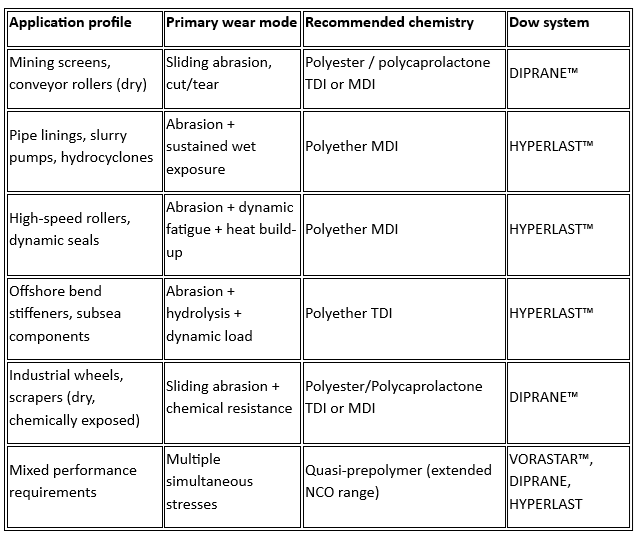
This matrix covers the most common industrial scenarios, but the optimal selection always depends on the specific combination of hardness range required, processing conditions available (pot life, casting temperature, cure cycle), and regulatory obligations. Refer to the downloadable selection guide for a structured decision matrix, or contact the Safic-Alcan polyurethane team for direct formulation guidance. For the procurement and TCO case behind material selection, see tour TCO & Material ROI article. For sourcing and supply chain considerations in Europe, see the EU Sourcing & Distribution article.
A note on regulatory compliance in wear-resistant PU formulations
European formulators working with cast polyurethane must now navigate the EU restriction on MbOCA (4,4'-methylene-bis(2-chloroaniline)) under REACH Regulation (EC) No 1907/2006. MbOCA was a widely used aromatic amine curative in cast PU systems and its classification as a substance of very high concern (SVHC) creates both regulatory and supply chain risk for processors who have not yet transitioned.
The HYPERLAST™ 153 series was developed specifically to address this transition — enabling processors to achieve tough, durable elastomers across a wide hardness range (55 Shore A to 75 Shore D) using REACH-compliant curative chemistry, without MbOCA. The full compliance and transition framework is covered in the dedicated MbOCA/REACH Compliance article.
Not sure which abrasion data actually applies to your part?
Get in touch with our PU experts today!
Tear resistance: the second half of wear performance
Abrasion is only half of wear. In screens, scrapers, rollers and chute liners, parts also fail by cutting and tearing when sharp material hits the surface. Cast polyurethane combines low abrasion loss with high tear strength, which is why it outlasts rubber in these applications.
Polyester-based systems usually give the best cut and tear resistance; polyether-based systems are preferred when the part works wet or needs high resilience.
Frequently asked questions
How is abrasion resistance measured in elastomers?
Abrasion resistance in elastomers is measured using the ISO 4649 rotary drum test (which superseded DIN 53516). A cylindrical specimen is pressed against a rotating abrasive drum under a 10 N load for a distance of 40 metres. The result is reported as volume loss in cubic millimetres — lower values indicate better wear resistance. The method provides reliable comparative data between materials but does not directly predict field service life.
Is polyurethane more abrasion resistant than rubber?
Yes, in most industrial wear conditions. Independent testing consistently shows cast polyurethane elastomers resisting abrasive wear 3 to 10 times better than conventional rubber compounds. This advantage comes from the molecular-level engineering possible with polyurethane chemistry — polyol selection, isocyanate choice, and curative type all directly influence the abrasion performance of the final elastomer.
Which polyurethane chemistry has the best abrasion resistance: polyester or polyether?
For dry or controlled environments with sliding abrasion as the primary failure mode, polyester and polycaprolactone-based systems (such as DIPRANE™ by Dow) deliver the highest abrasion resistance. For wet, cold or dynamically demanding environments where hydrolysis resistance and resilience also matter, polyether-based systems (such as HYPERLAST™ by Dow) offer a better balance of wear performance and environmental stability.
What is the difference between DIN 53516 and ISO 4649?
ISO 4649 is the current international standard for abrasion resistance testing of rubber and elastomers, having replaced the withdrawn DIN 53516. The test methods are closely similar — both use a rotating drum with standardised abrasive paper and express results as volume loss — but ISO 4649 provides more specific protocols, including options for rotating and non-rotating test piece configurations.
How does hardness affect abrasion resistance in cast polyurethane?
The relationship between hardness and abrasion resistance in cast PU is application-dependent. Higher hardness generally improves performance under sliding contact abrasion. In impact-abrasion environments, softer and more resilient grades can outperform harder formulations by absorbing impact energy rather than allowing surface crack propagation. Selection should be based on the dominant failure mode — sliding wear, impact, or both.
Where can I source HYPERLAST™ and DIPRANE™ prepolymers in Europe?
Safic-Alcan is the authorised European distributor of Dow Polyurethanes, covering the HYPERLAST™, DIPRANE™, VORASTAR™ and DURAMOULD™ ranges across France, the UK, Benelux, the Nordics, DACH (Germany, Austria, Switzerland), Spain, Portugal and most CEE countries. Contact the local Safic-Alcan team for technical data sheets, sample requests and formulation guidance.
Is polyurethane more tear resistant than rubber?
Yes. Cast polyurethane typically combines higher tear strength with lower abrasion loss than natural rubber or SBR, which extends part life in cutting and impact wear.
Which Dow prepolymer should I use for abrasion-resistant parts?
DIPRANE polyester prepolymers for dry, high cut and tear wear; HYPERLAST polyether grades for wet or dynamic applications. Our team can match grade and hardness to your part.
Sources
DIN 53516 / ISO 4649 abrasion test methodology (Kremer-Tec) ·
Polyurethane material testing and validation (Pepson PU) ·
Polyurethane industrial applications — performance data (Pepson PU) ·
Dow Hyperlast DIPRANE™ and HYPERLAST™ product line announcement (WebWire) · HYPERLAST™ and DIPRANE™ mining and quarrying applications (Dow) ·