


Antifoam agents in fermentation are selected on knockdown speed and dose economy. Their effect on the culture itself is rarely tested, and it is the variable most likely to explain a titre you cannot account for. This is largely because antifoams are used first to protect production-scale equipment, the bioreactor, from the consequences of uncontrolled foam, rather than to safeguard the batch yield after fermentation.
Your foam was under control. Agitation held. Nothing tripped an alarm. But the batch’s yield was significantly lower compared to the last one, the deviation investigation found no assignable cause, and the batch record contains no line describing the one material that was added specifically to change the behaviour of the gas-liquid interface your organism lives at.
Antifoam agents in fermentation occupy a strange position. As we set out in our overview of biopharma solutions from gene to final dosage form, foam control is a recognised critical requirement in upstream processing, yet the additive that delivers it is rarely characterised. They are indispensable, they are added in small quantities, and they are the least characterised input in most processes. Foam control itself is a solved engineering problem. What the antifoam does to the culture, to oxygen transfer and to everything downstream of the vessel is not.
What antifoam agents in fermentation actually do in the vessel
Antifoam agents in fermentation do not dissolve foam. They destabilise the thin liquid films that hold bubbles apart. The dominant mechanisms are bridging-dewetting, where an oil droplet enters both surfaces of the film and forms a lens that ruptures it, and bridging-stretching, where the droplet forms a bridge that stretches until the film fails. Both depend on the antifoam remaining as a dispersed, partly insoluble phase in the medium, which is why solubility is designed to be low and why the active never simply disappears into the culture media.
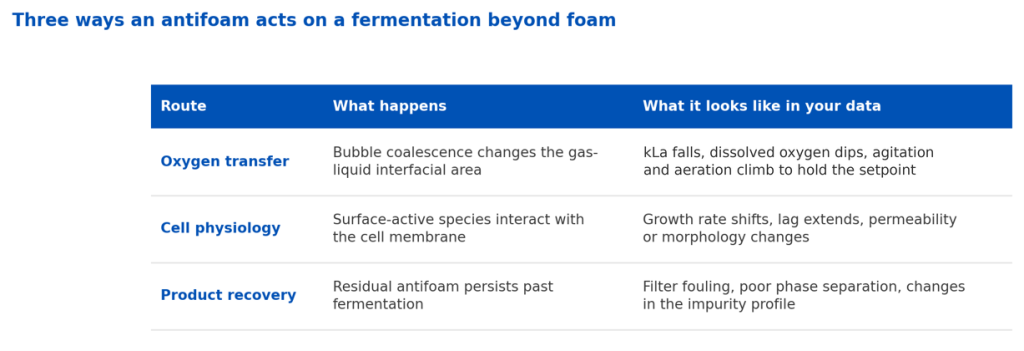
That same property is the reason an antifoam is never inert. A material engineered to sit at the gas-liquid interface and alter its behaviour will also alter the interface across which your organism takes up oxygen, and in many cases will interact with the cell membrane itself.
Does antifoam inhibit microbial growth?
It can, and it can also do the opposite. The published evidence does not support a single direction of effect.
The most cited review of this question is Sarah Routledge's *Beyond de-foaming: the effects of antifoams on bioprocess productivity*, published in Computational and Structural Biotechnology Journal in 2012. It documents that certain antifoams affect the growth rates of both prokaryotic and eukaryotic organisms, and that they can change surface properties such as lipid content, which in turn alters membrane permeability. In some systems this is unambiguously useful: the review records increased secretion of alpha-amylase and of GFP, and greater protein yields arising from increased biomass.
The same review notes how little is usually known at the point of selection. Antifoams are frequently added to bioprocesses with little knowledge of their impact on the cells or on the product, and their composition is often not disclosed in detail.
Beth Junker's 2007 review in Biotechnology Progress, *Foam and its mitigation in fermentation systems*, reached a similar conclusion from the process side. Junker catalogued antifoams by chemical class precisely because so few studies compare them directly under controlled conditions, and found that the comparisons which do exist only partially identify clear advantages for any one type.
The practical consequence is straightforward. Compatibility is not a fixed property of an antifoam. It is a property of a specific antifoam, at a specific dose, with a specific organism, in a specific medium. A supplier study showing no significant growth inhibition across a panel of tested strains is a genuine and useful input. It is not a statement about your strain.
How antifoam agents in fermentation affect oxygen transfer
This is the best quantified of the three routes, and the one most likely to be mistaken for something else.
By promoting bubble coalescence, an antifoam reduces the interfacial area available for mass transfer, which lowers the volumetric oxygen mass transfer coefficient, kLa. Routledge describes this mechanism directly for simethicone in cell culture medium.
The magnitude can be substantial. Work by McAndrew and Kauffman, reported in American Pharmaceutical Review and summarised in BioProcess International, evaluated simethicone concentrations from 1 ppm to 100 ppm in a drilled-hole sparger bioreactor and observed reductions in kLa of up to 50% at concentrations beyond 30 ppm. The reduction followed an exponential decay that plateaued above that threshold.
In contrast, no effects from the antifoam treatment were observed within a microsparger bioreactor system. Overall, the results suggest that use of a microsparger may support consistent oxygen mass transfer within high-foaming upstream bioprocesses where antifoam supplementation is required. So the objective is to balance out 3 characteristics between the antifoam, the kLa and the bioreactor setup.
Two things follow. First, the dose-response is not linear, so there is usually a concentration beyond which you are paying an oxygen transfer penalty for very little additional foam control. Second, if oxygen transfer falls and the control loop responds by raising agitation and aeration to hold the dissolved oxygen setpoint, the process appears stable while shear and stripping increase. The cost surfaces later, as titre or product quality, and by then the antifoam is several steps upstream of where anyone is looking.
Earlier work on stirred fermenters by Morão and colleagues found that polypropylene glycol, silicone and soybean oil antifoams all markedly decreased kLa at low concentrations, and that for silicone and soybean oil, though not for PPG in the range studied, there was a concentration above which further addition began to improve kLa again. The behaviour is chemistry-dependent, which is another reason a result obtained with one product does not transfer to another.
How do you test antifoam compatibility with your production strain?
The evaluation that matters is not complicated. It is simply rarely done before a grade is locked into a process. Three questions decide whether antifoam agents in fermentation are working for you or quietly against you: what happens to growth, what happens to oxygen, and what happens after the vessel.
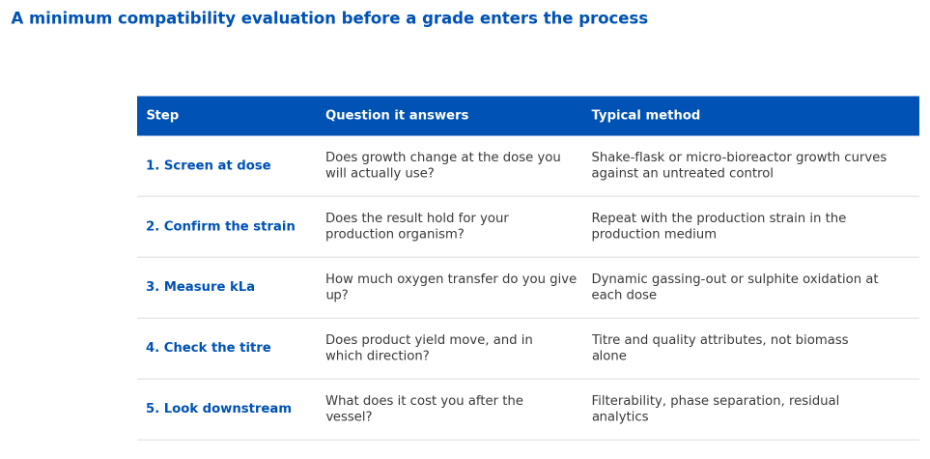
Three details decide whether the exercise is worth anything.
Test at the dose you will use. Compatibility screened at 10 ppm tells you very little about behaviour at 200 ppm, and the kLa data above shows why: the effect curve is non-linear and the interesting behaviour often sits at the top of the range.
Test in your medium. Complex media, high solids and high protein change both the foaming behaviour and the way the antifoam partitions. A result in defined medium does not transfer.
Measure the product, not only the biomass. The literature contains examples where growth rate and product titre move in opposite directions, one antifoam decreasing growth rate while increasing enzyme titre. If you screen on optical density alone, you will sometimes reject the better option.
What dosage is safe in a live culture?
There is no universal figure, and any supplier who offers one without qualification is describing their product rather than your process. What the evidence supports is a method:
- Establish the minimum effective dose for foam control under your real aeration and agitation conditions, not in a shake flask
- Test out different nature of agitators since this can impact oxygen transfer and foam formation across the bioreactor
- Characterise the kLa penalty across that range so the oxygen cost is known rather than absorbed
- Fix a maximum and write it into the batch record, including any top-up additions during the run, since cumulative dose over a long fed-batch is easy to lose track of
- Treat mode of addition as part of the specification, because continuous low-level dosing and bolus addition on a foam probe trigger are not the same exposure for the culture
Sterilisation, dispersion and the practical constraints
Two process realities narrow the shortlist of antifoam agents in fermentation before biology is considered.
The first is sterilisation. An antifoam added before in-situ sterilisation has to survive it with its performance intact. Emulsions can be destabilised by heat; concentrates generally behave more predictably. Momentive positions SAG 471 as maintaining stability during sterilisation with practically no loss in foam control, and Esca Ferm-S as stable to sterilisation without compromising performance, which is why both appear in sterilised fermentation processes.
The second is what the antifoam leaves behind on the equipment. Our earlier article on bio-fermentation and foam control covers the broader process context. Deposits on dosing lines and vessel internals are a cleaning validation problem before they are a cost problem. Momentive describes SAG 471 as self-dispersing in water with virtually no deposits on dosing pipes and fermenter vessels, which is a specification worth checking for whichever grade you are considering.
The three grades most used in pharmaceutical fermentation
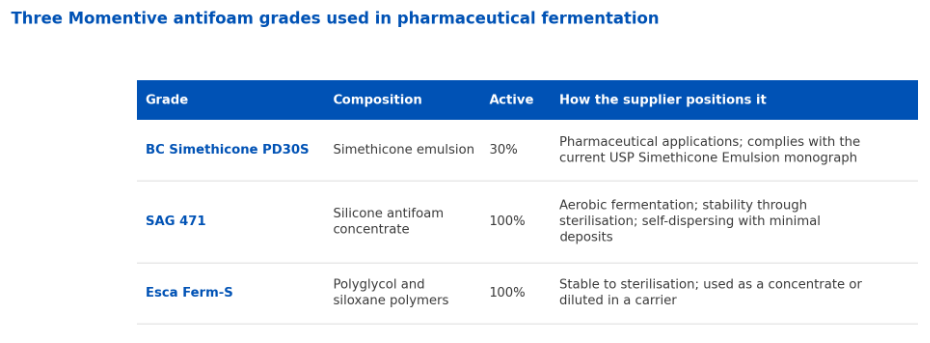
- **BC Simethicone PD30S** is a 30% active simethicone emulsion designed for suppression of foam in pharmaceutical applications. Its technical data sheet states that it complies with the current monograph for Simethicone Emulsion USP, and describes its use both as a process antifoam, including in biopharmaceutical applications such as cell culture, and as an excipient controlling foaming in pharmaceutical products. That dual role has documentation consequences, which we cover in the companion article below.
- **SAG 471** is a 100% active silicone antifoam concentrate for aerobic fermentation, positioned by Momentive for pharmaceutical applications such as vaccine production and antibiotic fermentations.
- **Esca Ferm-S** is a concentrate based on polyglycol and siloxane polymers, described as stable to sterilisation and usable either as a concentrate or diluted in a suitable carrier.
All performance and compatibility characteristics above are as stated by the manufacturer in current technical documentation. Confirm against the current technical data sheet and certificate of analysis for the grade and batch you intend to use.
Frequently asked questions
Does antifoam inhibit microbial growth?
It can, and in some documented cases it improves productivity instead. Published reviews record antifoams altering growth rates in both prokaryotes and eukaryotes, and changing membrane permeability, with effects that differ by antifoam chemistry, dose, organism and medium. The direction of effect has to be established experimentally for each combination. But ideally we want the antifoam to have neither negative or positive impact on microbial growth, since positive impact in microbial growth could lead to negative impact on microorganisms activity.
How is antifoam compatibility tested on a production strain?
By running growth curves with the production organism in the production medium, at the dose that will actually be used, against an untreated control, and then confirming that product titre and quality attributes move acceptably rather than looking at biomass alone.
How much does antifoam reduce oxygen transfer?
It depends on chemistry and concentration. One published study of simethicone in a drilled-hole sparger bioreactor observed kLa reductions of up to 50% above 30 ppm, following an exponential decay that plateaued beyond that point. The effect should be measured for your own system rather than assumed.
What dosage of antifoam is safe in a live culture?
There is no universal safe dose. Establish the minimum effective dose under real aeration conditions, characterise the oxygen transfer penalty across the range, set a documented maximum including top-ups, and treat the mode of addition as part of the specification.
Which antifoam agents in fermentation are used in pharmaceutical manufacture?
Grades positioned for pharmaceutical use include simethicone emulsions complying with the USP Simethicone Emulsion monograph, and silicone or polyglycol-siloxane concentrates selected for stability through sterilisation. The right choice depends on the sterilisation regime, the downstream train and the regulatory role the material plays in your process.
Talk it through with our technical team
Selecting antifoam agents in fermentation for a pharmaceutical process is a process decision, a biological decision and a documentation decision at the same time. Safic-Alcan distributes the Momentive antifoam range across Europe and supports customers through grade selection, sampling and the documentation required for qualification, backed by our global pharmaceutical applications laboratory in Étampes.
Request a technical consultation
Sources
- Routledge, S.J. (2012). Beyond de-foaming: the effects of antifoams on bioprocess productivity. Computational and Structural Biotechnology Journal, 3(4): e201210014. DOI: 10.5936/csbj.201210014
- Junker, B. (2007). Foam and its mitigation in fermentation systems. Biotechnology Progress, 23(4): 767-784. DOI: 10.1021/bp070032r
- McAndrew, J. and Kauffman, G. (2021). Characterizing the effects of Antifoam C emulsion on oxygen mass transfer within the BIOne drilled-hole sparger and microsparger single-use bioreactor systems. American Pharmaceutical Review, 6 April 2021. Summarised in *BioProcess International*.
- Morão, A., Maia, C., Fonseca, M., Vasconcelos, J.M.T. and Alves, S.S. (1999). Effect of antifoam addition on gas-liquid mass transfer in stirred fermenters. Bioprocess Engineering, 20: 165-172. DOI: 10.1007/s004490050576
- Routledge, S.J. and Bill, R.M. (2012). The effect of antifoam addition on protein production yields. In: Recombinant Protein Production in Yeast, Methods in Molecular Biology. Springer. DOI: 10.1007/978-1-61779-770-5_9
- Momentive Performance Materials. BC Simethicone PD30S Antifoam, Technical Data Sheet.
- Momentive Performance Materials. Fermentation antifoams product range.
- United States Pharmacopeia. Simethicone Emulsion monograph, USP-NF.