



Antifoam in a bioreactor has to survive sterilisation before it has to control foam. The cycle decides which grades remain on your shortlist, and it is usually the step nobody tests.
Sterilisation quietly removes most of your antifoam shortlist before performance is ever discussed.
In a stainless steel fermentation process, the vessel and medium are sterilised in situ, typically by injecting steam into a pressure jacket around the reactor, with batch sterilisation holding the medium at temperature before cooling to the operating condition. Only laboratory-scale bioreactors are small enough to fit an autoclave. The antifoam, if it is charged with the medium, goes through all of it.
That is not a trivial exposure for a surface-active material, and the way a grade responds to it has consequences for foam control, for cleaning validation and for your batch record.
What sterilisation does to an antifoam in a bioreactor
The form matters more than the chemistry.
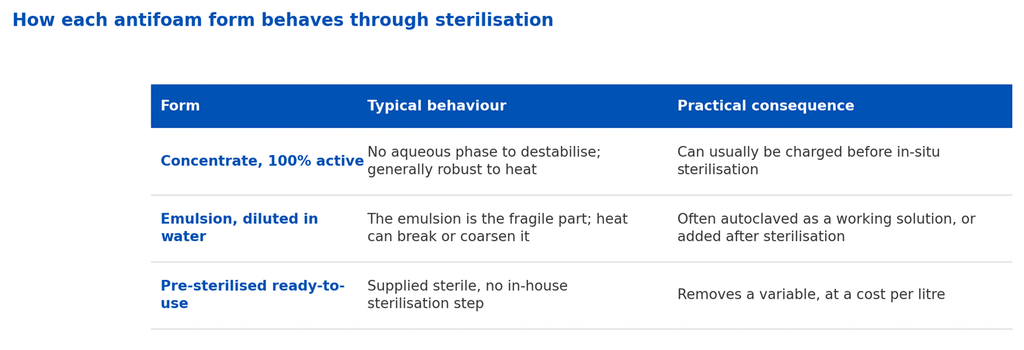
How each antifoam form behaves through sterilisation
A 100% active concentrate has no aqueous phase to destabilise. An emulsion does, and the emulsion system is the fragile part: heat can coarsen the droplet distribution or break the emulsion outright, which changes both the foam control performance and, as covered in our article on downstream processing and residue, the behaviour of the material at the membrane.
Published bioprocess work reflects this directly. In a micro-bioreactor study comparing five antifoams for monoclonal antibody production, working solutions of four antifoams were autoclaved to maintain sterility, while one, a simethicone emulsion, was used as a pre-sterilised ready-to-use solution. Both routes are legitimate. The point is that the decision was taken deliberately, grade by grade, rather than assumed.
Momentive positions two of the grades Safic-Alcan supplies on exactly this property. SAG 471 is described as maintaining stability during sterilisation with practically no loss in foam control, and Esca Ferm-S as stable to sterilisation without compromising performance. Those are supplier statements about named grades, and they are the right thing to ask for in writing.
Charge before sterilisation, or dose after?
This is the decision the sterilisation question actually forces, and it is rarely written down as a decision at all.
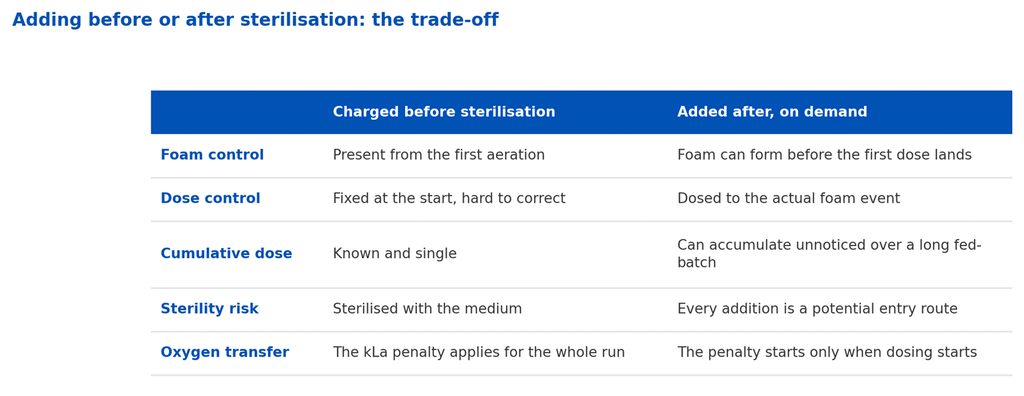
Adding before or after sterilisation: the trade-off
Charging before sterilisation gives you foam control from the first moment of aeration and a single, known dose. It also means the oxygen transfer penalty applies for the entire run, including the early hours when the culture is least able to afford it.
Dosing after sterilisation, on a foam probe trigger or on a schedule, matches the dose to the actual foam event. Where antifoam is administered this way it is traditionally given as bolus additions at defined dosage intervals. The trade-offs are a cumulative dose that is easy to lose track of across a long fed-batch, and an addition line that is a sterility consideration in its own right.
Neither is right in general. What matters is that the choice is explicit, that the cumulative dose is capped in the batch record, and that the mode of addition is treated as part of the specification rather than as an operator habit.
Where the antifoam is held and sterilised separately, note that the antifoam agent is itself sterilised in its storage vessel by steam in conventional fermentation plant design. That vessel and its transfer line are part of the sterile boundary.
The deposits problem, and why it is a cleaning question
An antifoam that separates or precipitates during or after sterilisation leaves material on surfaces: dosing pipes, probes, the vessel wall at the liquid line. That is a cleaning validation problem before it is a cost problem, because the hardest-to-clean location in the vessel is the one your recovery study has to address.
This is why dispersion behaviour belongs in the selection criteria. Momentive describes SAG 471 as self-dispersing in water with virtually no deposits on dosing pipes and fermenter vessels. Whatever grade you are evaluating, that is a property to confirm for the named grade rather than for the chemistry class.
What foam does if the antifoam fails
It is worth being explicit about what is at stake, because foam is often treated as a housekeeping nuisance.
Uncontrolled foam accumulation can result in decreased cell culture growth, decreased productivity, or complete loss of bioreactor system integrity. Headspace foaming left unchecked has the potential to foul the bioreactor exhaust filters used for off-gas venting and to keep internal pressure stable.
An antifoam that loses performance in the sterilisation cycle is therefore not a minor deviation. It is a loss of the control that protects the sterile boundary.
Verifying a grade for a sterilised process
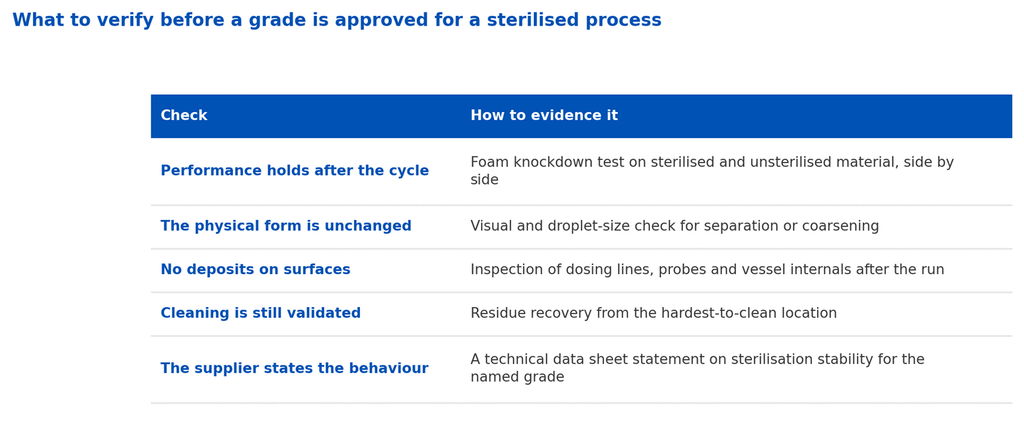
What to verify before a grade is approved for a sterilised process
The first test is the one most often skipped, and it is simple: take the same material, sterilise half of it under your actual cycle, and run the foam knockdown test on both. If the sterilised material performs measurably worse, you have found a problem in an afternoon rather than in a batch.
Frequently asked questions
Which antifoams survive SIP Sterilization-In-Place?
Behaviour depends on the form and the specific grade rather than the chemistry class. Concentrates with no aqueous phase are generally more robust to heat than emulsions, whose emulsion system can coarsen or break. Suppliers state sterilisation stability for named grades, and that statement is what should be held on file.
Should antifoam be charged before sterilisation or added after?
Both are used. Charging before gives foam control from first aeration and a single known dose, but the oxygen transfer penalty applies for the whole run. Dosing after matches the dose to the foam event but accumulates across a long fed-batch and adds an entry route to the sterile boundary. The choice should be explicit in the batch record.
Can sterilisation break an antifoam emulsion?
It can. The emulsion system is the heat-sensitive part. Options include autoclaving the working solution deliberately as a validated step, buying a pre-sterilised ready-to-use solution, or selecting a concentrate instead.
Does antifoam leave deposits in the fermenter?
Some do, on dosing lines, probes and vessel internals, which becomes a cleaning validation issue. Self-dispersion with minimal deposits is a property stated for some grades and worth confirming for the specific grade in use.
What happens if foam control fails during a run?
Published work records decreased culture growth, decreased productivity and, in the extreme, loss of bioreactor system integrity. Headspace foam can also foul the exhaust filters that maintain internal pressure.
Talk to our technical team
Safic-Alcan distributes the Momentive antifoam range across Europe, including grades positioned for sterilised pharmaceutical fermentation, and supports customers through grade selection, sampling and qualification documentation from our global pharmaceutical applications laboratory in Étampes.
Get a technical support
Sources
- Momentive Performance Materials. Fermentation antifoams product range.
- Sterilisation temperature in bioprocess engineering, ScienceDirect topic overview, on in-situ batch sterilisation and antifoam storage vessel sterilisation.
- Zhang, H. et al. Impact of media and antifoam selection on monoclonal antibody production and quality using a high throughput micro-bioreactor system. Biotechnology Progress.
- McAndrew, J. and Kauffman, G. (2021). Characterizing the effects of Antifoam C emulsion on oxygen mass transfer within the BIOne drilled-hole sparger and microsparger single-use bioreactor systems. American Pharmaceutical Review.