


Quick Answer: Monogastric gut health in pigs and poultry depends on a stable microbiota, intact intestinal barrier, and functional immune competence. The six main additive classes used to support this equilibrium are organic acids, probiotics, prebiotics, postbiotics, phytogenics, and exogenous enzymes. Each acts through a distinct mechanism — pH reduction, competitive exclusion, substrate fermentation, metabolite delivery, antimicrobial disruption, and anti-nutritional factor hydrolysis respectively. Selecting the right class, or combination of classes, requires matching the mode of action to the specific production challenge: weaning stress, necrotic enteritis risk, high-NSP diet composition, or post-antibiotic microbiome stabilization.
Why monogastric gut health requires a specific formulation approach
Monogastric species — pigs and poultry — share an anatomical and physiological challenge that ruminants do not face: a relatively short, fast-transiting gastrointestinal tract with limited endogenous enzyme capacity. Digesta moves quickly through the small intestine, leaving a narrow window for nutrient absorption. Any disruption to the mucosal epithelium, microbial balance, or digestive enzyme activity has measurable consequences on feed conversion and health outcomes.
A 2025 peer-reviewed review covering pigs and poultry across suckling, weaning, grower-finisher, broiler, and layer stages confirms that gut dysfunction — whether from infection, diet composition, or stress — suppresses immunity, reduces nutrient absorption, and elevates veterinary and husbandry costs. The same review documents that nutritional modulation through targeted additives can stabilize the microbiota, increase microbial diversity, reinforce the mucosal barrier, and raise short-chain fatty acid production.
Three critical stages define the risk window in monogastric production:
- Weaning in piglets (typically 21–28 days): abrupt diet change, loss of maternal antibodies, and social stress create a window of intestinal dysbiosis and post-weaning diarrhoea.
- Chick placement in broilers: the first week of life determines microbiome colonization patterns and influences lifetime immune development.
- Any high-NSP diet shift: changing cereal base (e.g., wheat to corn or rye) alters digesta viscosity and available substrates for fermentation, destabilizing established microbial communities.
Each of these stages has a distinct additive response profile, which is why class selection matters more than generic "gut health" supplementation.
Organic acids: the pH and pathogen control anchor
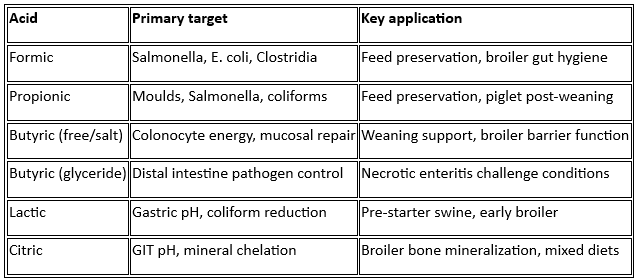
Organic acids are among the most widely used and mechanistically understood additive classes in monogastric nutrition. Their primary mode of action involves intracellular acidification of bacterial cells: undissociated acid molecules penetrate the bacterial cell membrane and dissociate inside, lowering intracellular pH and disrupting enzymatic function and DNA synthesis. This mechanism selectively targets Gram-negative pathogens — Salmonella, E. coli, Clostridia — over commensal Lactobacilli, which tolerate lower pH ranges.
The main acids used in feed are formic, propionic, butyric, lactic, citric, and their salt forms. Their activity spectra differ:
- Formic and propionic acids carry the broadest antibacterial range, covering Salmonella, coliforms, Clostridia, and fungi. A organic acids review confirms their consistent effects on reducing post-weaning diarrhoea and cecal coliform populations.
- Butyric acid is the primary energy source for colonocytes and stimulates the proliferation of intestinal epithelial cells. published research confirms butyric acid's role in reducing pathogenic bacteria, maintaining GIT pH, and modulating gut microbiota in poultry. Because free butyric acid is volatile and poorly tolerated organoleptically, it is commercially formulated as sodium butyrate, calcium butyrate, or glycerol esters that release acid further into the intestinal tract.
- Glycerol-esterified butyrate specifically addresses a delivery limitation of free acids: rapid absorption in the upper GIT limits their reach to the distal intestine where necrotic enteritis and dysbiosis most commonly occur. A 2025 broiler trial using butyric and valeric glycerides under subclinical necrotic enteritis challenge found improvements in performance and gut health gene expression compared to controls.
In practical formulation, organic acids are typically added at 0.5–3.0 kg/tonne depending on the target (mould control vs. Salmonella reduction vs. gut pH modulation). Blends outperform single acids for spectrum coverage. Safic-Alcan's organic acid range includes formate-based acidifiers validated for antimicrobial action against E. coli and Salmonella in French and European markets. The acidifier review in poultry and swine confirms synergistic activity between formate and propionate against cecal Salmonella populations.
Probiotics: live microorganisms for competitive exclusion
Probiotics are live microorganisms that, when administered in adequate amounts, confer a measurable health benefit to the host through modification of intestinal microbiota composition and local immune modulation. In monogastric production, the main genera in commercial use are Lactobacillus, Enterococcus, Bifidobacterium, and Bacillus.
Bacillus strains hold a practical advantage over other genera: their spore-forming capacity allows them to survive feed pelleting temperatures (70–90°C) that destroy vegetative cells. Bacillus amyloliquefaciens, B. subtilis, and B. licheniformis are the most frequently used species in broiler and swine feeds. Their mode of action combines competitive exclusion of pathogens, stimulation of endogenous enzyme secretion, and upregulation of IgA production at the mucosal surface.
Lactobacillus strains — L. acidophilus, L. reuteri, L. plantarum — are more commonly applied in liquid or wet feed formats or direct application to day-old chicks (competitive exclusion programmes), where the thermal stability constraint is less critical. In piglets, Enterococcus faecium is widely used around weaning, given its established role in lactic acid production and intestinal microbiota stabilization.
The 2025 synbiotics review confirms that probiotic supplementation across pigs and poultry reduces diarrhoea incidence, improves feed conversion, and decreases ammonia emissions — all through microbial community stabilization and short-chain fatty acid upregulation. Safic-Alcan's animal nutrition portfolio includes probiotic solutions for both species, evaluated against performance and regulatory compliance criteria across European and export markets.
A key formulation decision with probiotics is the strain-product match to the production challenge. A Bacillus-based product selected for heat-stable pelleted broiler feed performs differently to the same probiotic in liquid piglet supplementation. Product selection must specify: species, strain designation, CFU count at end of shelf life (not manufacture), and the clinical challenge it is validated against.
Prebiotics: substrate-driven microbiome selection
Prebiotics are non-digestible substrates selectively fermented by specific microbial populations, producing SCFAs and shifting microbiome composition toward commensal dominance. The main classes used in monogastric feeds are fructooligosaccharides (FOS), mannanoligosaccharides (MOS), galactooligosaccharides (GOS), and xylo-oligosaccharides (XOS).
MOS, derived from the outer cell wall of Saccharomyces cerevisiae, carry a secondary mechanism beyond fermentation: they bind type-1 fimbriae of Salmonella and E. coli, sterically blocking their attachment to intestinal epithelium. This dual action — microbiome modulation plus pathogen exclusion — makes MOS particularly relevant in broiler production where Salmonella control is a food safety priority.
FOS selectively stimulate Bifidobacterium and Lactobacillus populations, increasing SCFA output and reducing intestinal pH. The 2025 review confirms that inulin-type fructans and oligosaccharides fermented by commensal bacteria generate acetate, propionate, and butyrate — the same metabolite profile targeted by organic acid supplementation, but produced endogenously.
XOS, derived from xylan hydrolysis by xylanase treatment of agricultural by-products, represent an emerging prebiotic category with strong in vitro and growing in vivo evidence in poultry. Their use links prebiotic and enzyme strategies: adding xylanase to a wheat-based diet both releases nutrients and generates XOS oligomers that selectively feed beneficial fermenters.
Postbiotics: stability-first bioactivity
Postbiotics are the metabolic products of probiotic fermentation — short-chain fatty acids, bacteriocins, peptides, enzymes, and cell wall fragments — delivered independently of live microorganism viability. Their defining practical advantage is thermal and mechanical stability: they survive pelleting, acid environments, and extended storage without activity loss.
In the context of a high-temperature feed manufacturing process where probiotic viability is a concern, postbiotic products offer equivalent or complementary bioactivity without the CFU survival constraint. A Applied Sciences review confirms that postbiotics — particularly yeast-derived fractions and fermentation metabolites — modulate gut microbial populations, upregulate antioxidant enzymes, and improve weight gain and feed efficiency in both poultry and swine.
Yeast-derived postbiotics (beta-glucans, mannan-rich fractions, nucleotides, peptides from S. cerevisiae autolysis) are currently the dominant commercial category, valued in ruminant, poultry, and swine nutrition for immune system priming and gut barrier reinforcement. The distinction between a MOS prebiotic and a yeast cell wall postbiotic fraction is meaningful in formulation: the prebiotic delivers a substrate for fermentation; the postbiotic delivers the active molecules directly.
Phytogenics: multi-mechanism natural bioactives
Phytogenic feed additives (PFAs) are plant-derived compounds — essential oils, polyphenols, alkaloids, saponins, flavonoids — that simultaneously modulate gut microbiota, stimulate digestive secretions, reinforce the intestinal barrier, and reduce oxidative stress. Their multi-target action distinguishes them from single-mechanism additives and makes them particularly useful in complex or multifactorial gut health challenges.
The active molecules most studied in monogastric nutrition are carvacrol and thymol (from oregano and thyme), cinnamaldehyde (from cinnamon), eugenol (from clove), and capsaicin (from chilli). Their mechanisms include:
- Disruption of bacterial cell membranes, increasing permeability and causing leakage of intracellular contents.
- Stimulation of pancreatic enzyme secretion (amylase, lipase) and bile acid release, improving fat and protein digestibility.
- Upregulation of tight junction protein expression (claudin-1, occludin, ZO-1), reducing intestinal permeability.
- Modulation of pro-inflammatory cytokines (TNF-α, IL-6), reducing mucosal inflammation.
A phytogenics swine review confirms that PFAs reduce weaning diarrhoea, support microbiome recovery post-antibiotic treatment, and reinforce barrier integrity. A complementary Frontiers poultry review documents improved villus height and width, reduced crypt depth, and suppression of coliform populations in broilers supplemented with oregano-based essential oil blends.
The phytogenic efficacy review identifies encapsulation as the key technological lever for improving PFA bioavailability: microencapsulation protects volatile compounds through feed processing and enables controlled release at specific GIT sites. Synergies between carvacrol/thymol and carbohydrase enzymes have also been documented in broilers — the combination improved ileal villus architecture and reduced gut permeability beyond what either additive achieved alone.
Formulation note: phytogenic efficacy is dose and formulation-dependent. Inconsistent results in the literature largely reflect undisclosed product concentrations, different carrier systems, and mixed compositions. When sourcing PFAs, specifying active ingredient concentration (ppm carvacrol, ppm thymol) rather than product dose is essential for meaningful comparison.
Exogenous enzymes: unlocking diet-bound substrates
Monogastric animals do not produce the enzymes required to hydrolyze the major anti-nutritional factors in plant-based feed ingredients. Non-starch polysaccharides (NSPs) — arabinoxylans, beta-glucans, mannans — increase digesta viscosity, reduce nutrient transit efficiency, and alter fermentation substrates in the hindgut. Phytate sequesters phosphorus, calcium, and zinc, reducing their bioavailability and generating mineral loss in waste. Exogenous enzymes address both.
Carbohydrases
Xylanase is the dominant carbohydrase in volume terms, targeting arabinoxylans that comprise up to half of NSP content in corn and wheat-based diets. A xylanase swine review confirms reduced digesta viscosity, improved growth performance, and positive alterations in intestinal microbiota as consistent outcomes. The mechanism runs beyond nutrient release: NSP hydrolysis generates XOS oligomers that serve as prebiotic substrates, linking enzyme supplementation to microbiome effects.
Beta-glucanase targets beta-glucans in barley and oat-based diets; beta-mannanase addresses mannans in soybean meal and palm kernel meal. A carbohydrase phytase review confirms that carbohydrase supplementation improves intestinal health beyond the direct nutrient matrix — an effect increasingly attributed to reduced mucosal stress from viscous digesta and to the oligosaccharide substrates generated by hydrolysis.
A NSP enzyme study found improved nutrient digestibility across multiple diet types, particularly in finishing and breeding sow diets, where dietary fibre content is often elevated.
Phytase
Phytase releases inorganic phosphorus from phytate-phosphorus complexes, reducing the supplemental inorganic phosphate required in formulation. Its gut health relevance extends beyond phosphorus: phytate complexes also bind zinc, calcium, and protein. Releasing these nutrients reduces the anti-nutritional burden on the proximal intestine and improves overall digestive efficiency. The phytase-xylanase combination is one of the most consistently validated enzyme interactions in poultry nutrition, delivering additive and sometimes synergistic effects on performance and gut morphology.
Decision framework: matching class to challenge
No single additive class covers all monogastric gut health scenarios. The decision logic should start with the primary production challenge, then identify which mechanism addresses it most directly, then consider whether multi-class combinations are warranted.
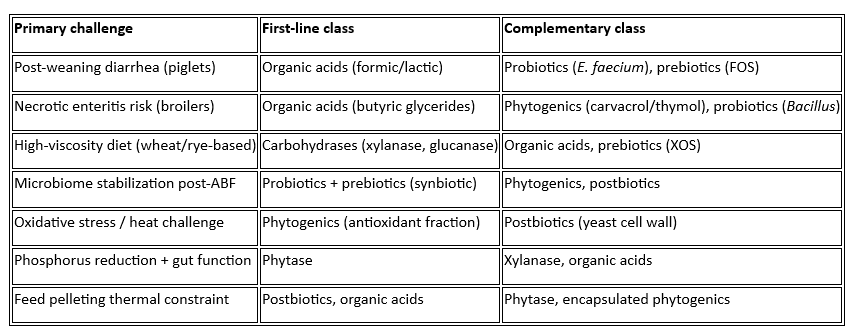
Two principles govern multi-class combinations. First, additive classes with different primary mechanisms rarely interact negatively and often act synergistically — organic acids and phytogenics address pH and membrane integrity from complementary angles; enzymes and prebiotics are directly linked through substrate generation. Second, the number of additives in a stack is not itself a quality signal: formulation discipline requires evidence of additive efficacy for each class at the dose and inclusion point used.
FAQ
What is the difference between probiotics, prebiotics, and postbiotics in monogastric feeds?
Probiotics are live microorganisms that modify gut microbiota composition when given in sufficient amounts. Prebiotics are non-digestible substrates that selectively stimulate specific beneficial bacteria. Postbiotics are the metabolic products of fermentation — SCFAs, peptides, bacteriocins — delivered without requiring live organisms. All three target the same output (stable, beneficial microbiota) through different mechanisms and with different stability profiles under feed processing.
Which feed additive class is most effective against post-weaning diarrhoea in piglets?
No class resolves post-weaning diarrhoea in isolation. Organic acids (formic, lactic, propionic) reduce gastric and intestinal pH and directly suppress E. coli and Salmonella, making them first-line inclusions. Enterococcus faecium-based probiotics stabilize the microbiome around weaning. Prebiotic FOS or MOS shift the fermentation environment toward commensal dominance. Multi-class combinations consistently outperform single additives in controlled trials.
How do phytogenic feed additives work in poultry gut health?
Phytogenics work through several parallel mechanisms: carvacrol and thymol disrupt bacterial cell membranes; cinnamaldehyde inhibits specific enzymatic pathways in pathogens; polyphenols reduce mucosal inflammation by downregulating pro-inflammatory cytokines; and essential oil components stimulate pancreatic enzyme and bile acid secretion. The net result is reduced pathogen load, improved villus morphology, lower crypt depth, and enhanced digestibility.
When should exogenous enzymes be prioritized in a gut health programme?
Enzymes are most relevant when the diet contains significant levels of NSP from cereal grains (wheat, rye, barley, sorghum) or soybean meal. Xylanase and glucanase reduce digesta viscosity, improve nutrient digestibility, and generate oligosaccharide substrates for beneficial fermenters. Phytase is relevant in virtually all plant-based monogastric diets. The enzyme-prebiotic interaction (NSP hydrolysis generating XOS) makes enzyme inclusion a logical foundation for a broader gut health additive stack.
What is the regulatory framework for feed additives in the EU?
Feed additives in the EU are regulated under Regulation (EC) No 1831/2003, which establishes authorization categories: technological additives, sensory additives, nutritional additives, zootechnical additives, and coccidiostats. Probiotics and other microbial additives fall under the zootechnical category. Each product must be authorized at species and dose level. Organic acids are authorized under the technological additive category for most species and production stages. Phytogenics may require authorization under the sensory additive category if flavor modification is the primary declared function.
Is encapsulation necessary for organic acids and phytogenics?
It depends on the target site. Free formic and propionic acids act primarily in the stomach and upper small intestine — no encapsulation is required for pathogen control in those compartments. Butyric acid needs protection to reach the lower intestine: sodium butyrate salts or glycerol esters deliver butyrate further than free acid. For phytogenics, encapsulation protects volatile compounds (carvacrol, thymol) through pelleting heat and enables release at the target GIT segment, improving consistency of results across production conditions.