


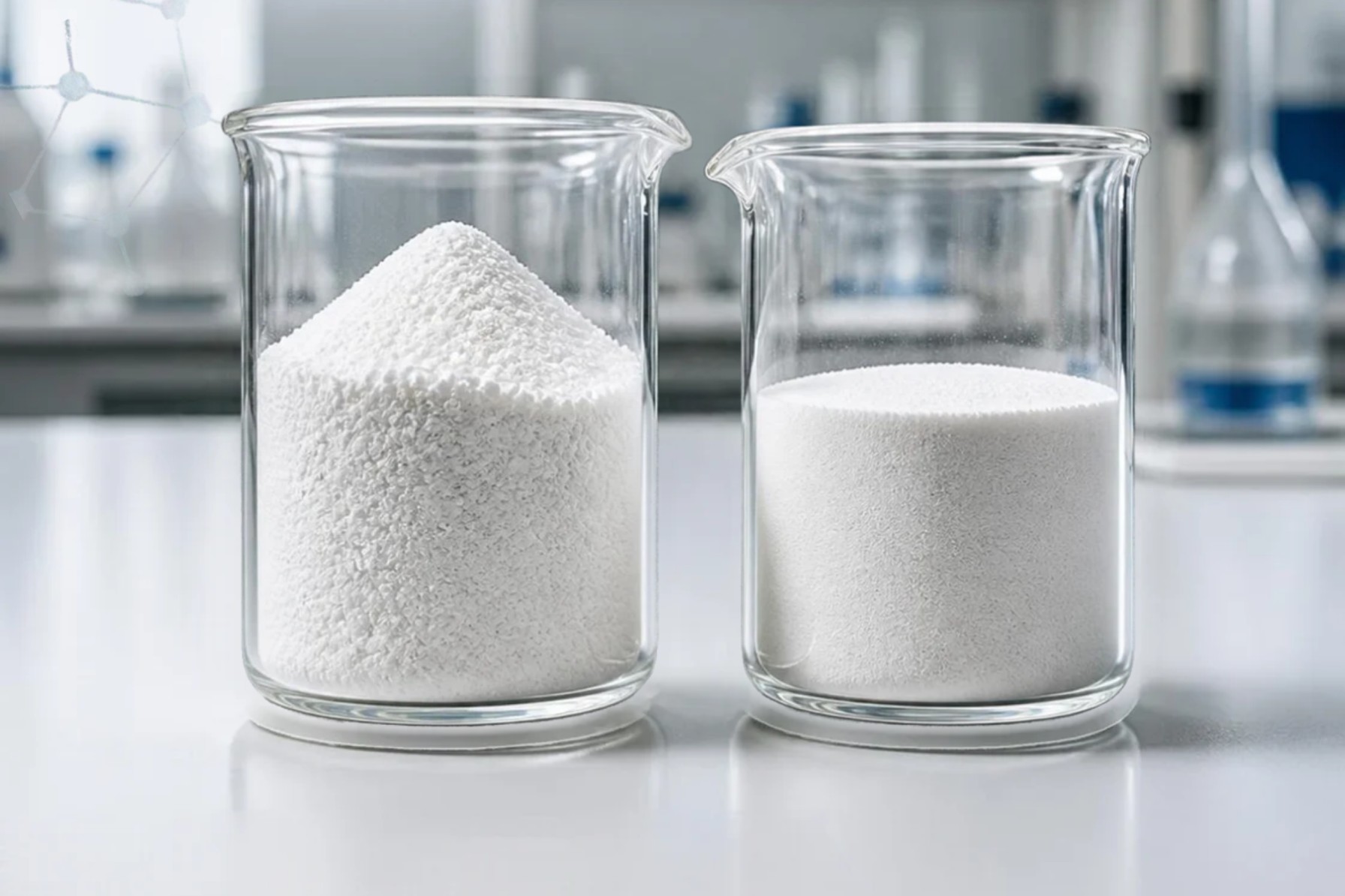
Both are amorphous synthetic silica. Both thicken, matt and stop things settling. And they are not interchangeable. The difference starts in how they are made, and it ends in what your formulation feels like and costs. This guide compares the two families property by property, and gives the questions that usually decide the choice.
Quick answer
- Fumed silica is made in a flame process and gives very fine, low-density particles with strong thickening at low dosage.
- Precipitated silica is made in a wet process and gives more porous, usually cheaper particles, well suited to matting, carrying liquids and free-flow.
- Choose fumed when you need rheology control and transparency; choose precipitated when you need matting, absorption or bulk at lower cost.
- Hydrophobic surface treatments exist in both families and often matter more than the family itself.
The difference in one paragraph
Fumed silica is produced by flame hydrolysis, which builds very small primary particles into open, branched aggregates. Precipitated silica is produced by precipitation from a silicate solution, which gives denser particles with a large internal pore volume. Both are amorphous silica, which is distinct from crystalline silica: the International Agency for Research on Cancer evaluated amorphous silica as not classifiable as to its carcinogenicity to humans, while crystalline silica in the form of quartz or cristobalite is classified as carcinogenic to humans when inhaled from occupational sources (IARC Monograph 68). That distinction is worth knowing when a customer asks about safety, and it does not remove the need for normal dust handling precautions.
Property by property
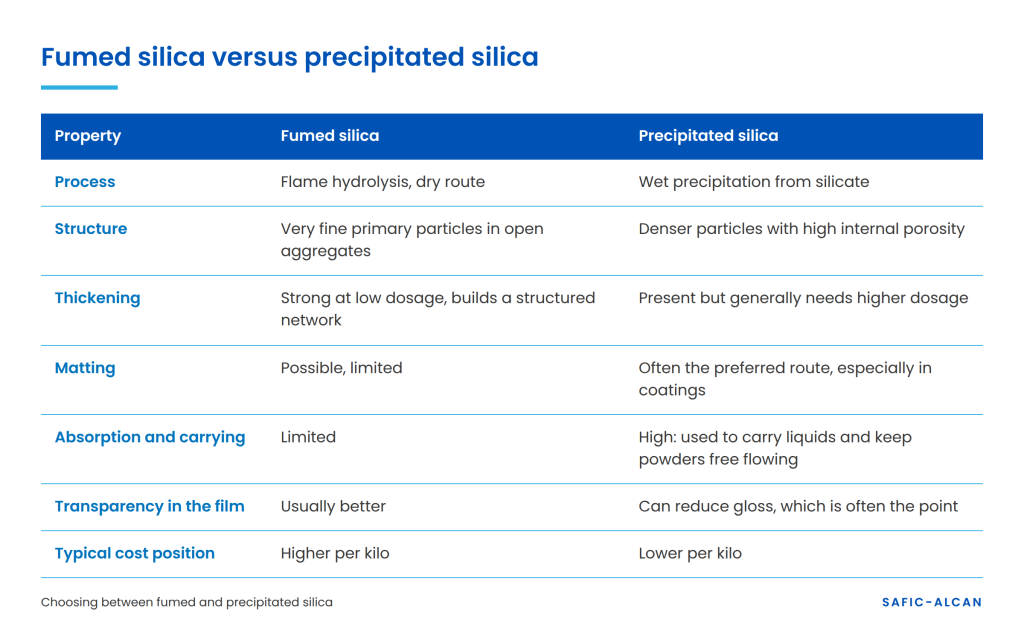
Two of our guides go deeper on each family: fumed silica explained covers grades and selection in detail, and our article on precipitated silica covers the wet route and its applications. This page is the comparison between the two.
Hydrophilic or hydrophobic matters more than you think
Both families exist untreated (hydrophilic) and surface treated (hydrophobic). The treatment changes how the silica interacts with water, with the binder and with itself, and it often decides the result more than the family does.
- Hydrophilic grades thicken polar systems efficiently and are the usual starting point in waterborne formulations.
- Hydrophobic grades perform better in non-polar systems, reduce water uptake and are often used where storage stability or moisture sensitivity is the issue.
If your problem is sag, levelling or settling in a liquid coating rather than the silica itself, start from the rheology side: our guide to rheology modifiers for waterborne systems sets out the options, and silica is one lever among several.
Not sure which silica grade fits your system?
Tell us the binder, the dosage window and what you are trying to fix. Safic-Alcan will suggest grades available in your country and send samples.
The four questions that usually decide it
- What am I actually trying to control? Thickening, matting, anti-settling, free flow and absorption pull towards different families.
- Is the system polar or non-polar? This decides hydrophilic against hydrophobic before it decides fumed against precipitated.
- How much dust and shear can my process take? Both are fine powders. Incorporation equipment and dust handling often rule out an otherwise good grade.
- What is my cost per unit of effect? Fumed silica costs more per kilo but is used at lower dosage. Compare cost in use, not price per kilo.
That last point is where most comparisons go wrong. A cheaper powder used at three times the dosage is not cheaper, and it also changes the rest of the formula.
Handling and incorporation
Both silicas are light, dusty powders with very low bulk density, and both need proper dust extraction and personal protection during incorporation. Dispersion matters as much as selection: insufficient shear leaves agglomerates that neither thicken nor matt properly, while excessive shear in some systems breaks down the structure that gives the thickening. Where foam appears during high-shear incorporation, our guide to defoamers in waterborne coatings covers the options.
Substance information on synthetic amorphous silica, including its registration status, is available in the ECHA substance database.
Comparing grades from different suppliers?
Safic-Alcan distributes silica grades from leading manufacturers. We can compare the options available in your market and arrange samples for your trials.
Frequently asked questions
What is the difference between fumed and precipitated silica?
The process. Fumed silica is made by flame hydrolysis, giving very fine particles in open aggregates with strong thickening at low dosage. Precipitated silica is made by wet precipitation, giving denser, more porous particles used for matting, absorption and free flow.
Which one is better for matting a coating?
Precipitated silica is usually the preferred route for matting, and grades are made specifically for it. Fumed silica can contribute but is chosen more often for rheology control.
Is silica the same as crystalline silica?
No. Both fumed and precipitated silicas are amorphous. IARC evaluated amorphous silica as not classifiable as to its carcinogenicity to humans, while crystalline silica inhaled from occupational sources is classified as carcinogenic.
Which is cheaper?
Precipitated silica is generally cheaper per kilo. Whether it is cheaper in your formula depends on the dosage you need for the same effect.
Do I need a hydrophobic grade?
If your system is non-polar, or if moisture pickup and storage stability are problems, a hydrophobic grade is usually the better starting point. In waterborne systems, start hydrophilic.