


TL;DR :The choice between polyether and polyester polyol base chemistry is the single most consequential formulation decision for a cast polyurethane component. It determines a cluster of downstream performance properties — hydrolysis resistance, dynamic behaviour, low-temperature flexibility, chemical resistance, abrasion mode — that no curative or additive adjustment can fully compensate for. Getting it right at the prepolymer selection stage is what separates a component that meets its service life target from one that fails ahead of schedule.
Every cast polyurethane elastomer starts from the same basic architecture: a polyol, an isocyanate, and a curative. But beneath that common structure, the choice of polyol base chemistry — polyether or polyester — drives a fundamental divergence in how the cured elastomer will behave in service. The two chemistries have different molecular backbones, different responses to moisture and temperature, and different mechanical profiles. In the right application, each outperforms the other. In the wrong one, either can fail.
For formulators specifying a prepolymer system, and for procurement teams trying to understand why a particular grade is being recommended, this guide covers the decision in full. It explains the chemistry, the performance consequences, how the isocyanate choice interacts with the polyol selection, and how the HYPERLAST™ and DIPRANE™ prepolymer families by Dow map to each requirement.
For a broader decision framework covering abrasion testing, TCO and sourcing considerations, see our article on high-performance elastomers in demanding environments. For a detailed treatment of abrasion testing methodology and how wear performance data translates to real service life,see our piece on abrasion and wear performance in polyurethane elastomers.
What makes the polyol choice so consequential
In a cast polyurethane elastomer, the polyol forms the soft segment of the polymer network — the flexible part of the chain between the hard segments created by isocyanate and curative. The soft segment determines the elastomer's response to environmental stress: how it behaves in water, under cold, under cyclic load, and in contact with chemicals.
The choice of polyol is what defines the bulk of a cast PU elastomer's long-term performance characteristics. Mechanical adjustments made through curative selection, stoichiometry, or processing conditions operate within the envelope the polyol chemistry creates. They cannot move the elastomer to a fundamentally different performance regime.
The two main polyol families used in industrial cast polyurethane prepolymers are:
Polyether polyols. The backbone contains ether linkages (–C–O–C–).The two used most widely in industrial cast systems are:
- PTMEG (polytetramethylene ether glycol), also called PTMG or polytetrahydrofuran, which delivers the highest resilience and the best dynamic performance.
- PPG (polypropylene glycol), a lower-cost polyether offering good hydrolysis resistance with more modest mechanical properties.
Polyester polyols, including adipate polyesters and polycaprolactone (PCL). The backbone contains ester linkages (–COO–).
These two backbone structures respond very differently to water, temperature, and mechanical stress — which is where the performance split begins.
Polyether-based systems: where to use them
Hydrolysis resistance — the decisive advantage
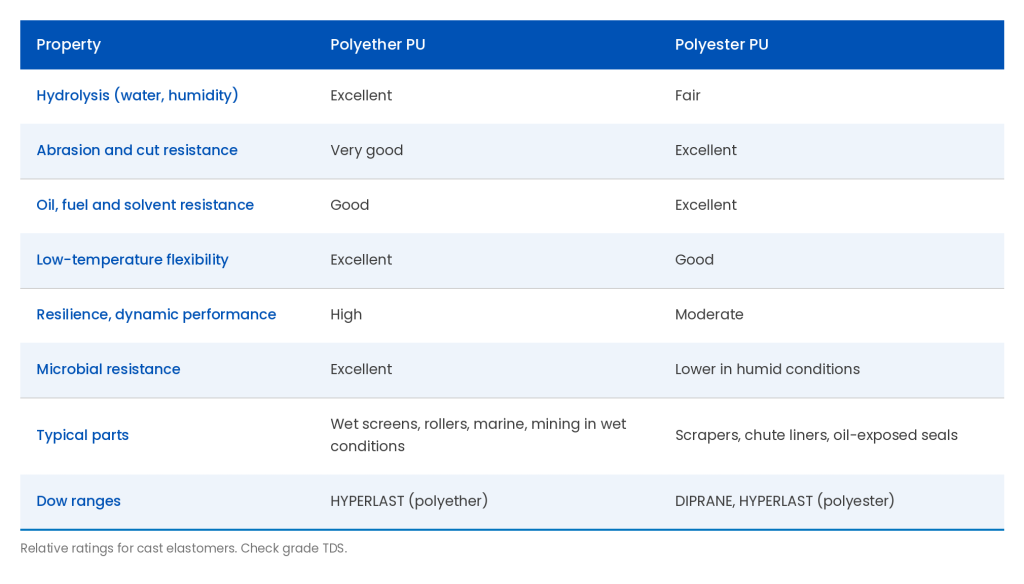
The most important property of polyether-based cast polyurethane is its resistance to hydrolysis — degradation by water or moisture. The ether linkage in the polymer backbone is chemically stable in the presence of water, even at elevated temperatures. Polyether polyurethanes can remain stable in water as warm as 50°C for long periods and are recommended wherever high humidity or water exposure is a concern.
In quantitative terms, polyether systems substantially outperform polyester formulations in sustained wet conditions, with hydrolysis half-life data showing polyether-based systems retaining mechanical properties far longer under immersion at elevated temperatures. Temperature is a critical modifier: at 90°C water, degradation accelerates sharply for both systems, but polyether materials retain properties significantly longer than polyester equivalents.
For applications in wet, humid, offshore or submerged environments — pipe and pump linings, offshore bend stiffeners, hydrocyclones, subsea protection components — polyether chemistry is the baseline requirement, not an optional upgrade.
Dynamic performance and low-temperature flexibility
PTMEG-based polyether systems deliver a combination of high resilience and low heat build-up under cyclic loading that polyester systems cannot match. PTMEG polyether materials offer excellent low-temperature flexibility and excellent dynamic properties, with resistance to microbial attack and hydrolysis. This makes them the preferred specification for high-speed rollers, dynamic seals, and any component where cyclic deformation generates internal heat.
Polyether urethanes are much less susceptible to dynamic heat build-up — that is precisely why they are the choice for high-speed rollers where rapid flexing creates heat. A polyester-based system in the same application will accumulate heat faster, accelerating degradation and ultimately reducing service life. The final decision lies in the failure mode : if the wear is the most important one, a polyester can be the right choice.
At sub-zero temperatures, polyether systems also maintain flexibility where polyester grades may begin to harden. This matters for components operating in cold storage environments, in winter outdoor conditions, or in refrigerated industrial processes.
The HYPERLAST™ range
The HYPERLAST™ range by Dow is built exclusively on polyether polyols. HYPERLAST systems produce elastomers with strong dynamic performance, resilience, hydrolysis resistance and performance at low temperatures — making them suitable for high-speed and high-load-bearing applications in cold or wet environments.
The range includes the HYPERLAST™ 153 series, developed to enable REACH-compliant reformulation away from MbOCA-cured systems — an important consideration for European processors. This is covered in full in the dedicated MbOCA/REACH Compliance article. HYPERLAST™ systems are available through Safic-Alcan across Europe, for processors seeking to minimise sensitisation risk.
Chemical resistance
Polyester polyurethanes are more resistant to oils, fuels, and chemical solvents than polyether equivalents. The ester backbone interacts more favourably with non-polar organic compounds, making polyester and polycaprolactone-based systems the preferred specification for components in direct contact with lubricants, hydraulic fluids, or hydrocarbon-based process chemicals.
The DIPRANE™ prepolymer range
The DIPRANE™ range by Dow is built on polyester polyols . DIPRANE prepolymers produce tough, durable elastomers with excellent resistance to wear and tear, cuts, flex fatigue and organic chemicals — ideal for wheels, rollers and mining equipment including screens, scrapers and conveyors. The range covers both TDI and MDI variants, enabling formulators to match the specific hardness range and processing requirements of each application.
DIPRANE™ systems can be formulated to achieve excellent solvent resistance and are available in grades spanning soft Shore A through to hard Shore D — making them highly versatile across the dry and chemically demanding application space.
The isocyanate dimension: TDI vs MDI
The polyol choice sets the environmental performance envelope. The isocyanate choice — TDI (toluene diisocyanate) or MDI (methylene diphenyl diisocyanate) — shapes the mechanical and processing profile within that envelope. The two choices interact, so it is worth understanding what each brings.
TDI: lower viscosity, better dynamic performance, longer pot life
TDI produces lower-viscosity prepolymers than MDI — a direct processing advantage for manual or semi-automated casting operations, particularly at lower temperatures. TDI-based systems offer excellent dynamic properties and low-temperature flexibility, and their longer pot life gives processors more working time before viscosity build prevents clean mold fill.
MDI: higher hardness potential, better thermal stability
MDI-based systems offer the path to higher hardness levels and better performance at elevated temperatures. MDI prepolymers combine easy processing with good flowability and are available in both ether and ester series.
The trade-off is a shorter pot life and, for pure 4,4'-MDI, a higher melting point that requires more careful temperature management in processing. Modified MDI variants with higher 2,4'-content exhibit lower melting points, slower reaction rates and better processing characteristics — an important consideration for formulators moving from TDI to MDI systems.
Hyperlast & Diprane™ quasi-prepolymers
Some applications impose combinations of requirements that sit between the polyether and polyester performance envelopes. Hyperlast & Diprane quasi-prepolymer systems from Dow extend the available formulation range beyond what standard prepolymers of either chemistry can achieve. They enable intermediate property profiles — higher NCO content, greater formulation flexibility — for applications where the standard polyether vs polyester decision does not resolve cleanly.
VORASTAR™ systems are particularly useful for processors who need to tune specific property combinations — hardness, resilience, chemical resistance — beyond the range achievable with full prepolymers alone.
Making the formulation decision: the four-variable framework
In practice, base chemistry selection comes down to a structured assessment of four variables:
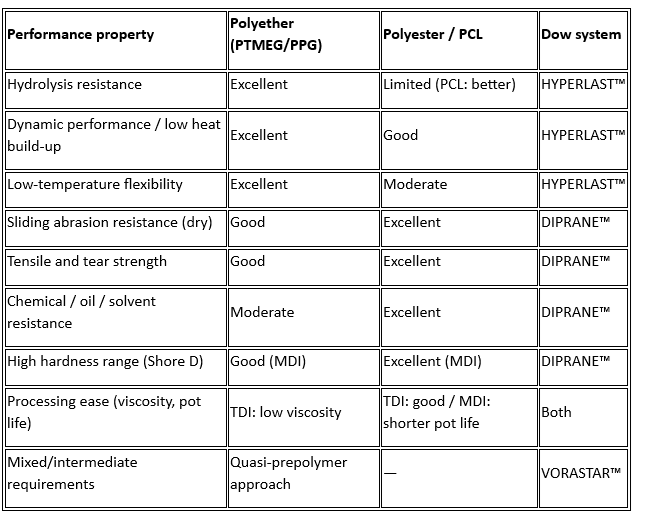
1. Primary performance requirement. Is the dominant failure mode abrasion, hydrolysis, dynamic fatigue, or chemical attack? Abrasion in dry conditions points to polyester. Hydrolysis or dynamic load points to polyether. Chemical exposure points to polyester or PCL.
2. Operating environment. Is the component wet, humid, submerged, or cold? These conditions strongly favour polyether. Dry, chemically exposed, or high-temperature environments favour polyester.
3. Hardness range required. Both polyether and polyester systems can be formulated across the full range, from soft Shore A to hard Shore D, so hardness alone rarely decides the base chemistry. It does influence the isocyanate choice: MDI-based systems reach the hardest grades more easily and hold their properties better at elevated temperature, while TDI-based systems are usually specified where dynamic performance and processing latitude matter more than peak hardness.
4. Processing conditions. What is the available pot life? Is the casting manual or machine-dispensed? TDI-based systems offer longer pot life and lower viscosity for more demanding casting operations. MDI systems require tighter temperature management but can deliver properties TDI cannot reach.
Not sure whether your application calls for polyether or polyester?
Send us your operating conditions, hardness target and processing setup. Our polyurethane technical team will recommend the HYPERLAST or DIPRANE grades that fit, and arrange samples.
Frequently asked questions
What is the difference between polyether and polyester polyurethane?
Polyether polyurethanes are built on a polyol backbone containing ether linkages (–C–O–C–), which delivers outstanding hydrolysis resistance, excellent low-temperature flexibility and strong dynamic performance. Polyester polyurethanes use a polyol backbone with ester linkages (–COO–), which delivers higher tensile and tear strength, better sliding abrasion resistance in dry environments, and superior resistance to oils and organic chemicals. The choice between them depends on the primary performance requirement and operating environment.
Which polyurethane is better for wet or submerged applications: polyether or polyester?
Polyether-based polyurethane is significantly better for wet, humid or submerged applications. The ether backbone is chemically stable in the presence of water, maintaining mechanical properties over long periods of moisture exposure. Polyester-based systems are susceptible to hydrolytic cleavage of their ester bonds, which progressively degrades mechanical properties in sustained wet conditions. For offshore, subsea, water treatment or high-humidity industrial applications, polyether systems are the standard specification.
What is HYPERLAST™ and when should it be used?
HYPERLAST™ is a range of polyether polyurethane prepolymer systems manufactured by Dow Polyurethanes. It produces cast elastomers with excellent hydrolysis resistance, strong dynamic performance, high resilience and good low-temperature flexibility. HYPERLAST™ is the preferred specification for high-speed, high-load-bearing industrial applications in wet or cold environments — including rollers, offshore bend stiffeners, pipe linings, hydrocyclones and dynamic seals. It is available through Safic-Alcan across Europe.
What is DIPRANE™ and when should it be used?
DIPRANE™ is a range of polyester polyurethane prepolymer systems by Dow. It produces tough, durable elastomers with excellent sliding abrasion resistance, high tensile and tear strength, and strong resistance to oils and organic chemicals. DIPRANE™ is the preferred specification for dry or chemically exposed industrial applications — including mining screens, conveyor rollers, industrial wheels and scrapers. It is available through Safic-Alcan across Europe.
What is the difference between TDI and MDI in cast polyurethane?
TDI (toluene diisocyanate) produces lower-viscosity prepolymers with longer pot life and excellent dynamic and low-temperature performance — preferred for dynamic load applications and manual or semi-automated casting. MDI (methylene diphenyl diisocyanate) offers higher hardness potential, better thermal stability and is preferred for very hard Shore D grades or elevated temperature applications.
Where can I buy HYPERLAST™ and DIPRANE™ prepolymers in Europe?
Safic-Alcan is the authorised European distributor of the complete Dow Polyurethanes range — including HYPERLAST™, DIPRANE™, VORASTAR™ and DURAMOULD™ — across France, the UK, Benelux, the Nordics, DACH (Germany, Austria, Switzerland), Spain, Italy, Portugal and most CEE countries. Contact the local Safic-Alcan technical team for data sheets, samples and formulation guidance.
Is polyether polyurethane better than polyester polyurethane?
Neither is better overall. Polyether wins in wet and dynamic conditions; polyester wins on cut, tear, abrasion and oil resistance.
REFERENCES
Polyester vs polyether polyurethane — Gallagher Corp ·
Beginner's guide to polyurethane — Gallagher Corp ·
Polyurethane elastomer hydrolytic stability — Anderson Development Company ·
Polyester vs polyether TPU — Geosynthetics Magazine