


TL;DR — Rheology modifiers are critical to cosmetic formulation: they control texture, stability, spreadability, and sensory perception. In skincare and personal care, they are used to build viscosity, stabilise emulsions, suspend actives, and deliver the desired skin feel. The right choice depends on pH, electrolyte load, formulation type (gel, emulsion, anhydrous), and target sensory profile.
Why rheology matters in cosmetic formulations
In cosmetics, rheology is not an abstract concept — it directly defines how a product behaves from the moment it leaves the packaging to its final perception on skin.
A cream that is too fluid will separate. A gel that is too rigid will not spread. A serum that feels sticky will be perceived as low quality, regardless of its active ingredients.
Rheology modifiers are therefore used to control:
- Texture and viscosity (cream, gel, fluid)
- Stability (prevent phase separation and sedimentation)
- Spreadability and absorption
- Sensory profile (light, rich, cushiony, dry touch)
A rheology modifier is any ingredient added to change how a formulation flows: its viscosity, its yield stress, its thixotropy, and its gel strength. For a broader overview of how these ingredients work across formulation types, our rheology modifiers guide covers the full landscape across cosmetics and coatings.
Ready to Work Together?
Get in touch with our team and discover tailored solutions for your industry
How rheology modifiers work in cosmetics?
Three core mechanisms are at play in cosmetic formulations.
Chain entanglement is the simplest: long polymer chains dissolve into the aqueous phase and physically intertwine, increasing resistance to flow proportionally to concentration. Hydroxyethyl cellulose (HEC) and hydroxypropyl methylcellulose (HPMC) work primarily through this entanglement mechanism. The result is smooth, stable viscosity — but no yield stress, meaning particles will eventually settle.
Associative networking is more sophisticated. Polymers carrying hydrophobic groups form reversible physical bonds between themselves and with the emulsion droplets or pigment particles in the system, building a three-dimensional network that thickens strongly at rest and breaks down under shear.. The network reforms when shear stops, giving genuine thixotropic behaviour — useful for suspending actives, preventing sedimentation, and resisting sag.
Covalent crosslinking creates a permanent network with a defined yield stress. Carbomers — crosslinked polyacrylic acid polymers — are the primary example in cosmetics. They resist flow until a threshold force is exceeded, then yield cleanly. This gives the short, non-stringy skin feel consumers associate with premium gels and serums.
The three families of cosmetic rheology modifiers
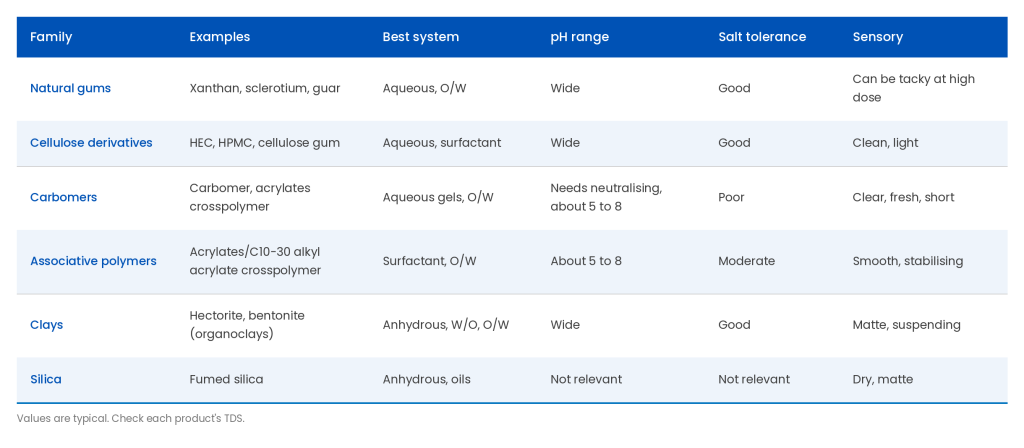
Rheology modifier selection table
Use the table as a first filter. Confirm the final choice with the supplier TDS and a stability test in your own base
1. Natural polymers
Natural-origin polysaccharide thickeners are biocompatible, biodegradable, and highly marketable in clean beauty contexts. The most formulation-relevant are xanthan gum, guar gum, carrageenan, and cellulose derivatives.
Xanthan gum is produced by bacterial fermentation of carbohydrates. It provides strong shear-thinning behaviour, excellent stability across a broad pH range, and good electrolyte tolerance — making it the go-to choice for sulfate-free shampoos, natural gels, and formulations with high salt or ionic load. At concentrations above approximately 0.5%, it delivers a yield value sufficient to suspend particles and prevent settling. Its main limitation is a characteristic ropy skin feel at higher concentrations that requires careful dosage management.
Guar gum is extracted from the endosperm of the guar bean and is nonionic — a significant advantage, since it is compatible with cationic conditioning agents that would precipitate anionic polymers like xanthan or carbomer. The well-documented synergy between guar and xanthan gum — where xanthan's double helix interacts with guar's mannan segment — produces synergistically enhanced viscosity and a combination of shear-thinning flow and meaningful yield stress that neither ingredient achieves alone.
Carrageenan is a sulphated polysaccharide from red seaweed with three sub-types differing in gelling tendency. It has demonstrated efficacy in sunscreen emulsions and structured body care and is a primary candidate in eco-design reformulation programs replacing synthetic acrylics in oil-in-water emulsions.
Cellulose derivatives — HEC and HPMC principally — are semi-synthetic, produced by chemical modification of wood-pulp cellulose. They are non-ionic, compatible with a broad range of actives and electrolytes, and easy to incorporate. They work well as straightforward viscosity builders in surfactant systems and emulsions but lack the suspension performance of anionic systems with a defined yield stress.
The natural challenge. Natural polymers generally require higher use concentrations than synthetic equivalents to achieve comparable performance, and they are more susceptible to microbial growth and batch variability. Research published in Cosmetics (MDPI) has confirmed that acrylic rheological modifiers can be replaced by polysaccharide combinations — sclerotium gum, xanthan gum, diutan gum, and carrageenan — in oil-in-water emulsions, though perfectly replicating synthetic texture profiles requires blending and optimization.
2. Synthetic polymers
Carbomers are crosslinked polyacrylic acid polymers and the dominant synthetic thickener in skin care. They produce exceptionally clear gels, deliver high viscosity at very low usage levels (typically 0.1–0.5%), and create a clean, non-stringy skin feel. They require neutralization with a base to develop viscosity — adding a manufacturing step — and their performance degrades significantly in the presence of salts and electrolytes.
Acrylates/C10-30 alkyl acrylate crosspolymers are hydrophobically modified carbomers belonging to the HASE family. The hydrophobic modification improves electrolyte resistance significantly, making them the preferred choice in vitamin C serums, AHA formulations at low pH, mineral sunscreens, or any system where ionic load would destabilize a standard carbomer gel.
The specific role of associative thickeners in preventing creaming, sedimentation, and phase separation is covered in our dedicated article on rheology modifiers and emulsion stability.
3. Mineral-origin rheology modifiers
Mineral thickeners derive their rheological effect from physical colloidal networks rather than polymer chains, giving them a distinctive combination of high yield stress, good thixotropy, and long-term stability.
Bentonite and hectorite are swelling clays that form gel networks through electrostatic platelet interactions in aqueous systems. They deliver strong thixotropy and effective pigment suspension, making them the standard choice in face masks, mineral foundations, and any emulsion with a high dispersed solid load.
Laponite is a synthetic layered silicate that produces exceptionally clear aqueous gels through edge-to-face electrostatic interactions between nanoplatelets — the so-called "house of cards" network. It is the preferred mineral option in transparent serums and leave-on products where clay opacity would be unacceptable.
Fumed silica builds its thickening network through hydrogen bonding between silanols on its particle surface. It is particularly relevant in anhydrous formulations — lipsticks, eye products, pressed powders — where polymer-based thickeners are ineffective, and in powder systems requiring anti-caking performance at very low loadings.
Natural Rheology modifiers for Cosmetics
Natural-origin rheology modifiers have moved from niche to mainstream as COSMOS certification, clean beauty positioning, and European microplastic restrictions reshape formulation priorities.
The most used options are xanthan gum, guar gum, sclerotium gum, hydroxyethyl cellulose (HEC) from plant-derived sources, and alginates. Each brings a distinct performance profile. Xanthan gum delivers strong shear-thinning behaviour and broad pH stability, making it the backbone of most natural gel formulations. Guar gum, being nonionic, is compatible with cationic conditioning agents — an advantage in rinse-off and hair care systems. Sclerotium gum, produced by fungal fermentation, produces smooth, skin-friendly gels with a sensory profile close to synthetic acrylics, and is increasingly used as a carbomer replacement in COSMOS-certified leave-on products. Plant-derived HEC builds straightforward viscosity in surfactant systems without ionic sensitivity. Alginates, extracted from brown seaweed, are primarily used in rinse-off masks and structured gel formats.
The trade-offs are real. Natural modifiers generally require higher use concentrations than carbomers to reach equivalent viscosity. Some, like xanthan at high loading, introduce a ropy or stringy skin feel. Clarity is another constraint: most natural polymers produce hazy to opaque gels, which limits their use in transparent serums. Microbial susceptibility and batch variability also add formulation complexity compared to synthetic alternatives.
Priority use cases are natural gels, COSMOS-certified leave-on creams and serums, and rinse-off products where biodegradability is a requirement.
Hydrophilic vs Lipophilic Rheology Modifiers: Which for Which System?
The polarity of the continuous phase is the first filter in any modifier selection decision. Using the wrong family in the wrong phase produces no thickening effect, regardless of concentration.
Hydrophilic modifiers — carbomers, cellulose derivatives, xanthan gum, and carrageenan — are designed for aqueous phases and oil-in-water emulsions. They dissolve or swell in water, building viscosity through chain entanglement, associative networking, or ionic swelling. They are ineffective in anhydrous or water-in-oil systems.
Lipophilic and structuring modifiers handle the inverse cases. Organically modified clays (bentone, hectorite), hydrophobic fumed silica, waxes, fatty alcohols, and castor derivatives structure oil phases, anhydrous formulas, and water-in-oil emulsions. At low loadings, hydrophobic fumed silica prevents sedimentation and controls flow in lipsticks and pressed powders without altering colour or texture perception.
Key selection criteria for formulators
pH and neutralization
Carbomers and HASE polymers are supplied in acid form and must be neutralized to develop viscosity. This adds a manufacturing step and restricts use below pH 4 — a hard constraint for AHA, vitamin C, or low-pH preservative systems. Xanthan gum, guar, and most cellulose derivatives build viscosity across a wide pH range without neutralization, which simplifies manufacturing and opens up acidic formulation space.
Electrolyte tolerance
Electrolyte resistance is one of the most critical and frequently underestimated selection criteria. Standard carbomers lose viscosity rapidly in the presence of salts. Xanthan gum and carboxymethyl cellulose offer higher electrolyte resistance but at a sensory cost. In formulations with high ionic load — mineral actives, preservation systems, electrolyte-rich actives — associative acrylate crosspolymers or natural polysaccharides are the practical default.
Aqueous vs. anhydrous systems
Hydrophilic modifiers — carbomers, xanthan, HEC — are designed for aqueous phases. Structuring the oil phase or formulating anhydrous products requires different tools: waxes, fatty alcohols, organically modified clays, or hydrophobic fumed silica. The polarity of the continuous phase is the first filter in any selection decision.
Sensory profile
The modifier choice directly shapes the consumer's tactile experience. Carbomers produce a clean, cushioned, non-tacky skin feel. Polysaccharides can introduce a long, stringy flow at higher loading that reads as heavy or gel-like. Mineral systems like Laponite produce a lighter, drier, more mineral finish. Research using neurosensory consumer testing — including prosody analysis and dynamic brain activity measurement — has confirmed that rheological modifier choice produces distinct and measurable emotional responses. Matching the modifier to the sensory brief is as important as matching it to technical performance.
Sustainability and regulatory constraints
The transition toward bio-derived thickeners is reshaping formulation choices globally. Natural thickeners held approximately 42.5% of the cosmetic thickener market in 2025, marking a crossover point as naturally derived options continue to gain ground. COSMOS and Ecocert certification, REACH microplastic restrictions, and clean beauty positioning are progressively constraining the eligible thickener pool — particularly in European markets for both leave-on and rinse-off product categories.
Application by product type
Creams and lotions require stable viscosity in emulsified systems, resistance to thermal cycling, and a pleasant after-feel. Carbomers dominate in classic oil-in-water emulsions. For certified natural positioning, sclerotium gum and xanthan combinations are the most established alternatives.
Serums and lightweight fluids demand clarity and a non-tacky finish. Carbomers and Laponite are the main options for transparent, high-active serums. Electrolyte-compatible acrylate crosspolymers are preferred in vitamin C or AHA formulations at low pH.
Shampoos and rinse-off hair care operate in anionic surfactant systems where carbomers underperform. Carbomers and xanthan gum are the workhorses for sulfate-based systems. For sulfate-free and EO-free natural formulations, guar-xanthan synergy delivers the right combination of shear-thinning flow and yield stress.
Colour cosmetics — foundations, mascaras, lip products — require modifiers that handle high pigment loads, resist separation on storage, and deliver precise application rheology. Bentonite, hectorite, and fumed silica serve the mineral structuring role; carbomers and hydrocolloides structure the aqueous phase of fluid foundations.
Anhydrous and powder systems — lipsticks, balms, pressed powders — rely on waxes, fatty alcohols, and mineral materials. Fumed silica at low loadings controls flow and prevents caking without altering colour or texture perception.
Face masks leverage the thixotropic performance of clays, which build a structured gel at rest but flow on application. Carrageenan and xanthan serve water-wash and peel-off formats where clay opacity is undesirable.
FAQ
What is a rheology modifier in cosmetics?
An ingredient that changes how a formula flows: it thickens, suspends particles, stabilises emulsions and shapes the sensory on application.
Which rheology modifier works in high-salt or surfactant formulas?
Natural gums, cellulose derivatives and clays tolerate electrolytes well. Carbomers lose viscosity with salt.
What can replace carbomer?
Xanthan or sclerotium gum, cellulose derivatives or clays, often in blends. See our carbomer alternatives guide.
Which thickener is best for anhydrous formulas?
Organoclays such as hectorite and fumed silica, because they build structure in oils.
Summary
Rheology modifier selection is a system decision, not an ingredient decision. The polarity of the matrix, the pH, the ionic load, the processing constraints, the sensory target, and the sustainability brief all constrain the viable options before a single bench test is run. Understanding the mechanism behind each family — chain entanglement, associative networking, mineral hydrogen bonding — is what allows formulators to narrow the field quickly and reach a stable, consumer-validated formula with fewer reformulation cycles.