


Quick answer: HLB stands for Hydrophile-Lipophile Balance. It is a number between 0 and 20 assigned to an emulsifier that indicates whether the molecule is more attracted to water (high HLB) or to oil (low HLB). In cosmetic formulation, the HLB value helps predict which type of emulsion an emulsifier will stabilise: values between 3 and 6 are used for water-in-oil (W/O) emulsions such as cold creams; values between 8 and 16 are used for oil-in-water (O/W) emulsions such as lotions and serums. The concept was introduced by W.C. Griffin in 1949 and remains one of the most widely cited orientation tools in emulsion formulation.
Oil and water do not mix on their own. In a cosmetic emulsion, they are held together at the interface by emulsifier molecules, which have one part that is attracted to water and another part that is attracted to oil. The HLB system gives each emulsifier a single number that expresses this balance, making it easier to choose the right molecule for a given formulation.
Understanding HLB does not require calculating anything. For most formulators, the HLB value is simply a descriptor on a technical data sheet, and the practical question is: what does this number tell me about how this ingredient will behave?
Where the HLB Scale Comes From
W.C. Griffin introduced the HLB concept in 1949 in the Journal of the Society of Cosmetic Chemists, with a more detailed calculation method published in 1954. The system was designed specifically to help formulators select non-ionic surfactants for emulsion systems, at a time when the range of available emulsifiers was expanding rapidly and there was no consistent framework for comparing them.
The scale runs from 0 to 20. Griffin assigned a value of 0 to a hypothetical molecule that is entirely lipophilic (oil-soluble, water-insoluble) and a value of 20 to one that is entirely hydrophilic (water-soluble, oil-insoluble). In practice, most emulsifiers used in cosmetics fall between 2 and 18. The scale gives formulators a semi-empirical method to predict what type of emulsion a given surfactant structure will support.
In 1957, J.T. Davies extended the system by proposing a group contribution method that allows HLB to be estimated for ionic surfactants and structurally complex molecules, not just the non-ionic ethoxylated compounds Griffin had originally addressed.
What the Number Tells You
The HLB value of an emulsifier predicts two things: which phase it will prefer to dissolve in, and which type of emulsion it will favour. An emulsifier that is more soluble in water will tend to pull the formulation toward an oil-in-water structure. One that is more soluble in oil will tend to pull it toward a water-in-oil structure. This is sometimes called Bancroft's rule: the phase in which the emulsifier is more soluble tends to become the continuous phase.
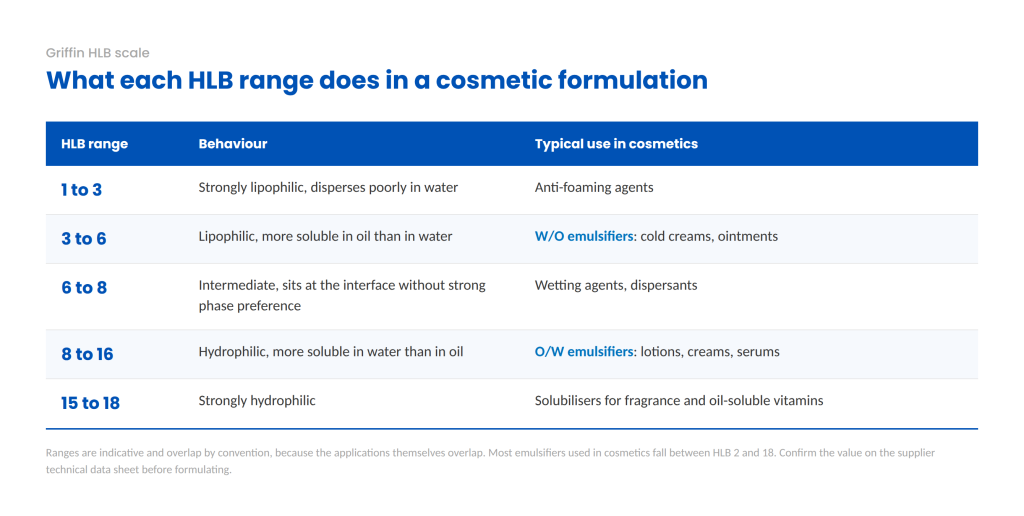
Ranges are indicative and overlap by convention. Confirm the value on the supplier technical data sheet.A lotion or light cream is almost always an O/W emulsion: the continuous phase is water, and oil droplets are dispersed within it. This gives a light, non-greasy feel on the skin. A cold cream or a rich occlusive treatment is more likely to be a W/O emulsion: the continuous phase is oil, and water droplets are dispersed within it. This gives a denser, more protective feel and reduces transepidermal water loss. The HLB of the emulsifier system is the first signal of which direction the formulation is heading.
O/W vs W/O: What the Emulsion Type Changes in Practice
The distinction between O/W and W/O matters beyond texture. It affects how the formulation applies, how active ingredients are delivered, how the product dries down, and how it interacts with the skin barrier.
Our cosmetics catalogue covers emulsifier systems suited to both emulsion types, including self-emulsifying grades for which the HLB is pre-optimised by the manufacturer.

HLB and the Required HLB of the Oil Phase
Every oil, wax, or fatty ester used in a cosmetic formulation has a required HLB: the HLB of the emulsifier system that produces the most stable emulsion for that ingredient. Matching the emulsifier HLB to the required HLB of the oil phase is the core practical application of the system.
Matching an emulsifier to a new oil phase?
Our cosmetics technical team can shortlist emulsifier systems for your target HLB and run the compatibility screening with you.
Some widely used reference values are listed below. These are reference ranges from the ICI HLB literature and from formulation guides; they are starting points, not guaranteed outcomes.
When a formulation contains several oil phase ingredients, the required HLB of the blend is the weighted average of each component's required HLB, calculated in proportion to its share of the total oil phase. This is the starting point for emulsifier selection, not the endpoint. Stability testing at temperature is always required to confirm the result.
The HLB tells you which emulsifier to try, not how much to use. Emulsifier concentration is determined separately through stability testing. A typical starting range for initial screening is 2 to 4% total emulsifier by weight of the finished formula, adjusted up or down depending on the oil phase content and processing conditions.

Common Emulsifiers and Their HLB Values
The following values are widely cited in formulation literature for the most commonly used non-ionic emulsifiers in cosmetics. HLB values for ionic and polymeric emulsifiers are either experimentally derived or not applicable in the same framework.
The glyceryl stearate / PEG-100 stearate pair is a classic example of HLB blending: glyceryl stearate alone sits at 3.8 (W/O territory), but when blended with PEG-100 stearate at 18.8, the combination produces a stable O/W emulsion. The two are often sold together as a self-emulsifying blend under various trade names precisely because their combined HLB lands in a useful range for skin care creams.
Where HLB Has Limits
- It does not apply to polymeric emulsifiers: Polymeric emulsifiers, including carbomer-based systems, acrylate/alkyl acrylate copolymers and modified polysaccharides, stabilise emulsions through steric and electrostatic mechanisms, not through classical amphiphilic balance. Assigning or using an HLB value for these systems is not meaningful. Most technical data sheets for polymeric emulsifiers do not include an HLB, and for good reason.
- It is less reliable for natural emulsifiers: Plant-derived emulsifiers (sucrose esters, cetearyl glucoside, lecithin, polyglyceryl esters) have more complex structures than simple ethoxylates, and many are heterogeneous mixtures. Their published HLB values are often approximations or are experimentally derived from reference surfactant comparisons rather than from the Griffin formula. Many modern data sheets for natural emulsifiers no longer include an HLB at all, preferring to indicate emulsion type (O/W or W/O) and recommended use levels directly.
- Temperature changes it: The HLB value of an ethoxylated non-ionic emulsifier reflects its relative solubility in water and oil — and solubility is temperature-dependent. At a certain temperature (the Phase Inversion Temperature, or PIT), a non-ionic emulsifier that forms an O/W emulsion at room temperature will invert to form a W/O emulsion. This is why stability testing at different temperatures (typically 4°C, 25°C, and 40°C over at least four weeks) cannot be replaced by HLB calculation alone.
- It does not account for the water phase: Electrolytes, humectants, and thickening agents dissolved in the water phase can significantly alter the effective behaviour of an emulsifier. High salt concentrations in particular can reduce the effective HLB of an ethoxylated surfactant, shifting the emulsion behaviour. The HLB system has no built-in mechanism for accounting for these effects.
Frequently Asked Questions
What does HLB stand for?
HLB stands for Hydrophile-Lipophile Balance. It is a numerical scale from 0 to 20 that describes the relative affinity of an emulsifier molecule for water (hydrophilic) versus oil (lipophilic). The higher the number, the more water-soluble the emulsifier. The system was developed by W.C. Griffin and first published in the Journal of the Society of Cosmetic Chemists in 1949.
What is a good HLB value for a lotion or face cream?
Most lotions and face creams are oil-in-water emulsions, which require an emulsifier system with an HLB between 8 and 16. The exact target depends on the oil phase composition: plant-oil-based formulas typically need a system around HLB 8 to 10, while formulas containing mineral oil, fatty alcohols, or esters tend to need HLB 10 to 14. The HLB of a blend of emulsifiers is the weighted average of the individual HLBs.
Can I use a single emulsifier, or do I need to blend?
A single emulsifier can work, but in practice a blend of two emulsifiers — one high-HLB, one low-HLB — generally produces a more stable emulsion than a single emulsifier at the same overall HLB. The two molecules organise into a tighter, more structured film at the oil-water interface. The classic example is the sorbitan ester and polysorbate pairing, sold under trade names such as Span and Tween, which has been used in cosmetic and pharmaceutical emulsions for decades.
Does HLB apply to all emulsifiers?
No. The Griffin HLB system applies reliably to non-ionic ethoxylated surfactants. It is less reliable for complex natural emulsifiers and gives only approximate results for ionic surfactants (where the Davies group contribution method is used instead). It does not apply at all to polymeric emulsifiers, which work through different stabilisation mechanisms. For these categories, the technical data sheet and the emulsifier manufacturer's formulation guide are more useful than any HLB value.
What happens if the HLB of my emulsifier system is wrong for my oil phase?
A mismatch between the emulsifier HLB and the required HLB of the oil phase typically results in an unstable emulsion. Visible signs include creaming (oil droplets rising to the top), sedimentation, phase separation, or a change in consistency over time during stability testing. If the HLB is too low for an O/W formulation, the system may invert or fail to form properly. If it is too high for a W/O formulation, the emulsifier will not concentrate effectively at the interface.
Where do I find HLB values for specific ingredients?
HLB values are listed on suppliers' technical data sheets for most conventional non-ionic emulsifiers. They are also compiled in reference works such as McCutcheon's Emulsifiers and Detergents (MC Publishing) and the ICI HLB guide. For natural or newer emulsifiers, the data sheet may not include an HLB — in that case, the manufacturer typically specifies emulsion type and recommended use conditions directly. Our cosmetics ingredient range includes technical documentation for each product.