


Rubber compounds do not fail because of mechanical overload alone. Most service failures trace back to two chemical degradation pathways that are well understood, largely preventable, and still routinely underestimated at the formulation stage: thermal-oxidative aging and ozone cracking. These two processes are chemically distinct, operate on different timescales, and require different additive strategies.
Antioxidants interrupt radical chain reactions driven by heat and oxygen. Antiozonants react preferentially with ozone before it reaches the polymer backbone. In most diene rubber formulations, both are needed simultaneously, because protecting against one pathway while ignoring the other produces a compound that fails from the unguarded side.
Interested in our rubber solutions ?
Talk to our experts today !
Why rubber degrades: two distinct mechanisms
Thermal-oxidative aging: the radical chain reaction
Oxidative degradation follows a classic radical chain mechanism. Initiation produces carbon-centred radicals (R•) along the polymer chain, either from heat, mechanical stress, or UV exposure. These radicals react immediately with atmospheric oxygen to form peroxyl radicals (ROO•), which abstract hydrogen from adjacent chain segments to generate hydroperoxides (ROOH) and new radicals. The cycle is self-sustaining: each propagation step creates a new initiation site.
The result, depending on the rubber type, is either chain scission (loss of tensile strength and elongation, typical in NR) or additional crosslinking (hardening and embrittlement, more common in SBR and NBR). Both paths degrade mechanical performance. As research on natural rubber composites confirms, terminating peroxyl radicals at the propagation stage is the primary protective function of antioxidants in rubber matrices.
Ozone cracking: a surface-specific reaction
Ozone degradation is chemically unrelated to oxidative aging. Ozone attacks the carbon-carbon double bonds (C=C) present in the main chain of diene elastomers — NR, SBR, BR, NBR — through an electrophilic cycloaddition that forms unstable ozonides. These ozonides fragment rapidly into carbonyl and carboxyl groups, breaking the chain at the surface. Under mechanical stress, these surface cracks propagate perpendicularly to the applied strain.
Concentrations as low as 0.02 ppm are sufficient to initiate cracking in unprotected NR under static tensile stress. The consequences are not cosmetic: surface cracks extend into the bulk material and ultimately compromise seal integrity, structural continuity, and service life. As reviewed in a 2025 environmental assessment of 6PPD and its transformation products, even low-level ozone exposure triggers chain scission at double bond sites, with degradation rate scaling with both ozone concentration and strain amplitude.
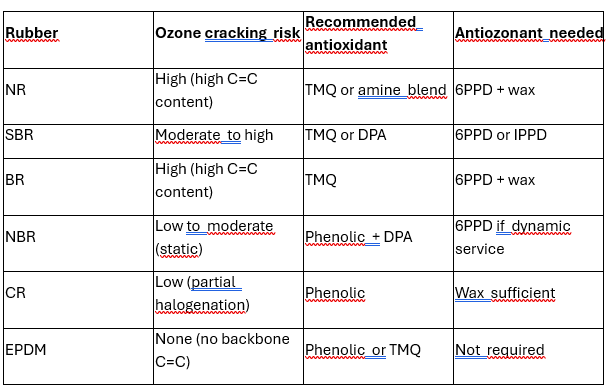
EPDM is a specific case: its polymer backbone contains no unsaturated bonds in the main chain (double bonds are confined to the diene termonomer side chains), so it does not undergo ozone cracking and does not require chemical antiozonants.
Chemical families of rubber antioxidants
Three main chemical families cover the antioxidant needs of industrial rubber formulation. They differ in mechanism, efficacy, colour contribution, and regulatory status.
Amine antioxidants
Secondary amines and their derivatives are the most thermally effective antioxidants available for rubber. They work by donating a hydrogen atom to peroxyl radicals (ROO•), terminating the propagation chain and forming a relatively stable aminyl radical that does not continue the chain reaction.
The main subgroups are:
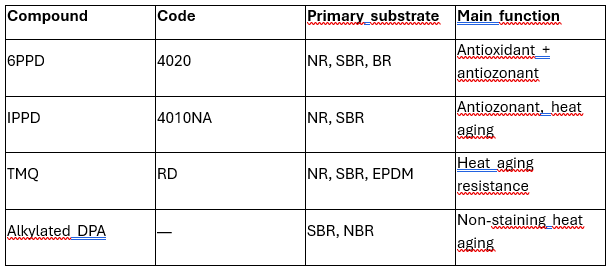
- p-Phenylenediamines (PPDs): 6PPD (N-(1,3-dimethylbutyl)-N'-phenyl-p-phenylenediamine, also known by the trade designation 4020) and IPPD (N-isopropyl-N'-phenyl-p-phenylenediamine, 4010NA) are the dominant compounds in this class. They are unique in having both antioxidant and antiozonant activity, which makes them the most versatile antidegradants in tyre and technical rubber compounding. DPPD (N,N'-diphenyl-p-phenylenediamine) and 77PD are also used.
- Polymerised quinolines: TMQ (2,2,4-trimethyl-1,2-dihydroquinoline, also known as RD) provides good protection against heat aging, particularly in NR and SBR. It is less effective against ozone than PPDs but contributes meaningfully to long-term thermal stability.
- Diphenylamines: Alkylated diphenylamine (DPA) is a non-staining amine antioxidant used where colour is a constraint. It offers heat aging protection without the staining associated with PPDs, at some cost to antiozonant performance.
The main limitation of amine antioxidants is their tendency to produce brown or grey discolouration in the finished article. Applications requiring light-coloured or white compounds generally exclude them. As molecular simulation studies on natural rubber have shown, several traditional amine antioxidants including 4020 and 4010NA have also failed recent EU REACH environmental certification, which is shaping formulation choices in regulated markets.
Phenolic antioxidants
Phenolic antioxidants share the radical-trapping mechanism of amines but operate through an O-H bond rather than an N-H bond. They are non-staining, which makes them the default choice for light-coloured compounds, food-contact applications, and medical rubber goods.
Commonly used compounds include BHT (2,6-di-tert-butyl-4-methylphenol), Irganox 1076 (octadecyl 3-(3,5-di-tert-butyl-4-hydroxyphenyl)propionate), and various bisphenol and thiophenol derivatives. They are frequently combined with phosphite co-stabilisers, which act as hydroperoxide decomposers and provide a complementary preventive mechanism.
Their limitation is thermal efficacy: at elevated temperatures, phenolics are generally less effective than amines. They also provide no direct protection against ozone cracking, which means compounds using phenolics exclusively will need a separate antiozonant strategy for applications where ozone exposure is a factor.
BHT specifically has come under regulatory scrutiny in several jurisdictions. As noted in research on anti-aging mechanisms in NR composites, BHT has failed some of the latest EU REACH environmental certifications, which limits its use in new formulations targeting European markets.
Heterocyclic and secondary antioxidants
Benzimidazoles (MBI — 2-mercaptobenzimidazole, and its zinc salt ZMBI) are used as secondary antioxidants, typically in combination with primary amine or phenolic antioxidants. They provide metal deactivation and some hydroperoxide decomposition, and are particularly useful in formulations exposed to copper or manganese ions, which catalyse oxidation.
Phosphites and phosphonites function as preventive antioxidants: they decompose hydroperoxides before these can generate new radicals, reducing the rate of chain initiation. They are used predominantly in processing stabilisation rather than long-term in-service protection. The MDPI 2022 rubber antioxidant review documents their classification alongside phenolics and amines as the three primary antidegradant classes in industrial rubber.
Chemical families of antiozonants
PPD-based chemical antiozonants
The p-phenylenediamine family dominates industrial antiozonant use for diene rubbers. Their protective mechanism was clarified by computational studies published in 2023: PPDs react with ozone through preferential electrophilic attack on the PPD nitrogen, forming a radical cation (PPD•+) and then, through subsequent reaction with a second ozone molecule, a quinone derivative. This reaction intercepts ozone before it reaches the polymer double bonds, and the rate of PPD-ozone reaction is several orders of magnitude faster than the rate of ozone-polymer reaction.
The dominant compound is 6PPD, typically incorporated at 0.5 to 1.5 parts per hundred rubber (phr). Global production exceeded 200,000 tonnes per year in China alone by 2020, reflecting its near-universal use in tyre compounds. IPPD and 77PD (N-(1,4-dimethylpentyl)-N'-phenyl-p-phenylenediamine) are also used, with similar mechanisms but differing volatility and persistence profiles.
Physical antiozonants: waxes
Paraffin and microcrystalline waxes protect rubber against ozone through a different mechanism: they bloom to the surface and form a thin physical barrier that limits ozone diffusion to the polymer. This approach is effective under static or low-strain conditions. Under dynamic deformation, the wax film is disrupted by surface movement and loses its protective function.
In practice, waxes and chemical antiozonants (PPDs) are almost always used in combination. Waxes handle the static ozone load; PPDs handle dynamic exposure. Wax selection (melting point, molecular weight distribution) is tuned to the service temperature range to ensure the bloom rate is adequate without producing surface blooming visible at room temperature.
Emerging alternatives to 6PPD
The regulatory position of 6PPD has changed substantially since 2021, when research published in Science demonstrated that its ozonation product, 6PPD-quinone (6PPD-Q), causes acute mortality in coho salmon at environmentally relevant concentrations. This finding triggered regulatory action in several jurisdictions.
California's Department of Toxic Substances Control designated motor vehicle tyres containing 6PPD as a Priority Product in October 2023. The US EPA began formal review under the Toxic Substances Control Act in 2024. The USTMA consortium, representing over 90% of the US tyre market, completed a Stage 1 Alternatives Analysis in 2024 identifying seven candidate alternatives for further evaluation. These include four PPD-variant compounds and three non-PPD materials, among them gallate esters and hindered phenolic compounds. Additional candidates under research include lignin-based antiozonants, graphene, and existing secondary antiozonants from other chemical families.
As of mid-2026, no alternative has been validated at industrial scale for tyre applications. The performance bar set by 6PPD — combining antioxidant and antiozonant activity at low loadings with high durability — has proved difficult to match without the PPD structural motif that generates the toxic quinone metabolite.
Selecting antidegradants by rubber substrate
The combination of antioxidant and antiozonant selected for a given formulation depends on the polymer type, service conditions, and any regulatory constraints on the end application.
Dynamic versus static service conditions
The distinction between static and dynamic service is critical for antiozonant selection. Under static strain, a wax film provides adequate surface protection and PPD loadings can be conservative. Under cyclic or dynamic deformation — automotive seals, hoses, engine mounts — the wax film is mechanically disrupted at every cycle, leaving chemical antiozonants as the only active barrier.
Typical PPD loading ranges from 1.0 to 1.5 phr in dynamic applications, with wax loadings of 1 to 3 phr as a static complement. The 2025 environmental review of 6PPD confirms 0.5 to 1.5 phr as the standard in-use range for tyre compounds.
REACH constraints and regulatory direction
Several antidegradants that were standard in rubber formulation are now under active regulatory pressure.
BHT and certain phenolic antioxidants have failed REACH environmental assessments in the EU, limiting their use in new formulations targeting European markets. The PMC study on anti-aging mechanisms notes that both 4020 (6PPD) and 4010NA (IPPD) have failed recent EU REACH certifications, reflecting growing pressure on the PPD class more broadly.
The EPA's 2024 TSCA risk evaluation for 6PPD is proceeding in parallel with the California DTSC process. Both are expected to produce binding restrictions that will affect formulation choices for tyre compounds sold in North American markets.
For food-contact rubber applications (seals, tubing, gaskets), amine antioxidants are generally excluded regardless of regulatory status, because of migration risk and potential nitrosamine formation. Phenolic antioxidants with low migration characteristics are the standard choice in these applications.
FAQ
What is the difference between an antioxidant and an antiozonant in rubber?
Antioxidants interrupt the radical chain reaction driven by heat and oxygen, protecting the bulk of the compound against thermal-oxidative degradation. Antiozonants react with ozone at or near the rubber surface before ozone attacks the polymer backbone. The two mechanisms are complementary and address different degradation pathways.
Can antioxidants protect rubber from ozone?
PPD-type antioxidants such as 6PPD have antiozonant activity in addition to their radical-trapping function, so they provide dual protection. Phenolic antioxidants do not react with ozone and provide no protection against ozone cracking. Heterocyclic and phosphite antioxidants are similarly ineffective against ozone.
Why is 6PPD under regulatory scrutiny?
When 6PPD reacts with atmospheric ozone, it forms 6PPD-quinone (6PPD-Q). Research published in Science in 2021 showed that 6PPD-Q causes acute mortality in coho salmon at concentrations found in stormwater runoff from roads. This finding triggered regulatory review in California and at the US EPA, and is driving an industry-wide search for alternatives.
Which antioxidant is appropriate for EPDM?
EPDM has no unsaturated bonds in its main chain and does not undergo ozone cracking. Phenolic antioxidants or TMQ are appropriate depending on the thermal demands of the application. PPD-type antiozonants are not required and add unnecessary cost and regulatory exposure.
What is TMQ and where is it used?
TMQ (2,2,4-trimethyl-1,2-dihydroquinoline, polymerised) is a quinoline-type amine antioxidant widely used in NR, SBR, and EPDM formulations for heat aging resistance. It is less effective than PPDs against ozone, but contributes to long-term thermal stability and is compatible with most compounding systems.
Can antiozonant waxes replace chemical antiozonants?
Under static conditions and moderate ozone concentrations, waxes provide adequate surface protection. Under dynamic deformation, the wax film is disrupted mechanically and loses its barrier function. Chemical antiozonants (PPDs) are required wherever the compound is subjected to cyclic strain in service.