


Quick answer
Bio-based emollients now match silicones on several key performance markers, including skin hydration and sensory feel, according to a recent clinical study. Their main remaining weak point is oxidative stability in unsaturated formulations, which formulators manage with antioxidant systems. With EU restrictions phasing out D4, D5 and D6 from 2026 onward, the performance gap that used to justify staying with silicones is closing fast.
Defining bio-based emollients
Bio-based emollients are skin-conditioning ingredients derived from renewable biomass, plant oils, fermented sugars or biosourced fatty acids, rather than from mineral oil or silicon. In a cosmetic formula, they perform the same core job as a silicone emollient: they spread across the skin or hair, reduce friction, and leave a defined sensory finish, from dry and powdery to rich and cushiony.
Differences from silicones
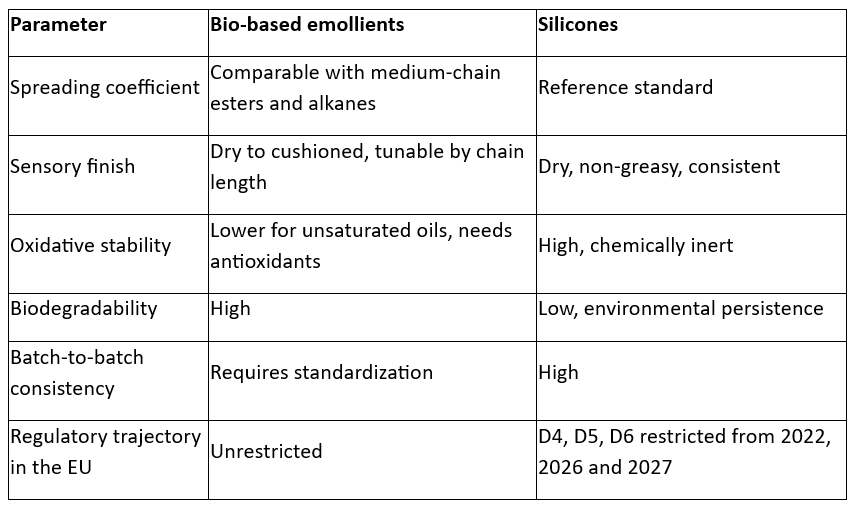
Bio-based emollients are skin-conditioning ingredients derived from renewable biomass, plant oils, fermented sugars or biosourced fatty acids, rather than from mineral oil or silicon. In a cosmetic formula, they perform the same core job as a silicone emollient: they spread across the skin or hair, reduce friction, and leave a defined sensory finish, from dry and powdery to rich and cushiony. This article focuses specifically on bio-based options; for a broader map of the silicone alternatives landscape across every cosmetic format, see our dedicated overview.
The main raw material families
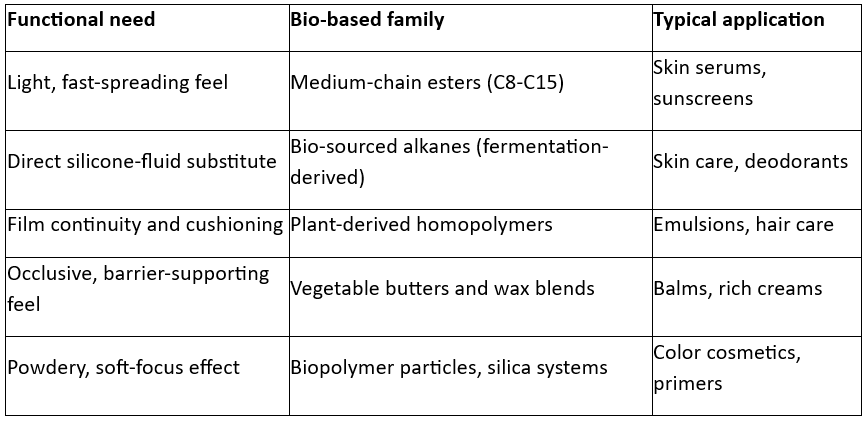
Three families cover most of the current market: medium-chain esters (C8 to C15) for a light, fast-spreading feel; biosourced alkanes produced through fermentation of renewable sugars, used as direct silicone-fluid substitutes; and plant-derived homopolymers built from natural monomers such as citronellol, used where film continuity and cushioning matter most.
Performance versus silicones
Bio-based emollients match silicone performance on several of the attributes that matter most in a finished formula, though not uniformly across every use case. A clinical trial conducted with the Federal University of São Paulo evaluated a plant-derived homopolymer built from citronellol against traditional emollients in topical emulsions. The emulsions kept their viscoelastic stability over time and delivered comparable skin hydration, moisture retention and elasticity, with reduced transepidermal water loss.
Sensory feel and spreadability
Formulators typically judge an emollient on spreading coefficient, evaporation rate, viscosity and surface tension. Medium-chain esters combined with squalane or plant-derived alkanes provide a close sensory match to low-viscosity silicone fluids in most emulsion systems, with a dry, non-tacky finish. Silicones still hold an edge in silicone elastomers, which create the soft-focus, powdery blur used in primers. Biopolymer particles and silica-based systems are the current substitute, though the match is not yet perfect.
Shelf life and oxidative stability
This is where the trade-off is real, not a formulation myth. Vegetable oils and esters rich in unsaturated fatty acids are more prone to oxidative degradation than silicones, which are chemically inert to oxygen. A peer-reviewed review of vegetable oil stabilization confirms that oxidation, driven by light, oxygen and temperature, is the main factor limiting shelf life in oil-based systems. In practice, this means pairing bio-based emollients with an antioxidant system and running accelerated stability testing before scale-up, rather than assuming a plant-derived ingredient behaves like a silicone once it is in the jar.
Film-forming and occlusivity
For film-forming and light occlusivity, biosourced alkanes and medium-chain esters replicate the continuous, low-tack film that low-viscosity dimethicone provides. Heavier occlusive claims call for blends with vegetable butters or waxes, since single bio-based esters rarely match the full occlusive profile of a high-viscosity silicone gum on their own.
Sustainability benefits of bio-based emollients
The main sustainability benefit is biodegradability: bio-based emollients break down in the environment, while cyclic silicones persist. Natural emollients already represent the largest share, in both value and volume, of the natural ingredient market, with skin care alone accounting for close to 40% of that revenue, and the esters segment leading the category.
Biodegradability versus cyclic siloxanes
Cyclic siloxanes such as D4, D5 and D6 are classified by ECHA as persistent, bioaccumulative and toxic, or very persistent and very bioaccumulative, precisely because they resist environmental breakdown. Bio-based emollients built on fatty esters and biosourced alkanes do not carry that persistence profile, which is the regulatory rationale behind the EU restrictions on cyclic silicones described below.
New sourcing routes: green chemistry
Fermentation and green chemistry are pushing the category beyond simple vegetable oil substitution. One documented approach functionalizes ferulic acid, a compound recovered from agro-industrial byproducts, into multifunctional emollients through chemoenzymatic synthesis, reaching isolated yields of 80 to 93% with a low environmental footprint on standard green chemistry metrics. This kind of route matters commercially because it turns a byproduct stream into a functional ingredient, rather than competing with food-grade vegetable oil supply.
EU regulations accelerating the shift
Regulation is now the strongest driver of reformulation, ahead of consumer preference alone. Octamethylcyclotetrasiloxane (D4) has been banned in EU cosmetic products since January 2022, and Regulation 2024/1328 extends the restriction to decamethylcyclopentasiloxane (D5) and dodecamethylcyclohexasiloxane (D6).
Scope of the D4, D5 and D6 restriction
Under the amended Annex XVII of REACH, D4, D5 and D6 cannot be placed on the market at a concentration of 0.1% or more by weight, whether as a standalone substance, a constituent, or part of a mixture. D4 and D5 have already been subject to this limit in rinse-off cosmetics since January 2020.
Timeline for wash-off and leave-on products
The general 0.1% threshold applies from 6 June 2026. Leave-on products, where cyclic siloxanes have historically been used at the highest concentrations, get a one-year derogation and must comply by 6 June 2027. Formulators working on moisturizers, serums, primers or SPF products fall squarely into that second deadline, which makes now the right time to validate a bio-based replacement rather than wait for the compliance date.
Choosing a bio-based emollient for your formulation
Start from the sensory and functional gap you need to close, then match it to a raw material family rather than a single ingredient.
Formulators working across skin care, hair care and color cosmetics can review Safic-Alcan's cosmetics ingredient range to match a raw material family to a specific formulation brief.
Where the trade-off stands today
The gap has narrowed substantially over the past two years. On spreading, sensory finish and hydration, bio-based emollients now hold their own against silicones in controlled studies, and the regulatory calendar means the comparison will matter less over time simply because D4, D5 and D6 will no longer be an option in the EU past 2027. The trade-off that remains is technical, not conceptual: oxidative stability and batch-to-batch consistency still require deliberate formulation work, through antioxidant systems, sourcing standardization and accelerated stability testing. That is a solvable formulation problem, not a structural limitation of bio-based chemistry.
FAQ
Are bio-based emollients as effective as silicones?
On spreading, sensory finish and hydration, yes, according to comparative and clinical data. On oxidative stability and long-term consistency, bio-based options require more formulation support, typically an antioxidant system and standardized sourcing.
Are natural emollients biodegradable?
Yes. Fatty esters, biosourced alkanes and plant-derived homopolymers break down in the environment, unlike cyclic silicones, which are classified by ECHA as persistent and bioaccumulative.
Do bio-based emollients feel greasy on skin?
Not necessarily. Medium-chain esters and biosourced alkanes deliver a dry, non-tacky finish comparable to low-viscosity silicone fluids. Heavier natural oils and butters do feel richer, which is why raw material selection should follow the target sensory profile rather than a blanket "natural" label.
Can bio-based emollients fully replace dimethicone?
For light to medium-viscosity dimethicone grades, yes, in most skin and hair care applications. For silicone elastomers and very high-viscosity silicone gums, current bio-based alternatives get close but do not yet fully replicate every sensory attribute, particularly the soft-focus blur used in primers.