



Biocides are substances or mixtures used to control, destroy, or prevent the action of harmful organisms. In industrial settings, they protect materials, processes, and products from microbial degradation. In the EU, their use is governed by a single binding framework that defines both what qualifies as a biocide and the conditions under which it can be placed on the market.
What is a biocide under EU law?
Regulation (EU) No 528/2012, known as the Biocidal Products Regulation (BPR), defines a biocidal product as any substance or mixture consisting of, containing, or generating one or more active substances, with the intention of destroying, deterring, or exerting a controlling effect on harmful organisms by means other than mere physical or mechanical action. The regulation came into force on 1 September 2013, replacing the earlier Biocidal Products Directive (98/8/EC).
The ECHA BPR framework establishes a two-tier system: active substances must first be approved at EU level, after which individual biocidal products containing those substances require separate market authorisation, either nationally or through a Union procedure. No biocidal product can be sold or used on the EU market without this authorisation.
A point that frequently catches non-EU manufacturers off guard: Product Type 6 under Annex V covers "preservatives for products during storage," meaning active substances added purely for in-can or in-storage preservation are regulated in the EU even when they are exempt in other jurisdictions.
The 22 product types: industrial relevance
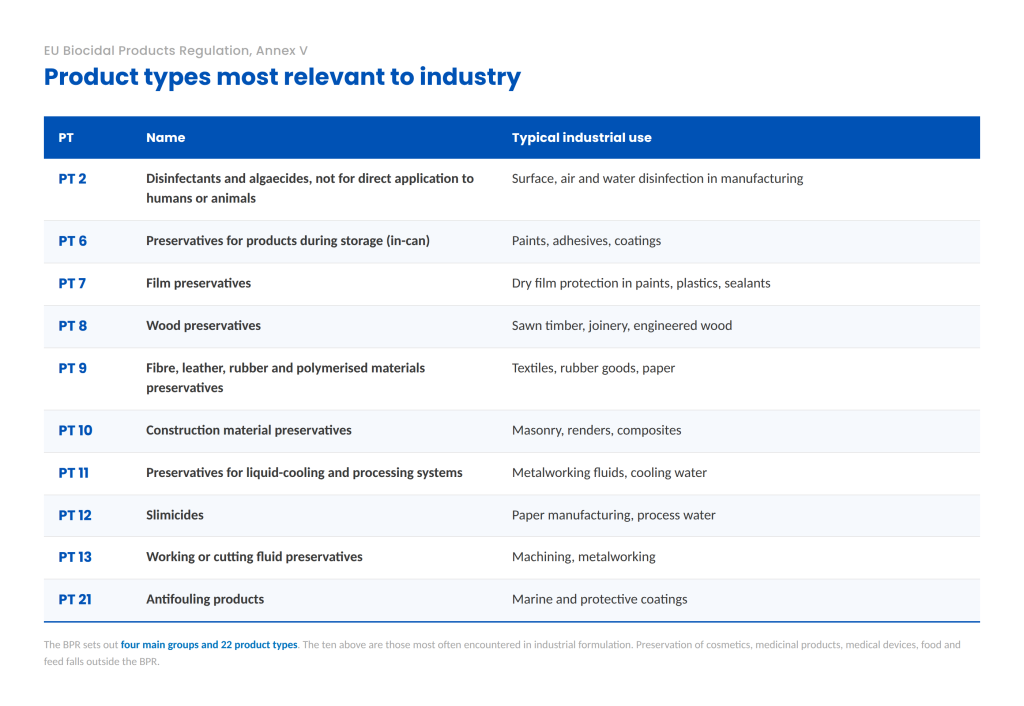
The BPR organises biocides into four main groups and 22 product types. The product types most relevant to industrial applications are:
Biocide families used in industry
Isothiazolinones
Isothiazolinones are among the most widely used preservatives in paints, coatings, adhesives, metalworking fluids, and personal care products. The most common members are methylisothiazolinone (MIT), chloromethylisothiazolinone (CMIT), benzisothiazolinone (BIT), octylisothiazolinone (OIT), and its chlorinated derivative DCOIT.
Their mechanism of action is primarily electrophilic: isothiazolinones oxidize thiol groups in cytoplasmic and membrane proteins, causing rapid inhibition of metabolic activity and growth in exposed cells. This makes them effective at broad spectrum against bacteria, fungi, and algae at low concentrations.
However, the same reactivity that makes them effective also underlies their toxicological profile. Recent studies confirm that isothiazolinones can penetrate the skin, bind to cellular components, and induce oxidative stress, apoptosis, and immune responses, with emerging data also suggesting possible endocrine-disrupting and neurotoxic effects. This has led the EU to impose strict concentration limits, particularly for MIT and CMIT/MIT mixtures in consumer-accessible products.
Biocidal activity varies across the family: MCI shows the highest potency, followed by OIT and DCOIT, then BIT, then MIT. This hierarchy is paralleled by cytotoxicity, creating a direct trade-off between efficacy and safety that formulators must navigate within the limits set by the BPR.
Formaldehyde-releasing agents
Formaldehyde releasers such as bronopol (2-bromo-2-nitropropane-1,3-diol) and IPBC (iodopropynyl butylcarbamate) are widely used in metalworking fluids and industrial water systems. They act by slowly releasing formaldehyde, which crosslinks proteins and nucleic acids in microbial cells. Regulatory pressure on free formaldehyde concentrations has pushed formulators toward controlled-release variants, but these remain under active review under the BPR.
Quaternary ammonium compounds (QACs)
QACs such as ADBAC (alkyl dimethyl benzyl ammonium chloride) and DDAC (didecyl dimethyl ammonium chloride) are approved active substances under multiple product types. They disrupt bacterial cell membranes through electrostatic interaction with negatively charged phospholipid bilayers. Their use in surface disinfection (PT 2) and film preservation (PT 7) is well established in industrial cleaning and coating applications.
Zinc-based inorganic biocides
Zinc oxide used as a dry-film preservative acts by slowly releasing zinc ions that inhibit fungal and algal growth on coated surfaces. It is cost-effective but requires careful formulation: improper stabilisation can cause viscosity increase, pH change, or gelation in the paint system.
How the BPR approval process works
Active substance approval is initiated by submission of a dossier to ECHA. The Biocidal Products Committee (BPC) then conducts a peer review and prepares an opinion within 270 days, on the basis of which the European Commission grants or refuses approval. Approval is granted for a specific product type, for a defined period not exceeding 10 years, and is renewable. The application for renewal must be submitted 550 days before the expiry date of the current approval.
Existing active substances, meaning those already on the market before 14 May 2000, are assessed through a transitional Review Programme. Products containing substances still under review may remain on the market under national transitional provisions until three years after the date of approval or non-approval.
Biocide resistance: a growing industrial concern
The long-term effectiveness of industrial preservation is increasingly challenged by microbial adaptation. A 2023 review in Nature Reviews Microbiology notes that most biocides primarily target the cytoplasmic membrane and enzymes, but that inappropriate use or sub-inhibitory concentrations can act as a selective stressor rather than a lethal agent, potentially driving the emergence of tolerance.
A 2025 review in ScienceDirect documents several mechanisms of concern: overexpression of efflux pumps, membrane alterations, and reduced porin expression, all of which can confer cross-resistance to multiple antibiotic classes. The same review identifies horizontal gene transfer as an important route by which resistance determinants spread in industrial environments.
Biofilm growth mode is a particular problem: bacteria growing in adherent biofilms show significantly higher resistance to biocides compared to their planktonic counterparts, driven partly by reduced penetration of the active substance and partly by altered metabolic states within the biofilm matrix.
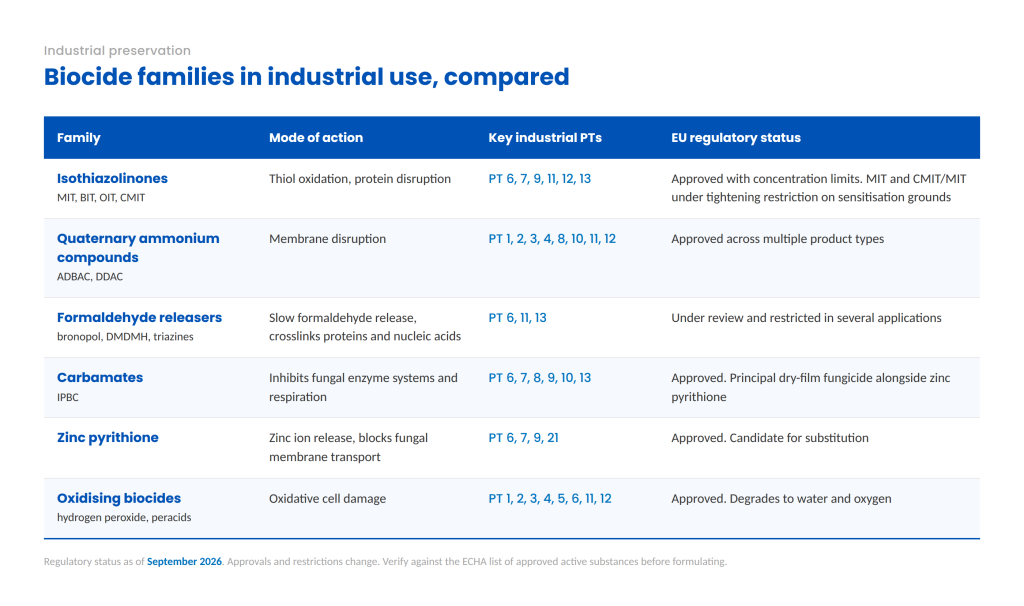
Comparison: key biocide families in industrial use
Frequently asked questions
What is the difference between a biocide and a preservative under the BPR?
The BPR does not establish a legal distinction: a preservative is a biocide used to protect a product or material against microbial deterioration during storage or use. Preservatives in food and cosmetics are explicitly out of scope of the BPR, which covers only industrial, material, and disinfectant uses.
What is a "treated article" under the BPR?
A treated article is any object that has been treated with, or intentionally incorporates, a biocidal product, such as a biocide-treated textile or a paint containing an in-can preservative. Under the BPR, treated articles may only use biocidal products containing approved active substances, and labelling obligations apply when specific claims are made or when sensitisation risks are present.
Why are isothiazolinones increasingly restricted?
Despite their efficacy, isothiazolinones are strong sensitizers producing skin irritation and allergic contact dermatitis. The EU has adopted strict concentration limits to balance the risks for workers handling these biocides and for end consumers exposed to treated products. Further tightening is expected as more toxicological data accumulate.
Can a biocidal product be sold in the EU without authorisation?
No, with limited transitional exceptions. ECHA's framework requires both active substance approval at EU level and product-level authorisation before market placement. Products that fail to obtain authorisation must be withdrawn. The authorisation process typically takes two to four years.
Do biocides contribute to antibiotic resistance?
This is an active area of scientific concern. A 2025 critical review identifies biocides as capable of exerting selective pressure on microbial populations, promoting the proliferation of resistant strains and contributing to the spread of antimicrobial resistance genes in both environmental and industrial settings. The risk is particularly linked to sub-inhibitory concentrations and long-term, low-dose exposure scenarios common in industrial preservation.