



Quick answer: The circular economy relies on specialty chemicals at almost every step: stabilizers and compatibilizers that let recycled plastics keep their properties, devulcanization agents that give rubber a second life, low-VOC resins that cut solvent waste in coatings, and upcycled or bio-based actives that replace virgin raw materials in cosmetics. None of these levers work alone. Formulators need a distributor who understands the regulatory and technical constraints across all of them at once.
What does the circular economy mean for the chemical industry?
The circular economy is a model built to keep materials in use for as long as possible, instead of extracting, using and discarding them in a straight line. For the chemical industry, that translates into three concrete levers, and they are not interchangeable.
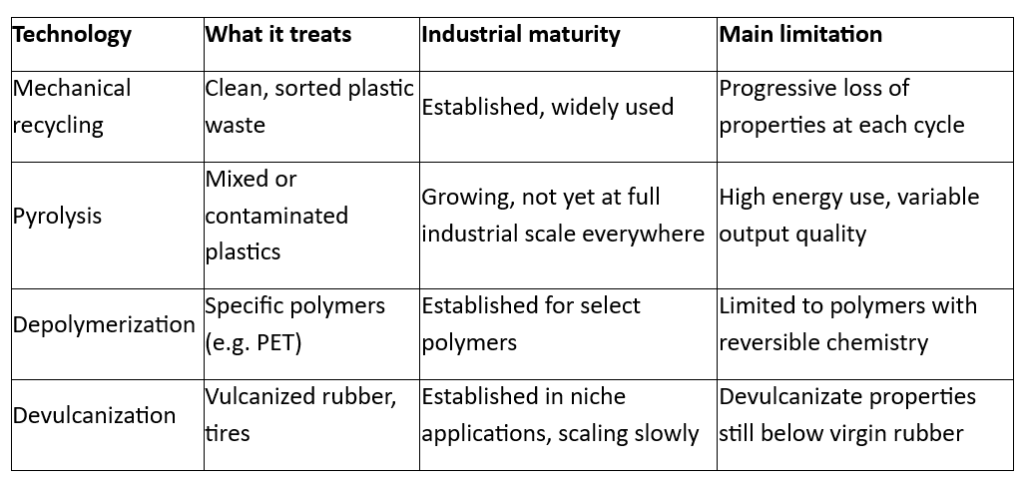
The first is mechanical recycling: physical processing (sorting, grinding, melting) that reshapes a material without breaking its molecular structure. The second is chemical recycling, sometimes called advanced recycling, which breaks the material down at the molecular level to recover monomers or feedstock. The third is bio-based sourcing, which addresses where a material comes from rather than what happens to it at end of life.
Mixing these three up is one of the most common mistakes in sustainability communication, and it matters for compliance as much as for messaging.
Mechanical recycling vs chemical recycling: what's the difference?
Mechanical recycling keeps the polymer chain intact. It works, but each cycle degrades the material a little, which limits how many times a given batch can be reprocessed before it loses performance. Chemical recycling breaks the polymer down into smaller molecules, in principle allowing a return to virgin-like quality, at the cost of more energy input and, for some processes, lower overall yield. Industry practitioners increasingly describe the two as complementary rather than competing: mechanical recycling for clean, well-sorted streams, chemical recycling for the harder, mixed or contaminated ones that mechanical processes cannot handle.
Which specialty chemicals support circularity across industries?
This is where a distributor's breadth matters more than in almost any other part of the business, because the additive that solves a circularity problem in plastics rarely looks anything like the one that solves it in rubber or in coatings.
How do stabilizers protect recycled resins during reprocessing?
Recycled plastic goes through repeated cycles of heat and mechanical stress, which accelerates oxidative degradation compared to virgin resin. Antioxidants and UV stabilizers are formulated into recyclate specifically to slow that degradation, so the material can be reused in demanding applications rather than downcycled into lower-value products at each pass.
What makes a rubber compound easier to recycle or reprocess?
Vulcanized rubber is chemically cross-linked, which is exactly what makes it durable and exactly what makes it hard to recycle. Devulcanization reverses part of that cross-linking, most often by breaking sulfur bonds through mechanical, thermal or chemical treatment, so the material regains enough plasticity to be reprocessed. Reinforcing fillers and coupling agents are then used to bring the resulting devulcanizate closer to the mechanical performance of virgin rubber, since devulcanized material on its own typically falls short.
How are coatings formulated to reduce solvent-based waste?
Traditional solvent-borne coatings can carry several hundred grams of VOC per liter, while waterborne formulations bring that down substantially by using water instead of organic solvent as the carrier. The shift is not just an environmental preference. VOC limits enforced under frameworks like REACH in the EU and the Clean Air Act in the US are pushing formulators toward waterborne, high-solid and powder coating technologies, which in turn changes what resins, dispersants and coalescing agents a formulator needs.
What role do upcycled ingredients play in cosmetics?
Upcycling in cosmetics takes byproducts that would otherwise be discarded, fruit peels, spent coffee grounds, oil pressing residues, and turns them into functional actives instead of processing them down like conventional recycling does. That distinction matters: upcycling generally preserves more of the original material's value and requires less energy than breaking a material down and rebuilding it. We covered this angle in more depth in our piece on upcycled ingredients for cosmetics.
What role do bio-based and renewable feedstocks play?
Bio-based sourcing is often talked about in the same breath as recycling, but it addresses a different part of the material's life cycle.
Is bio-based the same as biodegradable?
No, and conflating the two is a common and costly mistake. Bio-based describes what a material is made from, biomass rather than fossil feedstock. Biodegradable describes what happens to it at the end of its life, whether microorganisms can break it down under specific conditions. A material can be bio-based and not biodegradable, biodegradable and not bio-based, or both, or neither. Regulatory bodies have flagged this confusion directly: the assumption that bio-based automatically means biodegradable is explicitly called out as a misconception by the European Commission's research information service.
Chemical recycling technologies compared
Why the distributor's role matters in a circular supply chain
None of the additives above are useful if they cannot be sourced reliably, documented correctly and delivered in compliance with the market they are sold into. Recycled and recovered materials fall under REACH just like virgin substances, and the interaction between REACH and waste framework rules creates real compliance questions for anyone using recycled or recyclate-derived inputs. A distributor's job in a circular supply chain is to absorb that complexity: qualifying suppliers, tracking regulatory status substance by substance, and making sure a stabilizer package that works for recycled polypropylene does not quietly fall foul of a restriction that applies to recovered materials but not virgin ones. That is the same role we described for chemical distribution more broadly, applied here to a supply chain where the source of the material is part of what needs to be managed.
FAQ
Is chemical recycling better than mechanical recycling?
Neither is categorically better. Mechanical recycling is more established and less energy-intensive but degrades material quality over successive cycles. Chemical recycling can handle mixed or contaminated streams that mechanical processes cannot, at a higher energy cost. Most industry voices now describe them as complementary tools rather than rival technologies.
What is molecular recycling?
It is another name for chemical recycling: breaking a polymer down at the molecular level, typically back to monomers or basic feedstock, rather than just reshaping it physically.
Is bio-based always more sustainable than synthetic?
Not automatically. Bio-based sourcing addresses feedstock origin, not end-of-life impact, and a full comparison needs to account for land use, biodiversity and the material's actual life cycle, not just where the carbon came from.
How does REACH affect recycled or bio-based chemical inputs?
Recycled materials become subject to REACH registration once they are converted from waste into a usable substance or polymer, which means recyclers and their customers face the same substance-tracking obligations as producers of virgin material, on top of waste framework rules that already apply upstream.