



Substitution projects arrive from three directions: a regulation closes a door, a customer or retailer asks for a claim, or a supplier stops making the grade. The reflex is to look for a molecule that resembles the old one. The better starting point is the function it performed, and the property that will tell you whether the replacement works. This guide gives a starting map for the most common cases in cosmetics, and the method to test it.
Quick answer
- Write down the function and the acceptance criterion before shortlisting anything.
- Expect to replace one ingredient with a blend: single-molecule equivalence is rare.
- Check the regulatory status of the alternative against the same rules that pushed you to reformulate.
- Nothing in the table below is a validated substitute. It is a starting shortlist to test in your own base.
Three questions before the shortlist
- What is the function? Not the INCI name. Thickening at low shear, flash-off, film formation, pigment wetting, preservation, solubilisation.
- What will tell me it works? The measurement or the panel that decides, with the limit written down in advance.
- What constrains the answer? Regulatory status, claims, certifications, cost in use, supply, and the countries you sell in.
Most failed substitutions skip the second question. Without a written acceptance criterion, the trial becomes an opinion, and the project stalls between R&D and marketing.
A starting map for common cases
The table below is a direction of travel, not a recommendation. Each line points to a family of alternatives and to what has to be measured, because the same chemistry can behave very differently in a rinse-off and in an emulsion.
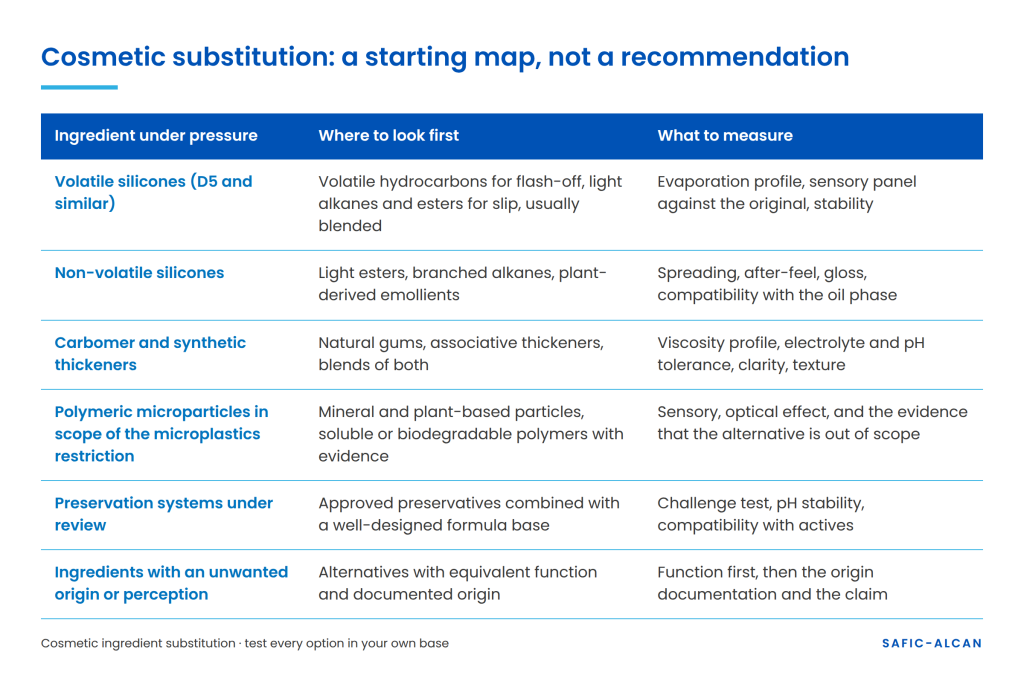
Each of these has a deeper guide on our site: replacing cyclopentasiloxane (D5), silicone alternatives in cosmetics, carbomer alternatives, the microplastics restriction calendar, our guide to preservatives, and controversial ingredients and their alternatives.
Need a shortlist for a specific ingredient?
Tell us the ingredient, its function and your constraints. Safic-Alcan cosmetic specialists will propose options available in your market and arrange samples.
Test it properly, and only once
A substitution trial that is not designed tends to be repeated. Four elements make the difference:
- The reference. Keep making the original formula alongside, so the comparison is real rather than remembered.
- One variable at a time. Changing the emollient and the thickener together saves a week and costs a month.
- Stability early. An oil phase or thickener change moves viscosity, emulsion stability and sometimes preservation.
- The panel. For anything sensory, a trained panel against the reference beats a beaker judgement.
The documentation arrives later than you think
A substitution is not finished when the formula works. The safety assessment has to be updated, which means the new supplier documentation has to arrive: composition, specification, impurities, toxicological data and the regulatory statements. That is usually the longest lead time in the project. Our CPSR documents checklist lists what to request, so you can ask once rather than three times, and start the request the day you shortlist rather than the day the formula is approved.
One more check that is easy to forget: the alternative has to be compliant in every country you sell in, not only in the EU. A material that solves an EU restriction may carry a different status elsewhere.
Reformulating before a regulatory deadline?
We can map which of the ingredients in your range are affected and what alternatives we distribute in your market.
Frequently asked questions
Is there a one-to-one replacement for most cosmetic ingredients?
Rarely. Most successful substitutions replace one ingredient with a blend, because the original was doing more than one job in the formula.
Where do I start when a regulation forces a change?
With the function of the ingredient and the acceptance criterion, then with the regulatory status of the candidates. Testing before checking status wastes trials.
How long does a substitution take?
It depends on the product and the evidence required, and the documentation from the new supplier is often the critical path rather than the laboratory work.
Can I keep my claims after a substitution?
Only if the substantiation still holds. Any claim that relies on the replaced ingredient has to be reviewed with the rest of the file.
Does an alternative with the same INCI name behave the same?
Not necessarily. Grade, process and specification differ between suppliers, which is why the trial against your own reference matters.