


Laundry detergent is one of the clearest examples of how a regulatory deadline can reshape a formulation almost overnight. For twenty years, EU manufacturers worked under Regulation (EC) 648/2004, a text stable enough that most formulators stopped thinking about it as a moving target. That changed on February 11, 2026, when the EU published Regulation (EU) 2026/405, replacing it entirely and tightening almost every lever a formulator has to work with: surfactant biodegradability, phosphate limits, fragrance labeling, and for the first time, a Digital Product Passport requirement. For anyone sourcing surfactants, enzymes or builders for a laundry formulation, this is not a distant compliance footnote. It is the reason the word "eco" on a detergent label means something more specific, and more demanding, than it did even two years ago.
What legally counts as an 'eco' detergent in the EU today
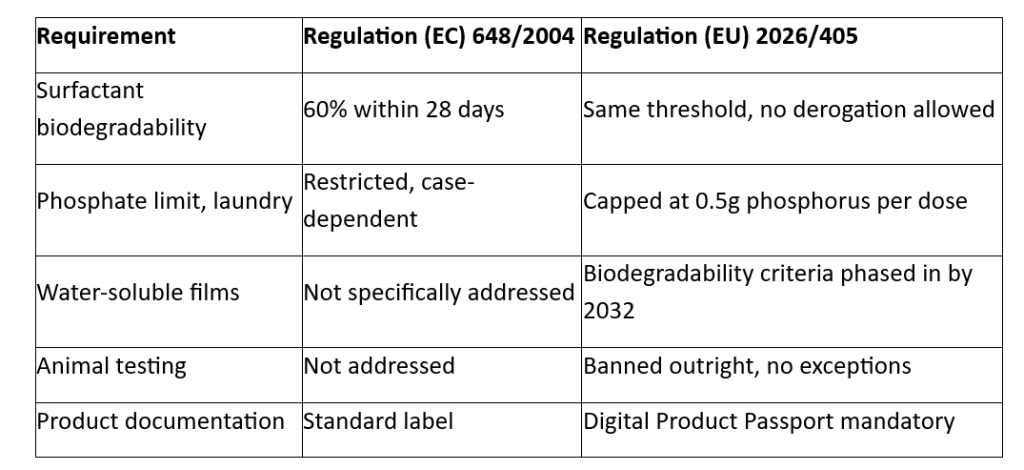
Under the new regulation, every surfactant used in a detergent placed on the EU market has to demonstrate ultimate aerobic biodegradability of at least 60% within 28 days, tested in an accredited laboratory. That threshold itself is not new, it carried over from the previous text. What changed is that the derogation process is gone. Under the old rules, a manufacturer could apply for an exception if a particular surfactant fell short of that bar but offered some other advantage. Regulation 2026/405 removes that option entirely: every surfactant has to clear the biodegradability threshold, full stop, with no case-by-case appeal.
Phosphate limits tighten in parallel. Household laundry detergents are now capped at 0.5 grams of phosphorus per standard dose, automatic dishwasher detergents at 0.3 grams. And the scope of the regulation itself widens: water-soluble polymer films, the kind used in unit-dose laundry capsules, now face their own biodegradability criteria, with compliance deadlines running out to 2032 and 2034 for the more concentrated organic substances. Detergents containing added microorganisms get a dedicated annex. Animal testing is banned outright for any detergent or surfactant in scope, with no exception process this time either.
None of this is cosmetic. A formulation that passed under the old regime because of a derogation is not automatically compliant anymore, and the compliance window is real but not infinite: sourcing teams have been told to audit their surfactant portfolios now, well ahead of the September 2029 deadline that applies to the surfactants themselves.
Why cold-water performance became a reformulation priority
Heating water accounts for a large share of the total energy used in a wash cycle, generally cited in the 75 to 90 percent range depending on the machine and the load. That single number explains why cold-water performance became one of the most active reformulation fronts in the industry over the past few years, well before the 2026 regulation gave formulators another reason to move.
Getting a detergent to clean as well at 15 to 20°C as it does at 40°C is not a marketing claim, it is a chemistry problem. Conventional surfactants lose efficiency as water temperature drops because their ability to reduce surface tension and lift grease is partly temperature-dependent. Enzymes solve part of that problem differently: proteases, lipases, amylases and cellulases work by breaking specific molecular bonds in stains rather than relying on heat to loosen them, which is why enzyme-rich formulations are the backbone of most cold-water detergent claims on the market today. The trade-off runs the other way at high temperatures, where excessive heat denatures the same enzymes and cancels out their benefit, so a formulator optimizing for cold water is also making a bet about how the product will actually be used.
Why concentration is not just a packaging decision
Concentrated formats get talked about as a packaging story, less plastic, lighter shipping weight, smaller shelf footprint, and that part is accurate. Traditional liquid detergents carry a high percentage of water, which inflates both the bottle size and the freight cost per wash. Stripping that water out and delivering the same cleaning power in a fraction of the volume genuinely reduces the material and transport footprint per load.
But concentration is also a stability problem that packaging framing tends to hide. A concentrate has to survive temperature swings in a warehouse or a delivery truck without the enzymes or the surfactant system breaking down, and it has to dissolve fully and evenly at the diluted, single-dose level a consumer actually experiences at the machine. That is a formulation constraint as much as a sustainability one, and it is one of the reasons the choice of surfactant and enzyme package for a concentrate is rarely a straight swap from a standard-dilution formula.
Where the reformulation trend intersects with sourcing
Put the regulatory shift and the performance trend together, and the sourcing brief for a laundry detergent formulator today looks different from the one that circulated even three or four years ago. It is not just "find a biodegradable surfactant." It is finding a surfactant that clears the ultimate biodegradability threshold under the new test protocol, performs at low wash temperatures, holds up in a concentrated, water-reduced matrix, and pairs correctly with an enzyme package that will not denature in transit or storage. Add the phosphate cap and the incoming rules on water-soluble films, and a formulator is effectively managing four or five moving regulatory and performance variables at once, not one.
This is the kind of brief where a distributor's role goes beyond catalog access. Tracking which surfactant grades already meet the 2026/405 biodegradability protocol, which enzyme suppliers have cold-water-stable product lines, and which combinations have actually been validated together rather than just on paper, is exactly the kind of cross-referencing that a specialized distributor is positioned to do for a formulator who does not have the bandwidth to track every annex of a regulation that is still rolling out new deadlines through 2034. We cover the broader version of that role in our article on what a chemical distributor brings to a formulation project, and the enzymatic angle specifically in our piece on enzymatic detergency.
Common questions from formulators
The question that comes up most often is whether "eco" is now a fixed, checkable standard or still a moving target. It is both, in a sense that matters practically. The biodegradability threshold itself, 60% within 28 days, has been stable since the previous regulation. What is not stable is the enforcement: the derogation process that let some formulations slide under the old rules is gone, and the scope keeps expanding, with polymer films and higher-concentration organic substances due to be pulled in over the next several years. A formulation that is compliant today needs to be checked again as each of those deadlines lands, not treated as permanently cleared.
A second question worth addressing directly: does cold-water performance mean giving up cleaning power. The honest answer is that it depends entirely on the enzyme and surfactant package behind the claim. Enzymes that are well matched to a cold-water profile can deliver comparable stain removal to a hot-water wash, which is why most credible cold-water claims lean on named enzyme systems rather than a generic "eco" label. A cold-water claim without a documented enzyme package behind it is worth being skeptical of.
And on concentration specifically, formulators sometimes assume a concentrate is simply a diluted formula scaled up. It is not. The surfactant and enzyme system has to be re-validated for stability at the higher concentration and for full dissolution at the point of use, which is why moving an existing formula to a concentrated format is a reformulation project in its own right, not a packaging change layered on top of an unchanged recipe.