



TL; DR The EU Ecolabel is a voluntary certification governed by Regulation 66/2010. To obtain it for a formulated product, you must (1) check that your product falls within an eligible product group, (2) demonstrate compliance with the relevant technical criteria (ecotoxicity, biodegradability, hazardous substances, packaging), (3) build a technical dossier with test reports and declarations, and (4) submit it to your national Competent Body. The process typically spans several months and Application fees are capped by Annex III of Regulation 66/2010 at €2,000, falling to €600 for SMEs and applicants from developing countries and €350 for micro-enterprises. National Competent Bodies set their own rates within those ceilings, so actual fees vary by country.
The EU Ecolabel is the European Union's official mark of environmental excellence. Established in 1992 and overhauled by Regulation 66/2010, it identifies goods and services that have a demonstrably lower environmental impact than comparable products across their full life cycle, from raw material extraction through to disposal. For formulators of detergents, cleaning products, and cosmetics, earning this label has become both a procurement signal in professional markets and a compliance-adjacent asset under Europe's Green Deal.
This article walks through the complete certification path: which formulated products are eligible, what the technical criteria actually require, how the application dossier is structured, and what realistic costs look like.
Reformulating for Ecolabel eligibility?
Browse our Home Care and Cosmetics ingredient ranges.
Which Formulated Products Are Eligible?
The EU Ecolabel operates by product group. Each group has its own Commission Decision establishing the scope and the specific criteria. For formulators working in specialty chemicals, the relevant product groups are the following.
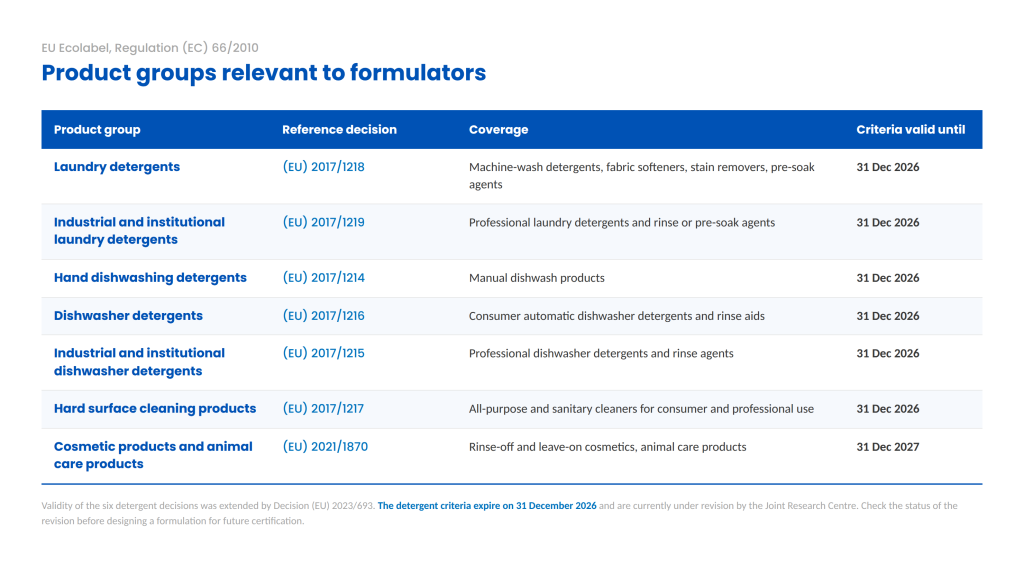
The detergent criteria for several of these product groups are under revision by the Joint Research Centre (JRC), with the first multi-stakeholder working group having met in March 2024. Formulators should monitor the JRC consultation process for updates before designing formulations aimed at future compliance.
Products outside these groups, including medicinal products for human or veterinary use and medical devices, are explicitly excluded from the EU Ecolabel scheme under Article 2 of Regulation (EC) No 66/2010.
For cosmetics specifically, Decision 2021/1870 expanded coverage in October 2021 beyond rinse-off products (previously governed by Decision 2014/893/EU) to include leave-on products such as creams, styling products, deodorants, and decorative cosmetics, as well as animal care products. The practical scope for formulators active in the cosmetics catalogue is therefore broader than it was five years ago.
Understanding the Technical Criteria
Regardless of product group, the criteria structure for formulated products follows a consistent logic: limiting aquatic toxicity, ensuring biodegradability, restricting hazardous substances, and setting packaging requirements. The weight and thresholds differ by product group, but the underlying methodology is shared.
Critical Dilution Volume (CDV): the core aquatic toxicity metric
The Critical Dilution Volume, or CDV, is the calculation that most often determines whether a formulation can qualify. It expresses the volume of natural water theoretically needed to dilute one functional unit of the product to a concentration below the threshold for chronic aquatic harm. The calculation is derived from the ecotoxicity and degradation parameters of each ingredient, using data drawn from the DID list maintained on the EU Ecolabel website.
For each substance, CDV is a function of its chronic toxicity factor (TFchronic, derived from NOEC or EC10 values across trophic levels) and its degradation factor (DF, from OECD 301 A-F or 310 biodegradability tests). The total CDV of the product is the sum of CDV contributions from all ingoing substances. If a substance does not appear in the DID list Part A, the applicant must calculate or extrapolate the relevant parameters using the DID list guidance, and attach the supporting documentation.
The European Commission provides a spreadsheet tool on the EU Ecolabel website to automate this calculation. The applicant enters the DID number and weight fraction of each ingredient, and the tool outputs the CDV result against the applicable limit for the product category.
Biodegradability requirements
For detergent product groups, all surfactants must be readily biodegradable under aerobic conditions. Non-ionic and cationic surfactants must additionally meet anaerobic biodegradability requirements. The criteria also set limits on the total content of aerobically non-biodegradable organics (aNBO) and anaerobically non-biodegradable organics (anNBO) in the finished formulation.
For rinse-off cosmetic products and animal care products under Decision (EU) 2021/1870, all surfactants must be readily biodegradable aerobically, with biodegradability under anaerobic conditions required as an additional threshold. The same CDV methodology applies, using the DID list as the primary data source.
For leave-on cosmetics, the criterion shifts: aquatic toxicity and biodegradability are assessed separately from rinse-off products, reflecting the lower environmental exposure route of leave-on formulations.
Hazardous substance exclusions
Under Article 6(6) of Regulation (EC) No 66/2010, the EU Ecolabel cannot be awarded to products containing substances classified as toxic, carcinogenic, mutagenic, or toxic for reproduction (CMR) under CLP Regulation, nor to substances identified as Substances of Very High Concern (SVHCs) under Article 57 of REACH.
At the product-group level, the cosmetics criteria impose additional substance-specific restrictions: limits on fragrances, a ban on certain preservatives, and restrictions on colorants. For detergents, phosphates and EDTA/EDTA salts are excluded due to specific environmental concerns relating to eutrophication and persistence. The DID list and the criteria user manuals specify which substances are permitted, restricted, or excluded outright.
Formulators working on compliant coatings formulations should note that substance eligibility for the EU Ecolabel must be evaluated against both the generic exclusions in the Regulation and the substance-specific restrictions in the relevant product group decision.
Packaging criteria
Packaging requirements typically appear as criterion 4 or 5 in the product group decisions. For cosmetics under Decision (EU) 2021/1870, the criteria address recyclability of packaging materials, limits on heavy metals in plastic packaging, and restrictions on certain additives. For detergents, dosing instructions and concentration instructions on packaging are also evaluated, since product efficacy at the recommended dose affects the overall environmental impact per functional unit.
How to Prepare a Compliant Formulation
Before preparing the dossier, it is worth spending time on formulation design with certification in mind. Several practical steps reduce rework during the assessment phase.
Start with the DID list
The DID list Part A contains the most widely used ingoing substances in detergent and cosmetic formulations, with pre-validated ecotoxicity and biodegradability parameters. Building formulations around DID list substances substantially reduces the documentation burden. Where a substance is not on the DID list, the applicant must either source validated test data or extrapolate using the DID list guidance methodology, which adds time and cost to the process.
Run a CDV calculation early
Using the Commission's CDV spreadsheet on a draft formulation before finalizing it is the most effective way to identify problem ingredients. Surfactants are typically the largest contributors to CDV in cleaning products. Switching to an aerobically and anaerobically biodegradable surfactant at the formulation stage is far less costly than reformulating after a failed assessment.
Verify REACH/CLP compliance for every ingredient
Every substance above 0.010% w/w in the final formulation must comply with the hazardous substance exclusions under the criteria. Checking each ingredient against the SVHC candidate list on the ECHA website and against the CLP classification of the substance should be completed before submitting the dossier.
Formulators active in plastics applications may encounter substances that are acceptable in those formulations under REACH but would fail the EU Ecolabel hazardous substance exclusion. The two frameworks operate independently and should be checked separately.
The 7-Step Application Process
The European Commission describes a seven-step process on its dedicated guidance pages. The following table summarises each step with the practical actions required.
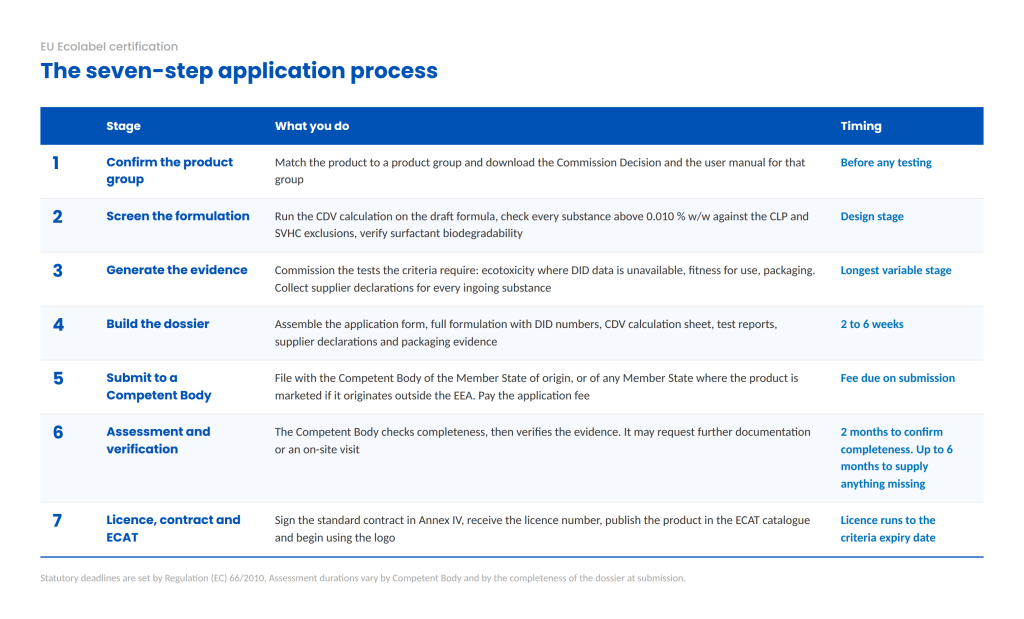
The application can be submitted to the Competent Body of the Member State where the product originates. If the product originates in several Member States simultaneously, the applicant may choose any one of them. If the product originates outside the EEA, the application is submitted to any Competent Body in a Member State where the product is or will be marketed.
ECAT registration is mandatory for all licence holders. The online EU Ecolabel catalogue serves as the traceability record for the scheme. Even once a licence is awarded, the licence holder remains responsible for keeping the ECAT entry up to date. The Competent Body may at any time request documentation from the licence holder to verify continued compliance, or conduct on-site visits.
Fees are set by each national Competent Body within the thresholds established by Regulation (EC) No 66/2010 as amended by Regulation (EU) No 782/2013. They vary by country and company size.
Companies holding EMAS registration can benefit from a 30% reduction on the application fee with certain Competent Bodies; ISO 14001 certification may provide a 15% reduction. Where both certifications are held, only the higher discount applies.
Competent Bodies may also charge an annual fee. Where it is calculated as a percentage of annual sales it cannot exceed 0.15% of ex-factory value, and is capped at €25,000 per product group per applicant. SMEs, micro-enterprises and applicants from developing countries receive a reduction of at least 25%. Testing, verification and on-site inspection costs are separate and borne by the applicant.
Maintaining the Licence
The EU Ecolabel licence is not a one-time certification. The licence contract, which follows the standard form set out in Annex IV of Regulation (EC) No 66/2010, requires the holder to ensure continued compliance with the criteria throughout the duration of the contract. When criteria are revised by the Commission, existing licence holders are given a transition period to adapt.
If the formulation of a certified product changes, the licence holder must notify the Competent Body. Depending on the nature of the change, a revised assessment may be required. Material changes to ingredients above the 0.010% w/w threshold, in particular changes affecting the CDV calculation or the hazardous substance profile, will generally trigger a reassessment.
When criteria validity expires and new criteria are adopted, a renewal application is typically required. Where criteria are extended without modification, licence holders may renew through a simplified procedure paying 50% of the standard application fee.
EU Ecolabel and Green Public Procurement
One of the most concrete commercial benefits of EU Ecolabel certification for B2B formulators is eligibility under Green Public Procurement (GPP) frameworks. The European Commission and many Member State governments specify EU Ecolabel certification as a technical criterion or award criterion in tenders for cleaning products, detergents, and cosmetics supplied to public-sector clients. Holding the licence removes the need for buyers to conduct their own environmental due diligence on the product, which simplifies procurement.
This channel is particularly relevant for formulators supplying the institutional cleaning market or the professional cosmetics sector, where public procurement represents a significant portion of total volume.
Frequently Asked Questions
Can a manufacturer outside the EU apply for the EU Ecolabel?
Yes. Regulation (EC) No 66/2010 explicitly allows operators outside the EEA to apply. In that case, the application must be submitted to a Competent Body in any Member State where the product is or has been placed on the market.
Does the EU Ecolabel cover the same substances as REACH?
No. The two frameworks are complementary but operate independently. The EU Ecolabel hazardous substance exclusion references both CLP classifications and the REACH SVHC list, but its scope is distinct from REACH authorisation and restriction requirements. A substance that passes REACH compliance checks may still fail the EU Ecolabel criteria.
What is the DID list and where can I access it?
The Detergent Ingredient Database (DID list) is maintained by the European Commission and contains pre-validated ecotoxicity and biodegradability parameters for the most widely used surfactants and ingoing substances in detergent formulations. It is available via the EU Ecolabel website and through national Competent Body websites. For substances not on the DID list, the list's Part B provides guidance on how to calculate or extrapolate the required parameters.
How long does the application process take?
Under Regulation (EC) No 66/2010, the Competent Body has two months after receipt of the application to check completeness and notify the applicant. After that notification, the applicant has up to six months to complete any missing documentation. In practice, well-prepared dossiers move faster; incomplete or complex applications can extend the timeline significantly.
Is the EU Ecolabel compatible with other ecolabels?
The EU Ecolabel scheme is designed to be compatible with national Type I ecolabels compliant with EN ISO 14024, including the Nordic Swan Ecolabel. In some countries, a dual application is possible, and certain Competent Bodies coordinate fees to avoid double payment of the annual turnover fee for a product holding both labels simultaneously.
What happens if my certified product fails a compliance check?
Under Article 10 of Regulation (EC) No 66/2010, the Competent Body may at any time request documentation from the licence holder or conduct on-site visits. If a product is found to be non-compliant, the Competent Body can suspend or withdraw the licence. The licence holder must then cease using the EU Ecolabel on the product.