


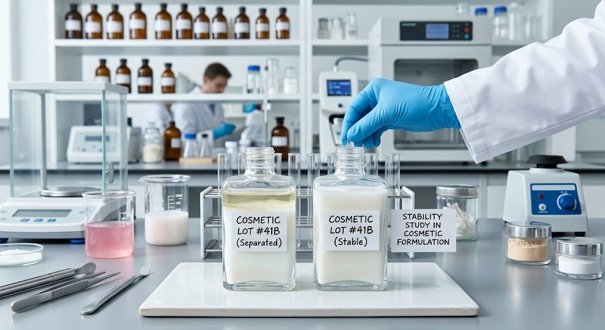
Formula stability: a challenge as old as formulation itself
Every cosmetic formulator has faced formula stability issues. A formula looks perfectly uniform after production. Initial tests are successful, the texture feels right, and the appearance matches expectations. Then, after a few days or weeks, signs of instability begin to appear: an oil layer forms at the surface, particles settle at the bottom, or distinct phases become visible.
Maintaining stability over time remains one of the most common and critical challenges in cosmetic formulation. A stable formula is one that maintains its appearance, texture, performance, and homogeneity throughout its shelf life under normal storage conditions. Stability directly impacts product quality, consumer perception, and commercial success.
While instability can have multiple causes, formulators typically encounter three main types of separation: oil release, phase separation and sedimentation.
Understanding the mechanism behind each phenomenon is the first step toward selecting the right stabilization strategy.
Understanding the Different Types of Formula Separation
1. Oil Release: When Emulsification Fails
Oil release occurs when oil droplets begin to agglomerate because the emulsification system is no longer able to keep them adequately separated.
As droplets merge, the emulsion loses stability and an oily layer gradually appears at the surface of the product. This phenomenon is often associated with insufficient emulsification efficiency or an inadequately structured interfacial film around the oil droplets.
In simple terms, oil release is primarily an emulsification issue.
2. Phase Separation: When the Suspension Network Is Too Weak
Unlike oil release, phase separation does not necessarily involve droplet coalescence.
Instead, the emulsion slowly migrates within the formula because the suspension system is not strong enough to maintain a homogeneous distribution. Over time, two distinct layers become visible, typically with an aqueous phase at the bottom and an emulsion-rich phase at the top.
This type of instability often occurs when the formula lacks sufficient structural support to keep dispersed elements uniformly distributed.
3. Sedimentation: When Particles Settle
Sedimentation occurs when suspended particles such as pearls, exfoliating beads, pigments, botanical petals, or other decorative ingredients gradually sink to the bottom of the container under the effect of gravity.
The opposite phenomenon, flotation, can also occur when particles are less dense than the surrounding medium.
As with phase separation, sedimentation is fundamentally a suspension challenge.
Choosing the Right Formula Stability Solution
Because oil release and suspension-related instabilities arise from different mechanisms, they require different formulation approaches.
Three categories of ingredients can help formulators improve long-term stability:
1. Emulsifiers: Strengthening Emulsification
Emulsifiers reduce interfacial tension and help maintain stable oil droplets within the formulation. By reinforcing the emulsion structure, they are often the most effective solution for preventing oil release.
Pellicer® LB-30G from Asahi Kasei is a natural liquid emulsifier compatible with cold-process manufacturing while remaining suitable for hot-process formulations. Its versatility enables the development of stable fluid emulsions, including emulsified bi-phase systems, lotions, and classic creams. For formulators seeking stability without sacrificing processing flexibility, it offers an interesting approach to creating elegant, stable textures.
2. Suspending agents: Improving Suspension Stability
Suspending agents help maintain homogeneous distribution throughout the formula by preventing particles, micelles, and oil droplets from migrating over time.
Amaze® XT from Nouryon is a modified xanthan gum offering stronger thickening performance than standard xanthan gum at equivalent dosage levels. In addition to its natural origin and cold-process compatibility, it provides improved suspension properties with reduced stringiness. Depending on use level, it can function as both a structural rheology modifier and a stabilization tool for transparent formulations requiring suspension performance.
Safic'Care™ T XCG from Safic-Alcan is a blend of natural gums designed to deliver suspension with minimal impact on viscosity. At very low use levels, it allows formulators to create highly fluid systems while maintaining effective suspension performance. This makes it particularly suitable for innovative formats such as pearlescent sprayable mists. At higher concentrations, the ingredient can also generate elastic solid films suitable for applications such as masks or patch-like systems, offering considerable formulation versatility.
3. Texturizing agents: Building Mechanical Stability Through Texture
Sometimes stability can be improved simply by reinforcing the mechanical structure of the formulation.
A more structured rheological network can reduce movement within the system and help limit sedimentation, phase separation, or instability phenomena.
Structure® Silk from Nouryon is a texturizing agent that helps create richer, glossier textures with a premium sensory profile, while contributing to the overall structural integrity of the formula.
Structure® XL from Nouryon provides efficient viscosity building with a more matte sensorial profile. By reinforcing the formulation network, it can contribute to improved mechanical stability.
Candelilla Wax DRZ from INA Trading, as wax structuring remains a classic approach to improving formulation stability. Candelilla Wax can increase the consistency of the internal phase, helping reinforce the overall architecture of emulsified systems.
Explore More Stability Solutions
Formula separation is not a single challenge but a collection of different instability mechanisms.
Before selecting a solution, formulators must first determine whether they are facing:
- Oil release caused by insufficient emulsification
- Phase separation caused by inadequate suspension
- Sedimentation caused by particle migration
Once the root cause is identified, the appropriate combination of emulsifiers, suspending agents, and texturizing ingredients can significantly improve long-term stability and help maintain product performance throughout its lifecycle.
Discover our full portfolio
Emulsifiers, rheology modifiers, suspending agents, texture enhancers - all in our Online Product Picker.