


A laundry liquid is built from three functional blocks that each do a different job: surfactants remove the soil, enzymes break down what surfactants alone cannot touch, and builders neutralize the water hardness that would otherwise stop both from working properly. Reformulating toward an "eco" profile does not mean swapping one ingredient for a greener equivalent. It means re-selecting all three classes together, because a change in one almost always forces a change in the other two. This piece looks at each class on its own terms, then at why the liquid format itself narrows the choice more than a powder ever would.
Surfactant classes: what each one actually contributes
Surfactants are usually split into anionic, nonionic, cationic and amphoteric families, and a laundry liquid formulation leans almost entirely on the first two.
Anionic surfactants carry a negative charge and are the primary cleaning agents in most formulations. Linear alkylbenzene sulfonate (LAS) is the most widely used, alongside alcohol ether sulfates and alpha olefin sulfonates. They give strong sudsing and good performance on particulate and oily soils, and according to the American Cleaning Institute, anionic and nonionic types together account for most of the cleaning power in household laundry and dish products.
Nonionic surfactants carry no charge and are built by adding ethylene oxide groups to a fatty alcohol, which is why they are usually called alcohol ethoxylates. They are lower-sudsing than anionics, more tolerant of hard water, and particularly effective on oily soils on synthetic fibers, a profile the same ACI glossary describes for alcohol ethoxylates specifically.
A third group, alkyl polyglucosides, has grown in relevance for eco formulations specifically because it is derived from renewable feedstock (fatty alcohol and glucose) rather than petrochemicals, and it behaves as a mild nonionic surfactant that pairs well with enzymes without deactivating them. It shows up less often in mainstream formulations than LAS or alcohol ethoxylates, but it is the class most formulators reach for first when a brief asks for a plant-based surfactant system.
Whatever the mix, the constraint that did not exist five years ago is now the same one across every class: under Regulation (EU) 2026/405, every surfactant in a detergent sold on the EU market must clear 60% ultimate biodegradability within 28 days, with no derogation process left to fall back on if it does not.
Enzyme classes: matching the enzyme to the stain, not the other way around
Enzymes work differently from surfactants. Instead of lowering surface tension to lift soil away, they catalyze the breakdown of specific stain molecules into smaller, water-soluble fragments. That specificity is exactly why a laundry liquid formulated for broad stain coverage typically carries several enzyme types rather than one.
Protease was the first enzyme class used at scale in laundry detergents and remains the workhorse for protein-based stains: blood, grass, egg, dairy. Amylase targets starch-based residues, common in food and sauce stains. Lipase breaks down fats and oils, the stain category surfactants alone struggle with most at low temperature. Cellulase does not target stains directly; it acts on the cotton fiber itself, smoothing surface fibrils to restore color depth and softness on repeated washes. Mannanase is the newer addition to the standard cocktail, targeting mannan-based residues from thickeners like guar gum and locust bean gum, found in a surprising number of food and condiment stains.
These five classes are compatible and are commonly combined in a single formulation, but compatibility comes with real constraints, not just a percentage to hit. Enzymes are proteins, and they denature above certain temperatures, which is precisely why a detergent optimized for cold-water performance leans harder on enzyme load than a detergent designed for a 40 to 60°C cycle. They are also sensitive to the surfactant system around them: a high concentration of anionic surfactant can suppress enzyme activity, and direct contact with oxidizing bleach during storage degrades them outright. Formulating an enzyme package is therefore inseparable from the surfactant and stabilizer choices made elsewhere in the same liquid.
Builder classes: why liquids can't just copy what powders use
Builders exist to do one job: capture the calcium and magnesium ions in hard water before they can interfere with the surfactant system. Without a builder, surfactants spend part of their capacity neutralizing water hardness instead of removing soil, and cleaning performance drops accordingly.
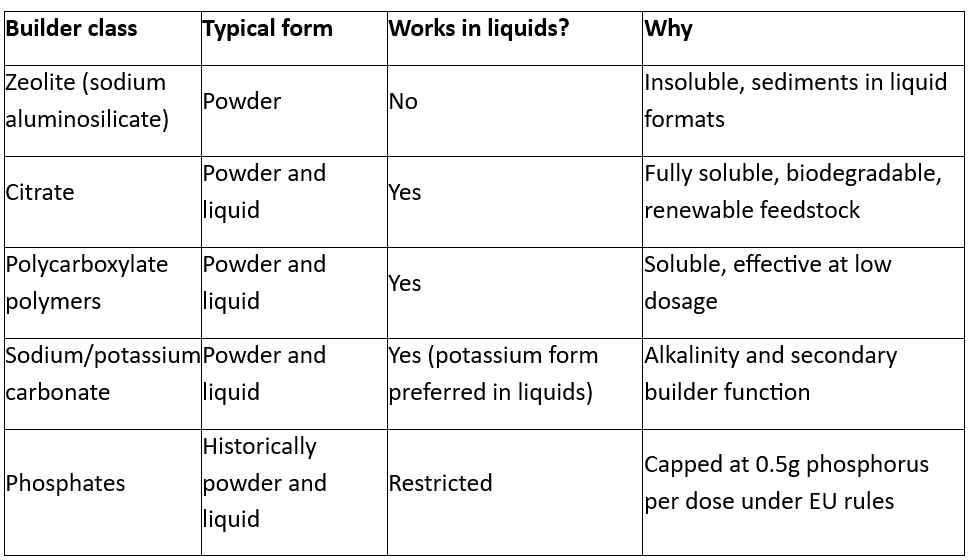
Powders and liquids solve this with different chemistry, and the difference is not a formulation preference, it is a physical constraint. Zeolite, the dominant phosphate replacement in powder detergents since the 1980s, is an insoluble ion-exchange material. That is fine in a powder, where it stays suspended as fine solid particles. In a liquid, an insoluble solid sediments out over time, causing exactly the kind of phase separation and instability a liquid formulation cannot tolerate. That is why heavy-duty liquid detergents lean on citrate builders instead: citric acid and its sodium salts are fully soluble, sequester calcium and magnesium effectively, and come from renewable feedstock, which is part of why patent literature on liquid detergent chemistry consistently flags citrate as the polycarboxylate builder of choice for liquid formats specifically.
Sodium carbonate and sodium silicate round out most builder systems as secondary alkalinity sources, though in liquids the potassium analogues are often preferred over the sodium ones simply because they are more soluble at the concentrations a liquid formulation needs.
Putting the three blocks together
None of these three classes is chosen in isolation once phosphate limits, biodegradability thresholds and cold-water performance targets are all on the same brief. A citrate-built, enzyme-rich liquid using LAS or alcohol ethoxylate as the primary surfactant and an alkyl polyglucoside as a mild co-surfactant is a common eco-oriented starting point, but the actual ratios depend on the soil profile the product is meant to handle, the wash temperature it is marketed for, and how long the formula needs to stay stable on a shelf before use. We go deeper into the regulatory side of that brief, and why sourcing a compliant surfactant is no longer a one-line spec, in our article on eco detergent reformulation. For the enzymatic side specifically, our piece on enzymatic detergency covers the performance case in more depth.