



Quick answer: Surlyn® is an ionomer resin produced by Dow from a copolymer of ethylene and methacrylic acid, partially neutralized with sodium or zinc ions. It combines glass-like optical clarity, impact resistance, and chemical inertness in a single thermoplastic material, which explains its dominance in luxury fragrance caps, closures, and cosmetic jars. Two sustainable grades, Surlyn® REN (bio-based) and Surlyn® CIR (circular feedstock), now extend its use to brands targeting verified sustainability credentials.
Contact a Plastics expert for Surlyn
Get in touch with one of our technical expert today !
What is an ionomer resin?
An ionomer is a thermoplastic polymer in which a fraction of the repeat units carry ionized carboxyl groups. In practice, a copolymer of ethylene and methacrylic acid (or acrylic acid) is partially neutralized with metal cations (most commonly sodium or zinc) to form ionic crosslinks between neighboring polymer chains, as described in a 2024 review published in Chem & Bio Engineering. These ionic clusters dissolve when the material is heated and reform upon cooling, giving ionomers a useful combination: they process like conventional thermoplastics on standard injection molding equipment, yet exhibit mechanical behavior closer to lightly crosslinked networks at service temperature.
The base polymer typically consists of 50–90 wt% ethylene and 10–30 wt% methacrylic acid. Higher acid content in the 18–30 wt% range favors optical clarity and adhesion; lower acid content (5–20 wt%) pushes toward toughness and easier melt processing, as detailed in the ionomer materials database maintained by PatSnap Eureka. The choice of cation (sodium, zinc, or lithium) and degree of neutralization then determine the balance between stiffness, flexibility, and surface finish.
Surlyn® was originally commercialized by DuPont in the early 1960s and is now sold by Dow for high-end packaging, medical, and sports applications, per the same 2024 review. It remains the dominant ionomer grade for luxury cosmetic packaging, with ExxonMobil's Iotek™ as the main competing product.
Why luxury brands use Surlyn® instead of glass or standard plastics
Optical clarity comparable to glass
Ionomers are transparent thermoplastics with very low haze. The Polymer Database describes them as materials with "glass-like clarity, high toughness, and outstanding flexibility." In injection-molded thick-walled components, Surlyn® maintains this clarity without the sink marks or surface defects that afflict other polymers when processed in sections above 5 mm. Brands producing heavy overcaps with the visual depth of crystal glass rely on this property.
Impact resistance and structural recovery
The ionomeric crosslink network distributes impact energy across the polymer chains rather than concentrating it at stress points. According to US Patent 6,660,350, tensile impact values for Surlyn® grades range from approximately 730 to 1,325 kJ/m² at room temperature, and the material retains up to 1,190 kJ/m² at −40 °C. In practice, this means a component that absorbs shocks without fracturing, which matters for retail shelf handling and for refillable systems subjected to repeated closing cycles.
Chemical inertness against fragrance formulations
Fragrances and skincare formulations typically contain ethanol concentrations of 70–90%, as well as perfume oils, aldehydes, and other reactive molecules. Standard clear polymers such as PET or PMMA can craze, cloud, or degrade under sustained contact with high-ethanol formulations. Surlyn® is effectively inert to these solvents: the polymer chain carries no plasticizers, and the ionic crosslinks resist chemical attack and liquid permeation. This chemical stability is the primary reason the material has become the default closure material for fine fragrance applications.
Weight reduction versus glass
US Patent 6,660,350 documents specific gravities of 0.94–0.97 g/cm³ for Surlyn® grades, compared to roughly 2.5 g/cm³ for soda-lime glass. For an equivalent volume of material, ionomer components are approximately 50% lighter than glass equivalents, a difference that reduces transport emissions, breakage risk, and distribution costs while allowing brands to design heavier-looking forms that are actually lighter in the hand.
Key processing routes and finishing options
Surlyn® runs on standard thermoplastic processing equipment designed for polyethylene and ethylene copolymers. The main routes used in luxury packaging are:
Injection molding is the primary route for caps, closures, cream jars, and collars. According to Dow's product page, the PC-2000 grade is specifically positioned for thick-walled cosmetic components with wall sections above 5 mm, processed in a single shot. Processing temperatures and screw designs follow standard polyolefin practices.
Blow molding and extrusion are used for bottles and tubular forms where the goal is to combine Surlyn®'s optical properties with a design that would be difficult to achieve in glass.
Decorative finishing is where the material's surface quality becomes commercially valuable. Surlyn® accepts metallization, hot stamping, engraving, and screen printing without adhesion promoters, which reduces production steps and allows brand designers to work with complex surface textures and optical effects that glass would require separate components to achieve.
For brands and formulators working across resin families, the differences between these options relative to other polymers are covered in the resin selection guide.
Sustainable grades: Surlyn® REN and Surlyn® CIR
In late 2023, Dow commercially launched two grades that use alternative feedstocks while delivering identical mechanical and optical performance to standard Surlyn®.
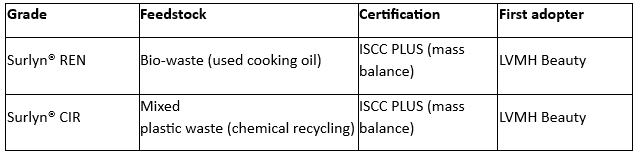
Both grades are certified under ISCC PLUS, a voluntary scheme that verifies the traceability of sustainable input streams through every step of the supply chain. The ISCC System describes it as covering "all materials linked to recycled or renewable feedstocks" with over 6,000 certificates issued globally. The mass balance approach means that sustainable feedstock is tracked as a proportional share of total production rather than physically segregated.
LVMH Beauty was the first to integrate these grades at commercial scale, including in Guerlain packaging, as part of its stated commitment to eliminate virgin fossil plastics from packaging. The shift toward sustainable fragrance packaging is reshaping procurement decisions across the sector: recycled materials now appear in 48% of new luxury fragrance prototypes, up from 27% in 2020, according to Scento.
PMMA offers similar transparency but fails under sustained ethanol exposure and tends to crack under impact. Standard polystyrene has neither the chemical resistance nor the toughness needed for fine fragrance closures. Glass remains the reference for bottle bodies but adds weight, breakage risk, and higher energy consumption in production. Surlyn® occupies the intersection of glass aesthetics and polymer processability, which is why it has remained the material of choice for luxury closures for over 60 years.
Applications in luxury packaging
- Perfume caps and overcaps are the core application. Thick-walled injection-molded caps in Surlyn® replicate the optical depth of cut crystal while remaining unbreakable and chemically stable against the ethanol vapor that escapes from the pump mechanism over time.
- Cream jars and pots for skincare at premium price points use Surlyn® for the same reason: a glass-like visual finish with the design flexibility of a thermoplastic, including the ability to mold complex curves and surface reliefs in a single shot.
- Collars and neckpieces on fragrance bottles are typically injection-molded in Surlyn® when the design calls for a transparent or metallized component that fits tightly against a glass body. The material's dimensional stability after molding makes it reliable for close-tolerance fits.
- Color cosmetics components (compacts, lipstick cases, palette inserts) increasingly use Surlyn® where visual clarity is part of the design, particularly for formats that show the product inside.
- For brands exploring the broader landscape of sustainable perfume packaging, ionomer resins represent one of the more mature and commercially validated material options available today.
FAQ
What is the difference between Surlyn® REN and Surlyn® CIR?
REN is produced from bio-waste feedstocks such as used cooking oil. CIR uses chemically recycled mixed plastic waste as its feedstock. Both deliver the same mechanical and optical properties as standard Surlyn® and carry ISCC PLUS certification under the mass balance method.
Can Surlyn® be recycled?
Standard Surlyn® grades are single-resin thermoplastics and can in principle be mechanically recycled. In practice, collection and sorting infrastructure for ionomer resins in cosmetic packaging streams remains limited. The CIR grade addresses this partly by incorporating post-consumer plastic waste at the production stage.
What wall thickness is achievable with Surlyn® injection molding?
The PC-2000 grade is documented for wall sections above 5 mm without sink marks, which is the main practical advantage over standard optical polymers for thick luxury closures. For thinner sections, standard Surlyn® grades perform well across the typical range used in cosmetic components.
Which brands use Surlyn® in packaging?
LVMH Beauty has publicly confirmed adoption of the REN and CIR grades for Guerlain packaging. Surlyn® has been used across fine fragrance and skincare by major houses for decades, though many brand-material relationships are not disclosed publicly.