


Organosilanes are hybrid molecules that bridge inorganic and organic matter. Their general formula is RₙSiX₄₋ₙ, where R is an organic group and X is a hydrolyzable group such as an alkoxy or halogen. This dual architecture makes them among the most versatile surface chemists in industrial materials.
What is an organosilane?
Organosilane compounds carry the general formula RₙSiX₄₋ₙ, where R is an organofunctional group and X is a hydrolyzable group, typically an alkoxy group or a halogen such as chlorine. The silicon atom sits at the center, simultaneously bonded to an organic chain on one side and to groups capable of reacting with inorganic surfaces on the other.
Organosilanes typically possess two reactive groups: organofunctional groups and hydrolyzable alkoxy groups. Through hydrolysis and condensation, they form silanols (Si-OH) and then siloxane (Si-O-Si) structures. This sequential chemistry is what gives organosilanes their adhesive and surface-modification power.
The R group is not decorative. As reviewed in dental polymer chemistry, R groups can be non-reactive substituents such as hydrocarbon or fluorocarbon chains, used as release agents, or they can carry reactive terminal groups such as methacrylate or epoxy able to copolymerize with organic resins. These latter types, with dual functionalities, are referred to as silane coupling agents.
How organosilanes react: hydrolysis and condensation
The reactivity of organosilanes unfolds in two steps that can be controlled by pH, solvent, and concentration.
Hydrolysis converts hydrolyzable alkoxy groups into silanols (Si-OH), and condensation between silanols then forms Si-O-Si siloxane structures. Once at an inorganic surface, these silanols bind covalently to surface hydroxyl groups.
According to a biosensor surface review published in Frontiers in Sensors, the mechanism begins when the trialkoxysilyl group is hydrolyzed to a trisilanol anchoring group by surface-adsorbed water molecules. The newly formed trisilanol subsequently diffuses to the surface-solution interface, undergoing reversible adsorption involving multiple condensation reactions with surface hydroxyl groups, resulting in islands that nucleate, expand during a reorganization phase, and aggregate to generate a covalently cross-linked adlayer.
Kinetic studies on GPS (gamma-glycidoxypropyltrimethoxysilane) show that in certain applications, acid-catalyzed hydrolysis in high concentrations of water is unsuitable, and it is necessary to work in systems diluted with acetone or ethanol, with the solvent directly affecting the rate of both reactions.
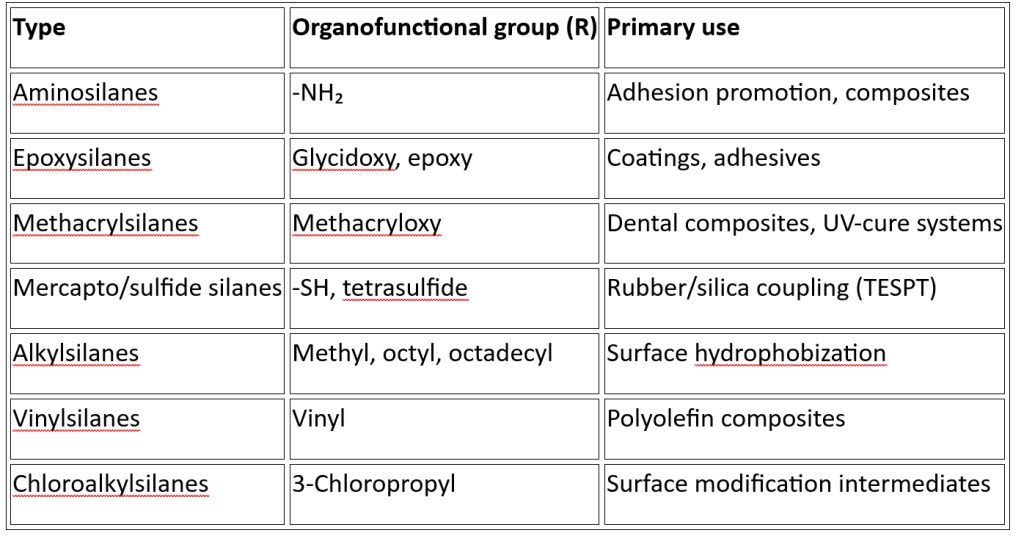
Main types of organosilanes
Applications
1. Adhesion promotion and composite materials
Organosilane coupling agents have been heavily used for bonding non-organic siliceous fillers and fibers such as talc, clay, and glass, as well as metals and metal oxides, to polymer matrices. They act both as chemical coupling agents and as filler dispersants, preventing agglomeration.
A particularly important example is the silica-reinforced green tire. This energy tire technology, which relies on coupling agents to replace carbon black with precipitated silica, now dominates the automotive tire market in Europe.
2. Rubber vulcanization
Silane coupling agents improve the mechanical properties of silica and silicate-containing fillers in rubber by forming a chemical bond between the filler and the rubber matrix. The most widely used are bis-(3-triethoxysilylpropyl)tetrasulfane (TESPT) and 3-thiocyanatopropyl triethoxysilane.
A study on silica-rubber composites published in Composites Science and Technology shows that bifunctional organosilanes such as TESPT form chemical crosslinks between two materials that would otherwise not react, with the coupling reaction proceeding from around 120°C during mixing.
3. Corrosion protection and metal pretreatment
A comprehensive coating review demonstrates that organosilane molecules form covalent bonds between inorganic and organic compounds, and that the inherent stability of the siloxane bond provides multiple benefits in coating systems. Their use in primers represents a healthier and more environmentally friendly alternative to chrome-based compounds in corrosion protection.
Bis-silanes outperform mono-silanes in corrosion protection due to better crosslinking and hydrophobicity, yielding improved barrier properties. This also means organofunctional silanes can directly replace toxic chromate treatments in metal finishing.
A review in the International Journal of Corrosion and Scale Inhibition further shows that corrosion inhibitors added to aqueous organosilane compounds enhance anticorrosive efficiency and provide a self-healing effect through documented synergistic action.
4. Surface hydrophobization and wettability control
A study published in ACS Omega on mineral surface treatment shows that organosilanes are an effective method for wettability alteration, with applications ranging from enhanced oil recovery to geological carbon sequestration processes such as improving storage capacity and caprock integrity.
Anti-adhesive organosilane coatings studied in the Journal of Applied Polymer Science enable precise adjustment of hydrophobic properties due to the wide range of available silane monomers, with covalent attachment and layer thicknesses in the range of tens of nanometers that do not alter the microstructure of coated surfaces.
5. Dental and biomedical applications
As detailed in an NIH-indexed review on dental polymer chemistry, the chemistry of organosilanes can be complex, involving hydrolytically initiated self-condensation reactions in solvents that culminate in polymeric silsesquioxane structures. In dentistry, organosilanes are the standard interface between inorganic fillers and resin matrices in composite restorations, governing both initial bond strength and long-term hydrolytic durability under oral conditions.
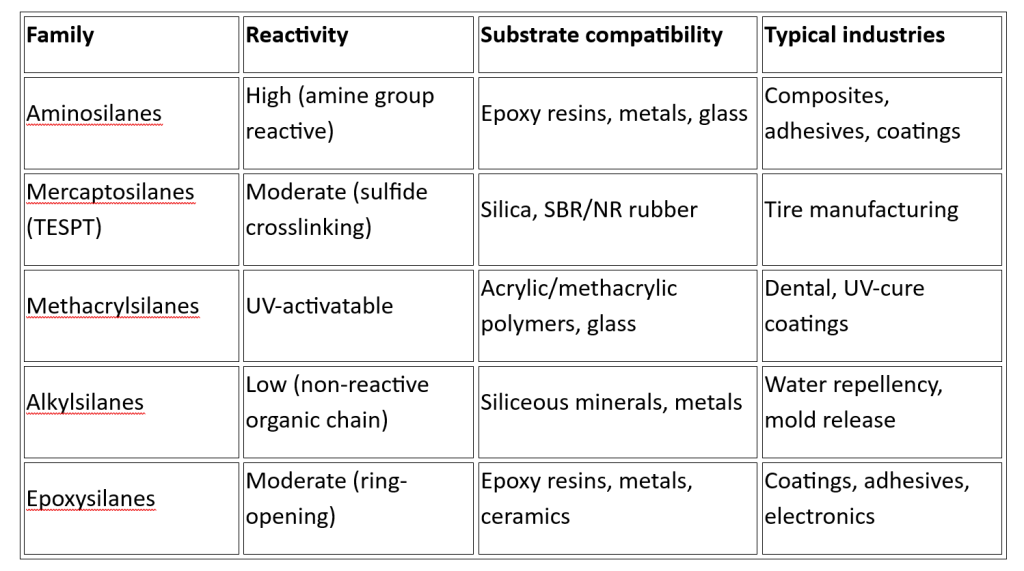
Comparison table: key organosilane families
Frequently asked questions
What is the difference between an organosilane and a silicone?
An organosilane is a monomer or small molecule with Si-C bonds and hydrolyzable groups, used primarily for surface treatment and coupling. A silicone (polysiloxane) is a polymer with a Si-O backbone, produced in part from organosilane precursors through hydrolysis and condensation at scale. Organosilanes are the reactive intermediates; silicones are the polymerized end-products.
Why are organosilanes preferred over chromates in metal pretreatment?
As shown in a corrosion protection overview, organofunctional silanes provide corrosion resistance through hydrophobic siloxane films without the toxicity of hexavalent chromium, aligning with stricter environmental regulations. They can be applied in thin nanometer-scale layers and form covalent bonds with both the metal surface and the organic topcoat.
How do organosilanes improve tire performance?
In silica-reinforced rubber compounds, silane coupling agents form a chemical bond between filler and rubber matrix, resulting in improved elasticity, resilience, and wear resistance. The replacement of carbon black by precipitated silica in tire treads reduces rolling resistance while maintaining grip.
Are all organosilanes water-stable?
No. Stability in water depends strongly on the organofunctional group and the pH. A review on organosilane corrosion inhibition notes that aminosilanes with primary amino groups form unstable aqueous solutions from which insoluble gels can precipitate, while those with tertiary amino groups hydrolyze quickly to give stable dilute solutions. Formulation chemistry, solvent choice, and pH control are all critical parameters.
What does "bis-silane" mean in corrosion protection?
A bis-silane has two trialkoxysilyl groups per molecule rather than one. According to a review on organofunctional silanes, this results in better crosslinking and hydrophobicity compared to mono-silanes, improving barrier properties and therefore corrosion resistance.