



Quick answer
A PFAS-free anti-graffiti specification clause needs a performance requirement (cleanability under the TL/TP AGS Beton and Gütegemeinschaft Anti-Graffiti e.V. framework, not a brand name), a precise chemical declaration ("does not contain intentionally added PFAS," Evonik's own confirmed wording, rather than an unqualified "PFAS-free"), and, if any product or standard is referenced, the words "or equivalent" attached to it. Under Article 42 of Directive 2014/24/EU, a clause that names one product without allowing equivalents is an automatic breach, confirmed by the CJEU in 2024.
Updating a specification clause?
The PFAS Transition Guide includes a ready-to-use anti-graffiti clause template, plus the restriction timeline and the technical pathway. 16 pages.
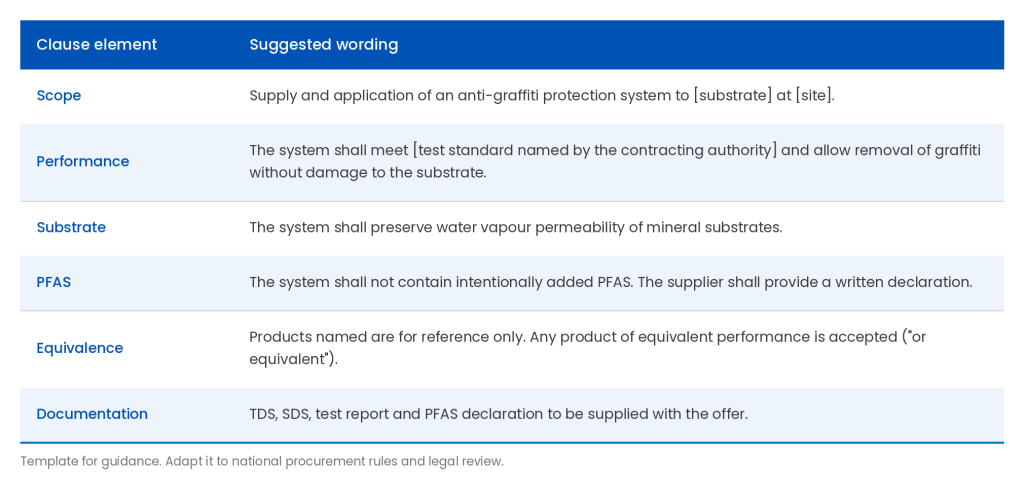
What a PFAS-free anti-graffiti clause actually needs to cover
A specification clause is not a marketing claim, it is a contractual requirement that has to survive a tender evaluation panel and, increasingly, a legal challenge from a competing bidder. For an anti-graffiti coating, that means stating three things separately: the cleanability performance the coating must achieve after repeated graffiti-removal cycles, the chemical declaration the product must meet, and the wording that keeps the clause open to more than one supplier. A clause that only says "PFAS-free anti-graffiti coating required, as manufactured by [supplier]" fails on more than one front at once, and public procurement law is now explicit about why.
Why anti-graffiti coatings specifically are affected
Anti-graffiti coatings are one of the applications where fluorochemicals have historically done the work: fluoropolymer and fluorosilane systems repel paint and solvent-based markers and let graffiti be removed without staining the substrate. That is exactly the chemistry the EU's PFAS restriction targets. Five national authorities submitted the restriction proposal to ECHA in January 2023, and by March 2026 ECHA's Risk Assessment Committee had adopted its final opinion, with the Socio-Economic Analysis Committee's consultation running to 25 May 2026 and a final opinion due by the end of 2026. A restriction entering into force before 2027 is unlikely, but anti-graffiti systems on public buildings are specified years ahead of installation, so the clause needs to be written now. The formulator-side detail of that timeline is covered in full in our silane-siloxane vs organofluorine comparison; this piece stays on what changes in the tender document itself.
How EU procurement law requires this clause to be written
Can a tender name a specific anti-graffiti product?
Not without qualifying it, and getting this wrong is now a documented legal risk, not a theoretical one. Article 42(3) of Directive 2014/24/EU gives contracting authorities an exhaustive list of ways to write a technical specification: in terms of performance or functional requirements, by reference to a technical standard, or a combination of both. Article 42(4) is the operative constraint: a specification that points to a particular product or brand is only lawful if followed by "or equivalent," unless the authority can objectively justify why no alternative would work. In 2024 the Court of Justice ruled on exactly this point in Case C-424/23, finding that a Belgian contracting authority's requirement for a specific pipe material, without "or equivalent," was an automatic breach of Article 42(2) and Article 18(1) even though the authority believed it had good technical reasons for the restriction.
What does "or equivalent" actually require from a specifier?
It means the clause has to describe what the coating must achieve, not which coating it must be. A clause built around a performance outcome (cleanability class, number of scrub cycles withstood, PFAS declaration) and, only secondarily, a named example product followed by "or equivalent," is the version that survives both a competing bidder's challenge and a compliance audit. A clause that names one supplier's anti-graffiti system with no equivalence language attached is the version that gets struck down.
Which performance test actually belongs in the clause
What test framework measures an anti-graffiti coating's performance?
Not ISO 11998, which measures wet-scrub resistance for wall coatings, not the cleanability of an impregnation system. Anti-graffiti performance for this product category is evaluated under the German TL/TP AGS Beton standard from the Federal Highway Research Institute (BASt), combined with the requirements of the Gütegemeinschaft Anti-Graffiti e.V. (Quality Association Anti-Graffiti). Substrates are coated with three defined paint systems, cleaned with an approved graffiti cleaner, and the cleaning is repeated ten times on the same spot, with a Ci value recording the degree of paint removal. Permanent systems must pass ten cycles after weathering equivalent to ten years outdoors (3,000 hours QUV); semi-permanent systems target a lower cycle count. This is the standard that actually measures what the buyer cares about: does the coating survive repeated cleaning without losing its protective performance. It replaces any water-repellency or freeze-thaw standard that doesn't test what an anti-graffiti product is designed to do.
"PFAS-free" or "does not contain intentionally added PFAS": the wording that survives review
These are not interchangeable. "PFAS-free" is an absolute claim, zero PFAS at any detectable level, which is difficult to substantiate given how ubiquitous trace fluorochemical contamination can be across a supply chain. "Does not contain intentionally added PFAS" is a formulation declaration, the exact wording used in Evonik's own technical data sheet for Protectosil® ECO-TRETE ANTIGRAFFITI: the manufacturer did not deliberately introduce a PFAS-based raw material for a functional purpose. It does not guarantee zero PFAS at trace level, and it is the wording that is legally defensible under REACH rather than an unsubstantiated absolute claim. A tender clause should use this exact phrasing rather than "PFAS-free" as a product descriptor.
Which chemistries meet this declaration today Non-fluorinated, surface-applied anti-graffiti coatings are the category responding to this shift. Evonik's Protectosil® ECO-TRETE ANTIGRAFFITI, distributed through Safic-Alcan's coatings portfolio, is a surface-applied, non-penetrating, fluorine-free coating in this category that does not contain intentionally added PFAS, per its technical data sheet. It is not a deep-penetrating water repellent and should not be specified as one; its role is graffiti protection and cleanability, which is what the TL/TP AGS Beton and Gütegemeinschaft clause above is written to test
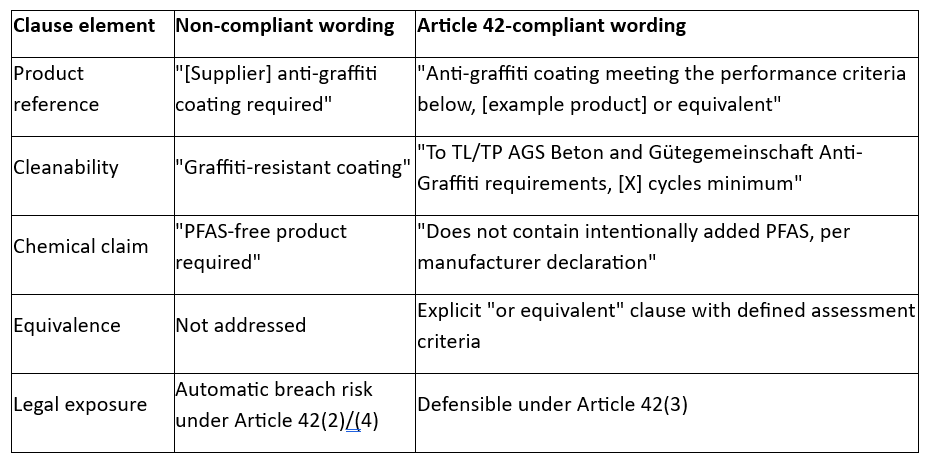
Brand-named clause vs performance-based clause
FAQ
Can a public tender name a specific anti-graffiti product?
Only if followed by "or equivalent," or if the authority can objectively justify why no alternative meets the requirement. A 2024 CJEU ruling (Case C-424/23) confirmed that naming a product without this qualifier is an automatic breach of EU procurement law.
What standard should test an anti-graffiti coating's performance in a spec clause?
Not ISO 11998, which measures wet-scrub resistance for wall coatings. The relevant framework is the German TL/TP AGS Beton standard (BASt) together with the Gütegemeinschaft Anti-Graffiti e.V. requirements, which test what an anti-graffiti coating is designed to do, unlike water-repellency or freeze-thaw standards written for different applications.
Is "PFAS-free" a defensible claim in a tender document?
Not without qualification. "Does not contain intentionally added PFAS," the wording Evonik uses in its own technical data sheet, is defensible under REACH, since an unqualified "PFAS-free" claim implies zero detectable PFAS, which is difficult to substantiate.
Does "or equivalent" weaken a specification?
No. It shifts the specification from a brand reference to a performance requirement, which is both the legally required approach under Article 42 and the version least exposed to a successful challenge from a competing bidder.
Can a public tender require PFAS-free anti-graffiti coatings?
Yes, if the requirement is objective, linked to the subject of the contract and worded as a performance or composition requirement, with "or equivalent" when a product is named.