


What is PVDF?
PVDF (polyvinylidene fluoride) is a semi-crystalline thermoplastic fluoropolymer — meaning it is both a thermoplastic (melt-processable, recyclable) and a fluoropolymer (fluorine-containing backbone). It combines the processing advantages of thermoplastics with the chemical and thermal resistance characteristic of fluoropolymers, making it uniquely suited to demanding industrial, energy and pharmaceutical applications.
Polyvinylidene fluoride (PVDF) is a semi-crystalline thermoplastic fluoropolymer produced by the polymerization of vinylidene difluoride (VDF). It occupies a distinctive position in the fluoropolymer family.
It is more processable than PTFE, denser with better mechanical strength than most commodity plastics, and uniquely capable of exhibiting piezoelectric behavior depending on its crystalline structure.
PVDF has a set of valuable properties :
- a relatively high melting point,
- high mechanical strength even at elevated temperatures,
- chemical and raditation resistance.
This combination explains why PVDF has expanded far beyond its original niche in chemical handling into electronics, energy storage, filtration, biomedical devices, and architectural coatings.
Applications of PVDF — By Industry and Grade
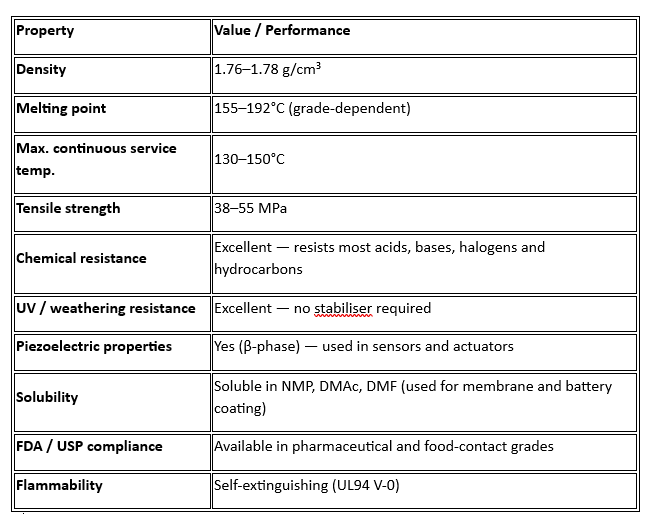
Polyvinylidene Fluoride Properties: At a Glance
Chemical resistance
PVDF expresses inherent resistance to ozone oxidation, nuclear radiation, UV damage, and microbiological and fungal growth — a profile that is fairly distinctive among thermoplastic materials. This resistance stems from the elemental stability of its carbon–fluorine bonds. It withstands most mineral acids, halogens, and aromatic solvents, though hot concentrated sulfuric acid and hot amines represent known limits of resistance.
Thermal stability
PVDF maintains useful properties across a wide temperature range, from −30 °C to 170°C.
Its thermal degradation temperature remains in the 400–450 °C range regardless of the crystalline phase or manufacturing method used. MDPI This stability underpins its suitability for high temperature industrial processing environments.
Mechanical performance
PVDF is one of the most rigid and abrasion-resistant of the melt-processable fluoropolymers, with excellent resistance to stress fatigue, abrasion, and cold flow. Compared to fully fluorinated polymers such as PTFE, PVDF offers superior mechanical strength and better dimensional stability under load.
Electrical properties
PVDF exhibits a relatively high dielectric constant and low dielectric loss across a wide frequency range, making it suitable for insulation and capacitive applications.
Crucially, in its electroactive crystalline form, it also develops piezoelectric and pyroelectric behavior — the ability to generate an electric charge in response to mechanical stress or temperature change — which distinguishes it from virtually all other melt-processable engineering polymers.
UV and weathering resistance
As a fine powder grade, PVDF is an ingredient in high-end architectural paints for metals. These coatings have extremely good gloss and color retention and are used on many prominent buildings around the world. This weathering durability is a direct consequence of the strength and inertness of its carbon–fluorine backbone.
What crystalline phases does PVDF form, and why does it matter?
One of the most technically significant aspects of PVDF is its crystalline polymorphism. Depending on how the polymer is processed, it can adopt several distinct structural phases, each with different property profiles.
The α-phase is the form that crystallizes naturally from the melt. It is non-polar and therefore does not exhibit piezoelectric properties. It is the dominant phase in most standard industrial processing.
The β-phase is the most electroactively valuable form. In the β-phase, the electronegative fluorine and electropositive hydrogen atoms are located on opposite sides of the polymer's carbon–carbon backbone, creating a net dipole moment that renders the piezoelectric properties to PVDF. This phase does not form spontaneously and must be induced through specific processing treatments such as mechanical stretching, high-pressure crystallization, or electrical poling.
The γ-phase is an intermediate form with weaker electroactive properties than β, typically obtained by solution casting or annealing near the melting point.
The practical implication is clear: the same base polymer can behave very differently depending on processing conditions. FOrs tructural or chemical resistance applications, the α-phase is entirely adequate. For sensor, actuator, or energy harvesting applications, maximizing β-phase content is critical.
What grades of PVDF exist?
PVDF is available in a range of grades tailored to different processing routes and end-use requirements. The two fundamental categories are homopolymers and copolymers.
Homopolymer grades deliver the highest crystallinity, the strongest mechanical properties, and the greatest chemical resistance. They are the standard choice for piping, chemical equipment, and applications requiring maximum purity or electrochemical stability.
Copolymer grades — primarily based on VDF copolymerized with hexafluoropropylene (HFP) or chlorotrifluoroethylene (CTFE) — trade some crystallinity for improved flexibility and lower processing temperatures. Copolymers with CTFE are among the most flexible PVDF products, showing excellent low-temperature performance and low shrinkage, making them ideal for wire, cable and tubing applications requiring enhanced flexibility.
Beyond the homopolymer/copolymer distinction, grades are further differentiated by:
- Melt viscosity, which determines suitability for extrusion versus injection molding
- Particle size and form (pellets vs. powder vs. dispersion), which is critical for coating applications and battery slurry preparation
- Purity level — industrial, semiconductor, and battery grades differ significantly in their contamination thresholds
- Molecular weight, which influences mechanical performance and melt flow behavior
For a broader perspective on how resin grade selection affects formulation and processing outcomes across polymer families, see our dedicated guide.
Ready to Work Together?
Get in touch with our team and discover tailored solutions for your industry
How is PVDF processed?
PVDF can be processed using techniques applicable to standard thermoplastics. Processing temperatures range between 190 and 280 °C. Drying of the resin before processing is usually not necessary, but care must be taken to eliminate dead zones where molten resin can collect and thermally decompose if residence time is excessive.
Extrusion
Extrusion is the dominant route for producing PVDF pipes, tubes, rods, films, and sheet. Controlled screw design, temperature profiling, and the elimination of stagnation points are essential to maintain polymer stability and surface quality. PVDF is available in the form of piping products, sheet, tubing, films, plate, and as an insulator for premium wire. It can be injected, molded, or welded.
Injection molding
Injection molding is used to produce precision components such as fittings, connectors, valve bodies, and housings. Appropriate mold design, temperature control, and shrinkage compensation are necessary to obtain dimensionally accurate parts.
Solution processing and coating
PVDF can be dissolved in polar solvents such as N-methylpyrrolidone (NMP), dimethylformamide (DMF), or dimethyl sulfoxide (DMSO) to form solutions suitable for casting films, preparing battery electrode slurries, or applying functional coatings. Solution-based processing routes include solution casting, spin coating, and film casting.
Compression molding and powder processing
Powder grades of PVDF are used in compression molding, rotational lining, and spray coating. As a fine powder or aqueous dispersion, PVDF is also the basis of high-performance architectural coatings applied to metal cladding panels.
What are the main application areas for PVDF?
Chemical processing equipment
Valves, piping, and other solid and lined components are typical applications of PVDF in chemical processing equipment. It is the only fluoroplastic available in rigid pipe form. It is also used for pump impellers, tank linings, heat exchanger tubes, and fittings in plants handling aggressive acids, solvents, and oxidizing agents.
Electrical and electronics
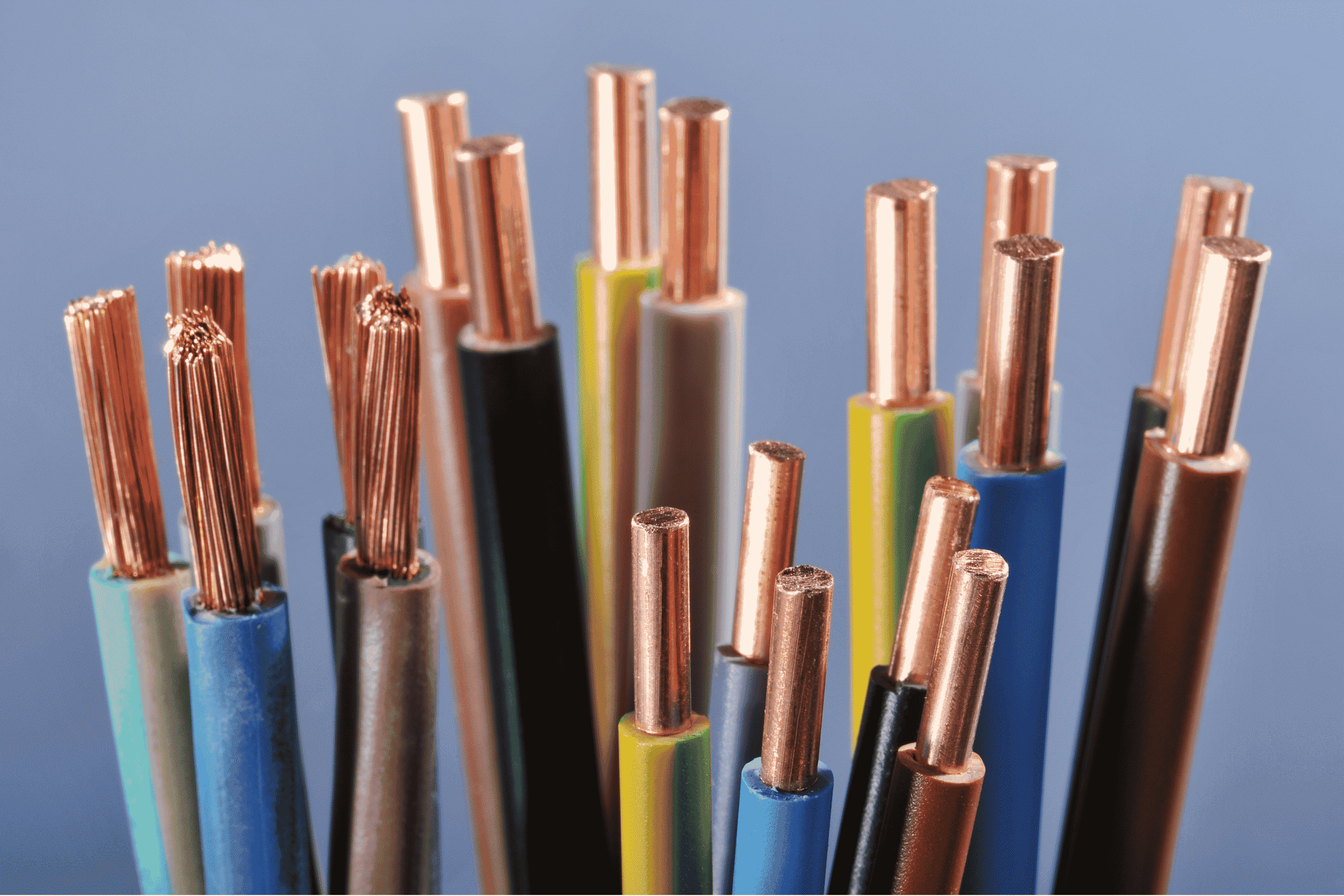
PVDF is commonly used as insulation on electrical wires because of its combination of flexibility, low weight, low thermal conductivity, high chemical corrosion resistance, and heat resistance. It is also used in high-frequency electronic devices and as a substrate or functional layer in flexible electronics.
Sensors, actuators, and energy harvesting
The β-phase piezoelectric properties of PVDF make it the polymer of choice for flexible sensors and transducers, acoustic emission detectors, pressure sensors, and vibration-based energy harvesting devices. Unlike ceramic piezoelectric materials, PVDF is lightweight, flexible, and biocompatible, making it uniquely suited to wearable and implantable sensor applications.
Lithium-ion batteries
PVDF has been the dominant polymeric binder in the mass production of lithium-ion batteries for decades. It has a good binding capacity while swelling to a limited extent in the electrolyte, facilitating the transfer of lithium ions to the surface of the active material. It is used both as a cathode and anode binder and as a separator coating in gel-polymer battery architectures. Battery-grade PVDF is subject to tight purity and particle size specifications that differentiate it significantly from industrial grades.
Filtration membranes
PVDF is used in biotechnology as a membrane to immobilize proteins and as a binder component for electrochemical applications. More broadly, PVDF membranes are widely used in ultrafiltration and microfiltration for water treatment, pharmaceutical filtration, and semiconductor ultrapure water systems, valued for their chemical durability, controllable porosity, and resistance to fouling treatments.
Architectural coatings
PVDF-based coatings applied as liquid or powder to metal cladding offer outstanding resistance to UV radiation, color fading, chalking, and atmospheric pollutants. This application relies on powder or dispersion grades and typically uses a blend of PVDF with acrylic resins to optimize both film formation and durability. The result is a coating with a service life measurable in decades — a property profile explored in depth in our article on sustainable coating systems.
Biomedical and pharmaceutical
PVDF can be used as a component of implants and sutures, as an engineering plastic in aggressive biological environments, as a component of transducers and sensors in the field of process control, and in the synthesis of separation membranes for biomedical applications. Its physiological inertness and mechanical robustness make it a credible alternative to metallic implant materials in selected structural applications.
How does PVDF compare to other fluoropolymers?
PVDF is often evaluated alongside PTFE, PFA, and ETFE. The key differentiator is processability: unlike PTFE, which cannot be melt-processed conventionally, PVDF is fully compatible with standard extrusion and injection molding equipment. Although the insulating properties and chemical inertness of PVDF are not as good as those of fully fluorinated polymers such as PTFE and FEP, the balance of properties available in PVDF qualifies it for many engineering applications across a temperature range from −73 to 149 °C.
Where PTFE excels in extreme chemical inertness and continuous high-temperature performance, PVDF offers better mechanical strength, easier and less costly processing, wider grade differentiation, and the unique advantage of electroactive behavior — a capability entirely absent in PTFE.
Key technical takeaways for formulators and engineers
PVDF is not a monolithic material. Grade selection, crystalline phase management, and processing route together determine whether the resulting part or coating will perform as a chemical-resistant structural component, a high-purity battery binder, a flexible piezoelectric sensor, or a decades-durable architectural finish. Understanding those levers — and matching them to application requirements — is the starting point for any serious formulation or design work involving this polymer.
FAQ on PVDF
What does PVDF stand for?
PVDF stands for polyvinylidene fluoride (also written polyvinylidene difluoride), a semi-crystalline thermoplastic in the fluoropolymer family. Its repeating unit — (CH₂–CF₂)n — alternates hydrogen and fluorine atoms, which drives its core pvdf properties: chemical durability, thermal stability, and piezoelectricity. Understanding what is pvdf starts with this structural duality, which distinguishes it from fully fluorinated polymers like PTFE.
What is the difference between PVDF homopolymer and PVDF-HFP copolymer?
PVDF homopolymer offers maximum crystallinity, stiffness, and chemical resistance. PVDF-HFP introduces hexafluoropropylene co-monomers that disrupt chain packing, reducing crystallinity and lowering the glass transition temperature. The result is a softer, more flexible material with higher ionic conductivity — a key advantage in gel polymer electrolytes — at the cost of some mechanical strength relative to the homopolymer.
Is PVDF food safe or biocompatible?
PVDF is approved for food and drinking water contact under FDA regulations and the European food contact regulation (EU 10/2011). In biomedical contexts, it is used in surgical sutures, hernia meshes, and implantable sensors. Its piezoelectric β-phase also enables active biomedical devices, though implant-grade applications require full device-level validation beyond material classification alone.
Can PVDF be recycled or is it considered sustainable?
As a thermoplastic, PVDF is theoretically recyclable through melt reprocessing, and closed-loop schemes have been explored for photovoltaic backsheets. In practice, fluoropolymer recycling infrastructure remains limited, and PVDF faces tightening PFAS scrutiny in the EU. Its long service life partially offsets end-of-life challenges, but the material does not qualify as inherently sustainable under current circular economy standards.
What solvents dissolve PVDF?
PVDF dissolves in polar aprotic solvents: N-methyl-2-pyrrolidone (NMP), dimethylformamide (DMF), dimethylacetamide (DMAc), and dimethyl sulfoxide (DMSO). Solubility is temperature-dependent, and solution concentration critically affects membrane morphology in phase inversion casting — central to polyvinylidene fluoride uses in filtration. Aliphatic hydrocarbons, water, and alcohols do not dissolve PVDF, which underpins its use in aqueous chemical environments.
Ready to Work Together?
Get in touch with our team and discover tailored solutions for your industry