


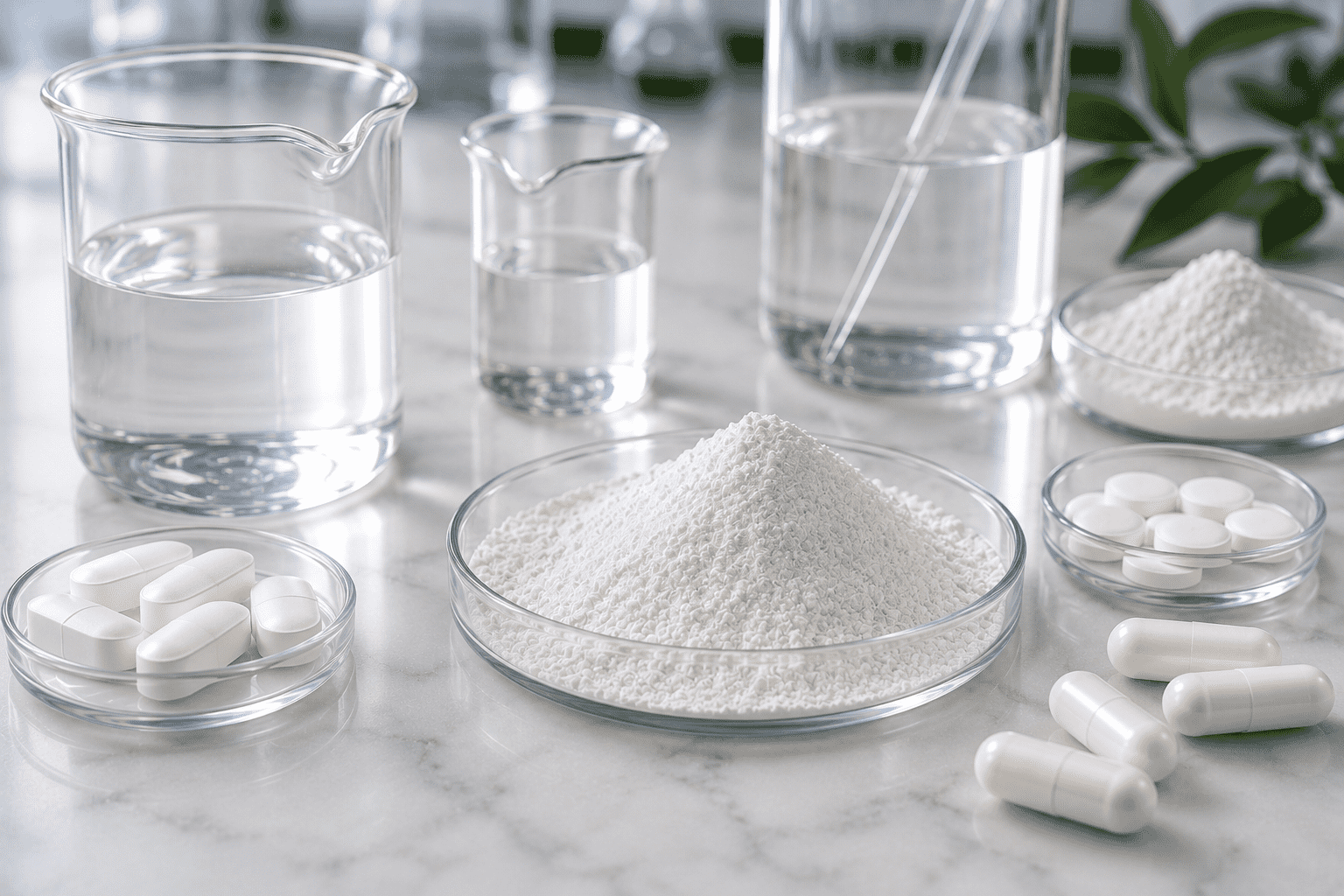
Food-grade sodium hyaluronate is one of the most versatile active ingredients available to nutraceutical formulators. A single ingredient supports three high-demand health claim categories (joint mobility, skin hydration, and digestive health) across all major dosage forms: tablets, capsules, oral liquids, beverages, and functional food formats.
Quick answer: Food-grade sodium hyaluronate (HA) in the 200 to 600 kDa range is the standard ingredient specification for multi-claim dietary supplements. It is produced by bacterial fermentation (non-animal origin), compatible with Halal and Kosher certification, and supported by clinical evidence at doses of 80 to 200 mg/day for skin, joint, and gut endpoints. Key formulation considerations are molecular weight selection, solubility in aqueous matrices, and stability in combination with common co-ingredients such as collagen, glucosamine, and chondroitin sulfate.
Need a specific molecular weight bracket?
HAPLEX is available across the 0.2 to 0.6 MDa range with full
technical documentation and samples
What food-grade sodium hyaluronate is
Sodium hyaluronate is the sodium salt of hyaluronic acid, a linear mucopolysaccharide composed of repeating disaccharide units of D-glucuronic acid and N-acetyl-D-glucosamine. In supplement formulation, it is preferred over the free acid form for its superior water solubility and pH stability across typical food and beverage matrices.
Commercial food-grade HA is produced by bacterial fermentation, a process that eliminates the immunogenicity and supply chain risks associated with animal-derived sources (historically rooster comb). Fermentation-derived HA is non-animal, compatible with vegan, Halal, and Kosher positioning, and delivers consistent molecular weight control, a parameter that directly affects biological activity and viscosity in liquid formats.
The body's own HA content declines progressively with age. Data from Longas et al. (1987), referenced in Bloomage Biotech product documentation, indicate a drop from 100% (relative index at age 20) to approximately 25% by age 60, with consequences across skin, joint, and ocular tissue. This age-related depletion is the primary rationale for oral supplementation across all three health claim areas.
Why molecular weight matters for supplement applications
Molecular weight governs both the biological activity of HA and its processing behaviour in formulation.
In the gut, HA cannot be absorbed intact. Gut bacteria (particularly Bacteroides species) cleave ingested HA into oligosaccharides below 3 kDa, which are then absorbed through the intestinal epithelium. A 2023 study in Carbohydrate Polymers (Simek et al.) established that gut microbiota composition is the primary determinant of oral HA bioavailability, and that the absorbed oligosaccharides and their short-chain fatty acid metabolites mediate systemic effects rather than intact molecule delivery.
Absorption pathway also varies by MW. A 2025 study in Int J Mol Sci (MDPI) found that LMW-HA (below 100 kDa) is predominantly absorbed in the cecum and distributed via the circulatory system, while HMW-HA (above 100 kDa) is transported primarily through gut-associated lymphoid tissue before systemic dissemination.
For formulation, the 200 to 600 kDa range represents the best-validated bracket: it covers the clinical trials used to substantiate skin, joint, and gut health claims, while remaining processable in both dry and liquid matrices without excessive viscosity.
Application 1: joint health supplements
The formulation case
Joint health is the most established nutraceutical application for oral HA. Synovial fluid in healthy joints contains high-MW HA that provides viscoelastic lubrication between cartilage surfaces. In osteoarthritis, both HA concentration and MW in synovial fluid decline, reducing lubrication and accelerating cartilage degradation. Oral HA supplementation is proposed to restore this through stimulation of endogenous HA synthesis in synoviocytes.
Clinical evidence
A 2023 RCT in Exp Ther Med (Sugiyama et al., Hokkaido University, 56 subjects, 12 weeks) administered 111 mg/day oral sodium hyaluronate to healthy adults with mild knee discomfort. The treatment group showed significant improvement in knee health maintenance versus placebo, with no adverse findings.
A 2020 RCT in Diseases (Cicero et al., University of Bologna, 60 subjects with symptomatic knee osteoarthritis, 56 days) found improvements in WOMAC score, Lequesne Functional Index, and VAS pain score, alongside reduced NSAID rescue medication use versus placebo.
A 2025 review in Frontiers in Nutrition synthesised the clinical landscape for oral HA in joint health, confirming that combination formulations with glucosamine and chondroitin sulfate are standard in commercial joint products and that both LMW and medium MW grades demonstrate efficacy.
Typical joint health stack
Oral HA at 100 to 120 mg/day is commonly combined with glucosamine sulfate (1,500 mg/day), chondroitin sulfate (1,200 mg/day), and vitamin C in tablet or capsule formats. HA contributes viscoelastic support to the combination claim alongside the structural roles of glucosamine and chondroitin.
Application 2: skin beauty-from-within supplements
The formulation case
Skin is the largest reservoir of HA in the body, accounting for approximately 50% of total body HA content. Dermal HA concentration directly governs skin hydration, elasticity, and resistance to visible aging. Oral supplementation targets the dermis systemically, bypassing the stratum corneum barrier that limits topical delivery of high-MW HA.
Clinical evidence
A 2023 RCT in Skin Research and Technology tested 100 and 200 mg/day of 300 kDa HA across age groups (18 to 65) and skin types (dry, normal, oily). Both doses produced significant improvements in skin hydration and elasticity versus placebo across all subgroups, confirming efficacy in younger and older consumers alike.
A 2025 RCT in Scientific Reports (Nature, 150 healthy adults) confirmed that oral sodium hyaluronate improved skin hydration, barrier function, and signs of aging versus placebo.
A 2025 meta-analysis in J Drugs Dermatol (Amin et al.) pooled seven RCTs and found statistically significant improvements in skin hydration, elasticity, and wrinkle depth from daily oral HA. Results are measurable at 4 weeks and well established at 8 to 12 weeks.
Typical beauty-from-within stack
Oral HA at 120 mg/day is commonly combined with hydrolysed collagen (5 to 10 g/day), vitamin C, biotin, and zinc. HA contributes the hydration and plumping mechanism; collagen peptides provide structural amino acids; vitamin C is required for endogenous collagen synthesis. This combination is standard in premium skin supplement formats.
Application 3: digestive and gut health
The formulation case
HA is a structural component of the intestinal mucosa extracellular matrix. It plays a role in maintaining the integrity of the epithelial lining and in modulating intestinal immune response. Orally ingested HA that is not absorbed intact is fermented by gut bacteria into short-chain fatty acids (SCFAs), which are available to the host as additional metabolic effectors with documented gut health benefits.
Evidence
The Carbohydrate Polymers 2023 study confirmed that unabsorbed HA fragments are metabolised into SCFAs in the gut, providing a secondary systemic effect beyond the oligosaccharide absorption pathway. Animal studies have documented a role for HA in supporting intestinal innate host defence and epithelial barrier function.
A 2025 study in Int J Mol Sci investigating the gut-skin axis found that oral HA combined with probiotic Bifidobacterium longum increased intestinal absorption by approximately 30% versus HA alone, and by 82% versus sodium hyaluronate standard. This has practical implications for formulators developing synbiotic combinations targeting both gut health and skin.
Typical gut health stack
Oral HA at 100 to 150 mg/day combined with probiotics (Lactobacillus or Bifidobacterium strains) and prebiotic fibres in capsule or sachet format. The probiotic component enhances HA absorption via microbiota-mediated cleavage and reduces intestinal inflammation, while HA contributes structural mucosal support.
Safic-Alcan distributes HAPLEX sodium hyaluronate, with full technical documentation, samples, and formulation support. Browse our nutraceuticals catalog for the complete Bloomage Biotechnology range.
Claims: what you can and cannot say in the EU
Oral hyaluronic acid has no authorised health claim under Regulation (EC) 1924/2006. Applications for skin hydration and for joint maintenance were both assessed and recorded as non-authorised. The clinical evidence summarised above informs formulation and dosing decisions; it does not create a claim right.
In practice, EU products built on HA carry authorised claims from co-ingredients. Vitamin C at 12 mg or more per 100 kcal contributes to normal collagen formation for the normal function of skin, cartilage and bones. Zinc, copper, manganese and biotin carry their own authorised wordings. HA is formulated as the functional active while the label claim rests on the substantiated nutrient.
Requirements differ outside the EU. Verify against the applicablenational framework before finalising a claim strategy.
FAQ
What is the recommended grade of sodium hyaluronate for dietary supplements?
The 200 to 600 kDa range is the most widely used specification in clinically validated supplement products. It provides the MW profile needed for gut microbiota-mediated absorption, covers the dose ranges used in joint and skin RCTs (80 to 200 mg/day), and remains processable in dry and liquid dosage forms without excessive viscosity. HAPLEX at 0.2 to 0.6 MDa matches this bracket.
Can one HA ingredient cover joint, skin, and gut health claims?
Yes. Food-grade sodium hyaluronate in the medium MW range supports all three claims through a single absorption and systemic distribution mechanism. The oligosaccharides produced by gut microbiota cleavage circulate to skin, joint, and gut tissue. Clinical trials confirm efficacy for each endpoint independently, making multi-claim supplement positioning scientifically defensible.
What dosage forms is food-grade sodium hyaluronate compatible with?
Hard capsules, tablets, oral liquids, functional beverages, jelly products, and dairy formats. Solubility is good in neutral to mildly alkaline aqueous matrices. Viscosity must be managed in liquid formats above 0.5% w/v. Acidic formats (below pH 4) require stability testing.
What certifications should a food-grade sodium hyaluronate carry for supplement markets?
For EU and US dietary supplement markets, key certifications are: Halal and Kosher (for broad market access), ISO 22000 or equivalent food safety management system, and heavy metal and microbiological specifications conforming to supplement pharmacopoeia standards. HAPLEX carries Halal, Kosher, ISO 9001, HACCP, and ISO 22000 certifications, with heavy metals ≤10 ppm and full pathogen-negative specification.
What co-ingredients combine well with sodium hyaluronate in supplement formulations?
For joint health: glucosamine sulfate, chondroitin sulfate, vitamin C, collagen type II. For skin beauty-from-within: hydrolysed collagen, vitamin C, biotin, zinc. For gut health: probiotic strains (Lactobacillus, Bifidobacterium), prebiotic fibres. It is confirmed that Bifidobacterium longum increases oral HA absorption by approximately 30%, making probiotic co-formulation particularly relevant for gut-skin axis products.
Is fermentation-derived sodium hyaluronate suitable for vegan supplement formulations?
Yes. Fermentation-derived HA has non-animal origin and carries no animal-derived processing aids. It is compatible with vegan, vegetarian, Halal, and Kosher labelling claims, provided the capsule shell and other excipients in the formulation also meet those requirements.