


Quick answer
Plant-based drinks separate because they are thermodynamically unstable dispersions: fat droplets, protein particles, fibre and minerals of different densities are suspended in water, and left alone they always drift toward two separated layers. Separation is not one event but several distinct processes running at once, mainly gravitational separation (creaming and sedimentation), flocculation, coalescence and protein aggregation. Plant matrices are especially prone because their proteins are less soluble and less surface-active than dairy casein, their particles are larger and denser, heat processing pushes proteins to aggregate, and near the isoelectric point the charge that keeps particles apart collapses. The rate of separation follows Stokes' law, so the practical defences are shrinking droplets, thickening the water phase and preserving surface charge. No formulation is permanently stable, so the goal is kinetic stability for the length of the shelf life.
Get support today
Do you need help formulating stable plant-based drinks ?
Separation is the default state, not a defect
Separation is the thermodynamic destination of almost every plant-based drink, and formulation only delays it. A plant-based drink is a colloidal dispersion held in a state of higher energy than the two separated layers it would form at rest, so the system is always driving toward that lower-energy endpoint. The task is not to make it permanently stable, which is not physically possible, but to slow the journey so the product still looks uniform when it reaches the glass. A design review of fortified plant-based milk substitutes makes the scale of the problem concrete, reporting that resistance to gravitational separation varied more than 40-fold between the most and least stable commercial products, driven by differences in particle size, particle density and aqueous-phase viscosity.
The physics of gravitational separation
Gravitational separation is governed by Stokes' law, which sets how fast a particle rises or sinks. The velocity climbs with the square of the particle radius and with the density difference between the particle and the surrounding water, and drops as the water phase gets more viscous, a relationship stated explicitly in a food-emulsion review. Three consequences follow directly. Large particles separate far faster than small ones, because the radius term is squared. A big density gap, such as fat rising or dense protein aggregates sinking, speeds separation. And a thin, watery continuous phase offers almost no resistance. Every stabilisation strategy is an attack on one of these three terms.
Separation is several mechanisms at once
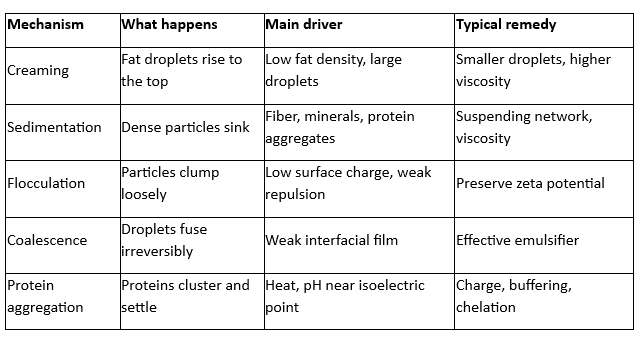
The word separation hides at least five different physical processes, and telling them apart matters because each has a different cause and a different fix. A nanoemulsion review sets out the standard taxonomy: gravitational separation, where droplets rise (creaming) or particles sink (sedimentation); flocculation, where particles clump loosely without merging; coalescence, where droplets fuse irreversibly into larger ones; and Ostwald ripening, where large droplets grow at the expense of small ones. In plant drinks a sixth route, protein aggregation into insoluble clusters, often dominates. A companion methods review lists the droplet properties that decide which route wins: concentration, size, surface charge, interactions and bulk rheology.
Why plant matrices separate more than dairy
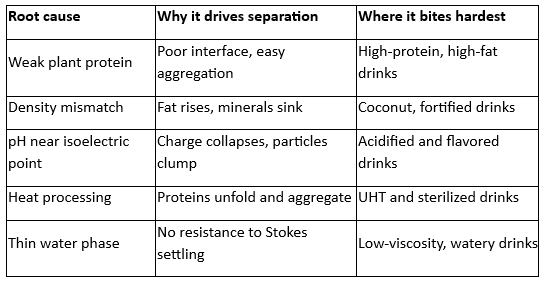
Plant-based drinks separate more readily than cow's milk because their building blocks are less suited to staying dispersed. Where dairy milk carries protein in structured, stable casein micelles, a plant drink combines plant proteins, insoluble fibre, minerals and vegetable oil in one system, and because these components differ in density, size and water affinity they naturally drift apart during storage, a point made in the same design review of fortified substitutes.
Plant proteins are a weaker anchor
Plant proteins hold particles together less effectively than casein because of how they are built and where they come from. They usually originate from water-insoluble plant material and exist as large particles that lack the stable architecture of casein micelles, so they aggregate more easily during processing and storage. An analogue review of plant-based milks lists protein solubility alongside particle size and emulsion quality as the factors that decide whether a drink stays uniform, and notes that poorly soluble protein and undisintegrated starch both promote sediment. The practical result is that plant drinks lean harder on added emulsifiers and stabilisers than dairy does, and that the choice of protein source shapes the stability problem from the start. The role of plant proteins is therefore central to any stability brief.
The isoelectric point problem
Charge is the invisible force holding particles apart, and it disappears at the isoelectric point. A protein carries no net charge at that pH, so the electrostatic repulsion that keeps droplets separated collapses, and the particles are then free to aggregate, flocculate and settle. This is why acidified plant drinks are so hard to stabilise. The design review notes that coconut milk showed extensive aggregation and creaming near the coconut protein's isoelectric point, and again at high salt levels, both cases where electrostatic repulsion is suppressed. The quantity to protect is the surface charge, measured as zeta potential: a chickpea study found that raising the absolute zeta potential to between roughly minus 37 and minus 40 mV, together with an 86% gain in protein solubility, delivered complete resistance to creaming over 14 days, while an untreated control failed.
How processing tips the balance
Processing both stabilises and destabilises a plant-based drink, so the same steps that extend shelf life can also trigger separation if they are mismanaged. Heat treatment kills microbes and lengthens shelf life, but it also stresses the proteins that hold the system together, while homogenisation is the single most effective physical defence against gravitational separation.
Heat treatment drives protein aggregation
High-temperature processing is the most common trigger for protein-driven separation. When a plant drink is pasteurised or given a UHT or sterilisation treatment, the proteins unfold and expose the water-avoiding regions normally buried inside them, and those exposed regions then bind to one another, so the proteins aggregate, settle or gel, as described in the analogue review. The behaviour is protein-specific: a protein aggregate review reports that in soybean systems the different storage-protein subunits react to heat in different ways, with some staying soluble and others forming large insoluble clusters through water-avoiding interactions. This is why a drink that looks fine off the homogeniser can still throw a sediment after sterilisation, and why heat stability has to be designed in, not assumed.
Homogenisation is the first line of defence
Homogenisation fights separation by attacking the particle-size term in Stokes' law. By forcing the drink through a narrow gap at high pressure, it breaks fat and protein into much finer, more uniform particles that rise or settle far more slowly. The analogue review reports that ultra-high-pressure homogenisation of almond milk cut the mean droplet diameter from 1.4 µm to 0.29 µm, close to a fivefold reduction, and because the Stokes term is squared, that alone slows creaming dramatically. Applying homogenisation after heat treatment can also break up the aggregates that sterilisation creates, recovering some of the lost stability. Even so, homogenisation buys time rather than permanence, which is where emulsifiers and stabilisers take over.
How separation is measured
Stability is assessed by tracking how fast particles migrate through the drink under accelerated conditions, rather than waiting out the full shelf life. The standard laboratory method scans a sample from top to bottom with light and records changes in backscattering as particles cream or settle, so a formulator can rank recipes in hours or days instead of months. In one emulsifier review of plant-based milk alternatives, unstable systems showed a large rise in backscattering change, signalling rapid phase separation, while the most stable combination held the change under 0.5%, close to fully stable. Reading these curves against the droplet properties in the methods review, size, charge and rheology, is what turns a separation complaint into a specific, fixable cause.
From diagnosis to fix
Every route to separation maps to a defence, which is why diagnosing the mechanism comes before choosing an ingredient. The design review sets out the main levers for a drink that aggregates and sediments: change the emulsifier stabilising the system, add an anionic polysaccharide that keeps proteins from clumping, buffer the pH so it does not fall toward the isoelectric point, or chelate the free calcium released as pH drops. In Stokes' terms these reduce to three moves: make the particles smaller, make the continuous phase more viscous or gel-like, and keep the surface charge high. Emulsifiers do the first by holding droplets fine and coated, while rheology modifiers and natural hydrocolloids do the second by thickening the water phase or building a suspending network. Matching the fix to the mechanism is what separates a stable product from a lucky one.
FAQ
Why does my oat milk separate?
Oat milk separates because its fat, protein and fine oat solids differ in density from the water they sit in, so over time the lighter fat creams upward and the denser solids settle. Warmth, low acidity from added flavours and simple standing all speed it up. Most separation is physical, not spoilage.
Why does almond milk separate?
Almond milk carries almond oil and protein particles that are only loosely held in suspension, and almond protein is a weaker stabiliser than dairy casein. As the analogue review notes, low protein solubility and large particles both promote sedimentation, so a layer of solids at the bottom and a lighter layer on top is common.
Is separation a sign the drink has gone off?
Usually not. Separation is generally a physical process driven by density and gravity, described by Stokes' law, rather than microbial spoilage. A drink can be perfectly safe and still separate. Off smells, sourness, gas or a curdled texture that does not re-mix are better indicators of spoilage.
Why does plant milk curdle in hot coffee?
Coffee is hot and mildly acidic, and both push plant proteins toward their isoelectric point where their charge collapses and they aggregate. As the design review explains for coconut protein, aggregation and separation peak near the isoelectric point and at high salt levels, which is why barista formulations add buffering and stabilising ingredients to hold the protein together.
Can separation be stopped completely?
No. A plant-based drink is thermodynamically unstable, so it will always separate eventually. Formulation delays it to kinetic stability across the shelf life by shrinking droplets, thickening the continuous phase and protecting surface charge, but it cannot make the system permanently stable.
Does shaking fix a separated drink?
Shaking usually re-disperses the layers well enough to drink, because most separation from creaming or sedimentation is reversible. Aggregation and coalescence are not fully reversible, so a drink that has formed hard clumps or a firm sediment may not recover its original smooth texture.