


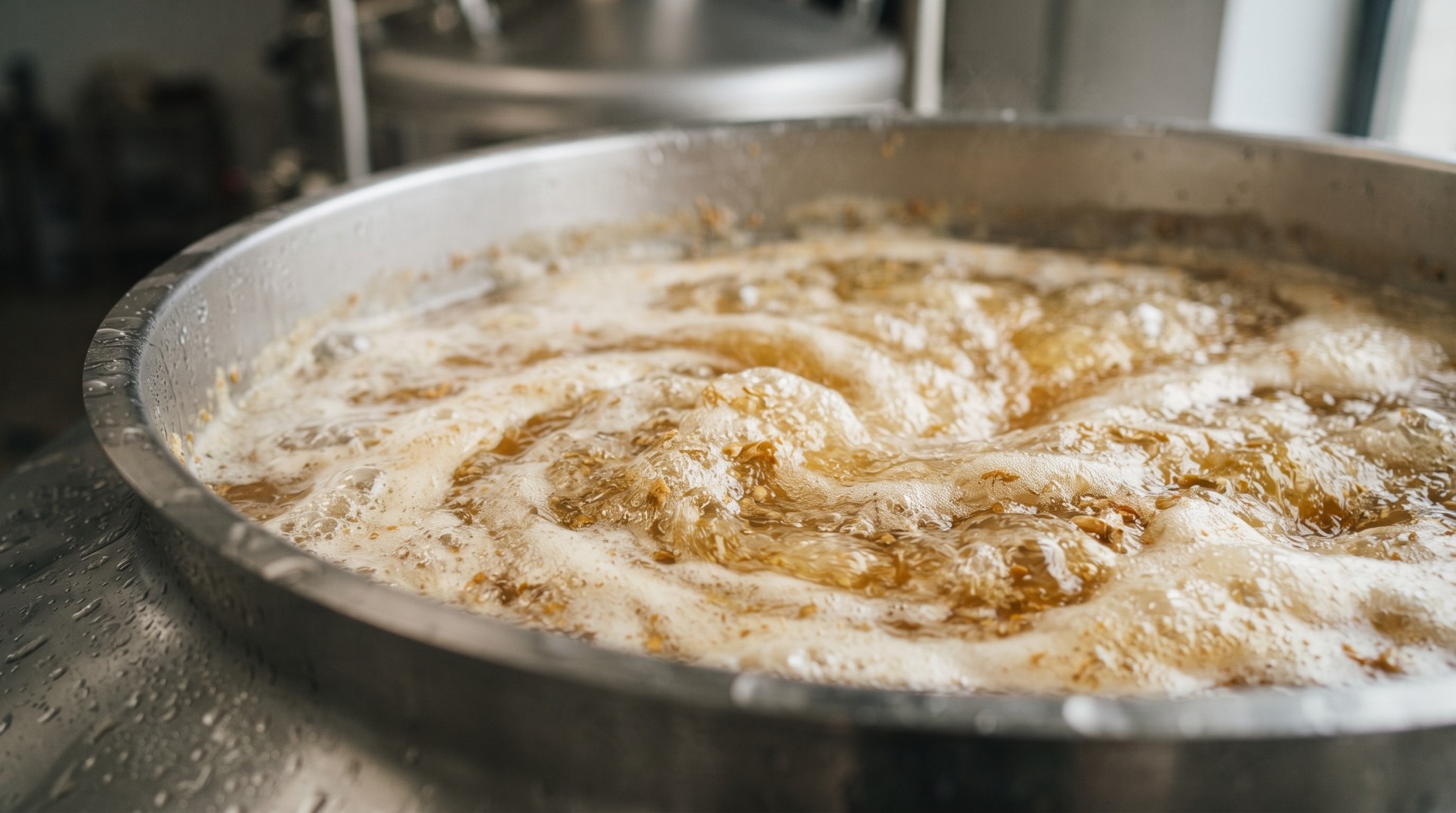
Antifoam in cell culture and live-cell fermentation is usually assessed on growth. When the organism is the product, the number that matters is viable cell count, and it is printed on the label.
In an API fermentation the organism is a factory. You want the molecule; the cells are separated and discarded, and a growth effect costs you yield, which is an efficiency figure you can absorb.
In a probiotic or live biotherapeutic process, the organism is the product. A loss of viability is not a margin problem. It is a movement in the specification you release against and declare on the pack.
That changes what an antifoam has to be tested for.
The difference in one table
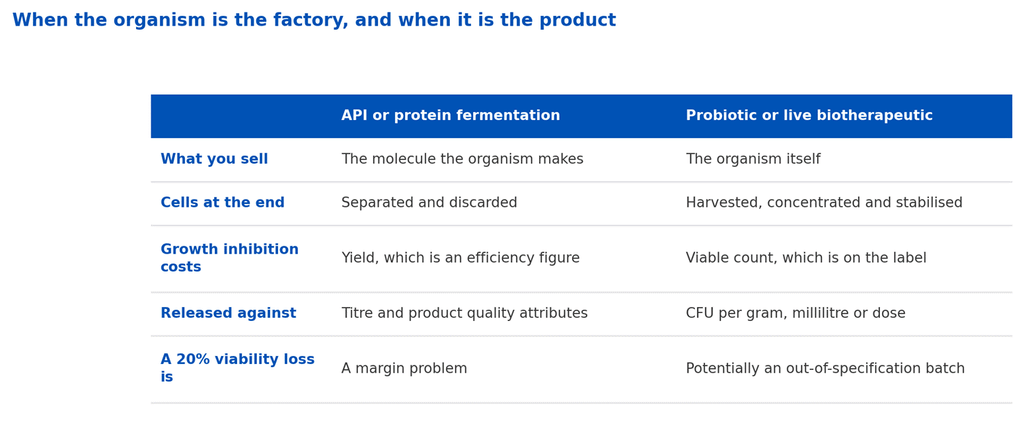
When the organism is the factory, and when it is the product
The consequence is that an antifoam screen designed for a protein process asks the wrong question. Optical density rises when cells are present. It does not tell you how many of them are alive, and a viable cell count is what you will be releasing against.
Why viability is a release criterion, not a performance metric
This is set out in the pharmacopoeia rather than left to internal practice.
In 2019 the European Pharmacopoeia brought into effect a general monograph on live biotherapeutic products for human use, 3053, together with two general chapters on microbiological examination of these products, 2.6.36 and 2.6.38. It was the first harmonized set of quality requirements for this category in Europe.
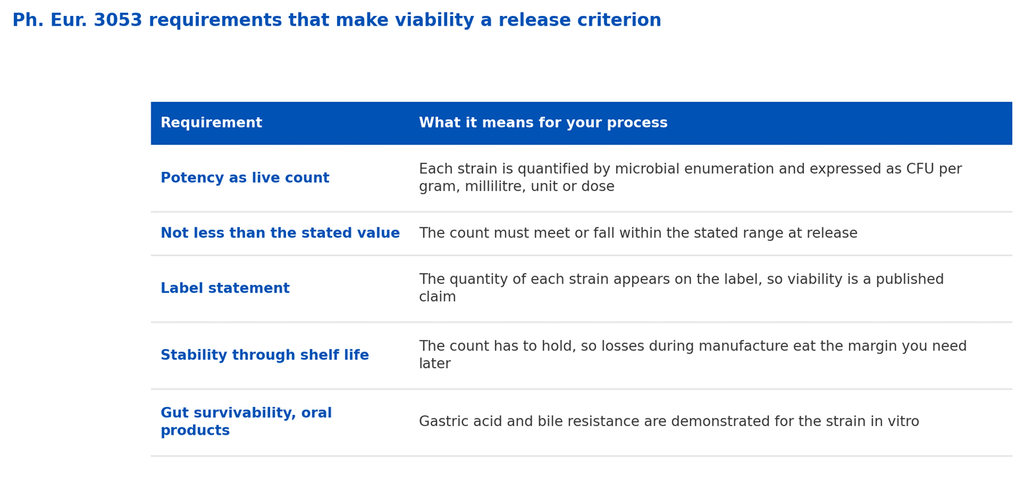
Ph. Eur. 3053 requirements that make viability a release criterion
The monograph requires that the number of each live microorganism is determined by a suitable microbial enumeration test and expressed as CFU per gram, per millilitre or per unit, and that the result is not less than the stated range. The label must state the quantity of each strain. For oral products, survivability in the human gut is demonstrated by in vitro gastric acid and bile resistance testing.
There is also a stability dimension that makes upstream losses expensive. The count has to hold through shelf life, and liquid live biotherapeutic products are recommended not to be frozen in order to maintain full viability. Every log you lose in fermentation is a log you no longer have in reserve for drying, storage and distribution. For context, a viable dose for a next-generation probiotic candidate is commonly cited at around 10^9 CFU per dose at the point of consumption (including until the end of the gastrointestinal tract), not at the point of manufacture.
Can antifoam reduce CFU count?
It can, and the mechanism is the same one that makes an antifoam work.
A material engineered to sit at an interface and alter its behaviour will also interact with the cell membrane. Published work has demonstrated negative impacts of antifoams on the growth of mammalian cells, bacterial cells and fungi, including cell membrane leakage and cytotoxicity, and effects on protein expression.
Membrane leakage is the term to pay attention to here. In a protein process it is a productivity question. In a live-cell process it is directly a viability question, and viability is the specification.
The direction is not fixed, which is the reason to test rather than assume. The most cited review of antifoam effects on bioprocess productivity documents antifoams changing growth rates in both prokaryotes and eukaryotes and altering surface properties such as lipid content and membrane permeability, with effects that in some systems improved yields. What is consistent is that the effect is real, specific to the combination, and measurable.
Dose discipline matters correspondingly more. In a mammalian cell culture study, a concentration of one antifoam ten times lower than the manufacturer's recommended starting concentration of 100 ppm was sufficient to dissipate artificially generated foam, and that antifoam dissipated foam almost seven times faster than another at the same concentration. The recommended starting dose is a starting point, not a target.
How to evaluate an antifoam when viable count is the specification
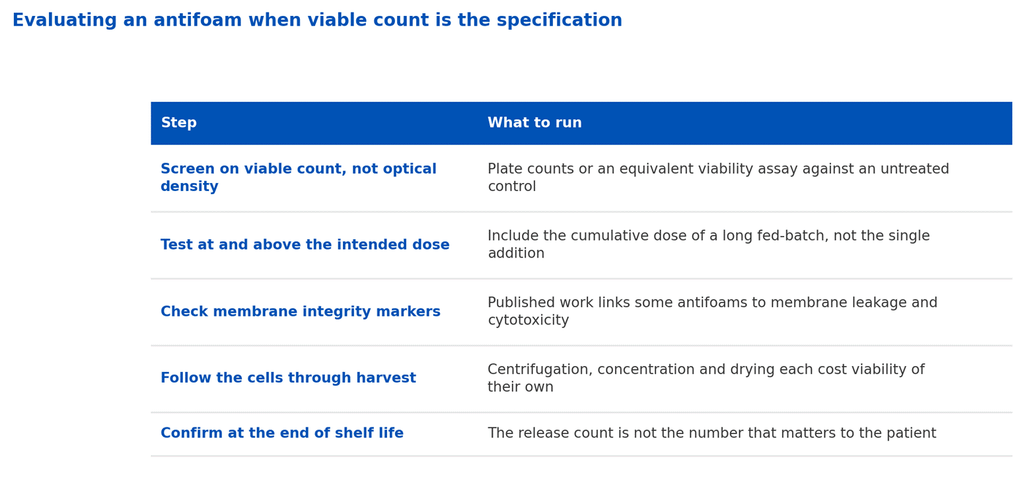
Evaluating an antifoam when viable count is the specification
Three points deserve emphasis.
Plate counts, not turbidity. This is the single change that distinguishes a live-cell antifoam screen from a standard one. A viability assay against an untreated control, at the dose you will actually use.
Follow the cells past the fermenter. Harvest, concentration and drying each take their own toll on viability. An antifoam that leaves membranes slightly compromised may show an acceptable count at harvest and an unacceptable one after spray drying or freeze drying. If your process includes a drying step, the screen should extend through it.
Test the cumulative dose. A long fed-batch with bolus additions on a foam trigger can reach a total dose several times the single addition. That total is what the culture experienced.
The general evaluation framework is covered in our article on antifoam agents in fermentation; what changes here is the endpoint, not the method.
Which grades suit live-cell production
There is no grade that is universally correct for live-cell work, and any claim otherwise should be treated with suspicion. What exists is a shortlist to evaluate against your own strain.
Of the grades Safic-Alcan supplies for pharmaceutical fermentation, Simethicone PD30 S is a 30% active simethicone emulsion whose technical data sheet positions it as a process antifoam suited to biopharmaceutical applications including cell culture, and states compliance with the current Simethicone Emulsion USP monograph. SAG 471 and Esca Ferm-S are 100% active concentrates positioned for aerobic fermentation and for stability through sterilisation.
Supplier compatibility data, including studies reporting no significant growth inhibition across a panel of tested strains, is a genuine and useful input. It is a statement about the strains tested. It is not a statement about yours, and for a product released on viable count, that distinction is the whole point.
Where this sits beside nutraceutical production
The same logic applies to probiotic food supplements, with a different regulatory frame. The compendial requirements above apply to live biotherapeutic products regulated as medicines; a probiotic supplement is a different category with different obligations. The process reality is identical. Viable cell count is the claim, and anything added during fermentation that costs viability costs you the claim.
Frequently asked questions
Can antifoam reduce CFU count in a probiotic fermentation?
It can. Published studies have demonstrated negative impacts of antifoams on the growth of mammalian, bacterial and fungal cells, including cell membrane leakage and cytotoxicity. The size and direction of the effect depend on the antifoam, the dose, the organism and the medium, and must be established experimentally for each combination.
How is viability protected during fermentation of a live product?
By screening the antifoam on viable count rather than optical density, at and above the intended cumulative dose, by following the cells through harvest and any drying step, and by setting a documented maximum dose including top-ups during the run.
Why does Ph. Eur. 3053 matter for antifoam selection?
Because it makes viable count a release criterion. The monograph requires the number of each live microorganism to be determined by enumeration and expressed in CFU, not less than the stated range, with the quantity of each strain stated on the label. Viability lost during fermentation is lost from a number you are legally declaring.
Which antifoam grades suit live-cell production?
There is no universally correct grade. Simethicone emulsions positioned for biopharmaceutical and cell culture applications, and 100% active concentrates positioned for aerobic fermentation, are the usual starting shortlist. Final selection has to be made against your own strain and process.
Is a supplier compatibility study enough?
It is a useful input and not a substitute. A study reporting no significant growth inhibition across tested strains is bounded to those strains. For a product released on viable count, compatibility with your production organism has to be demonstrated for your organism.
Talk to our technical team
Safic-Alcan distributes the Momentive antifoam range across Europe and supports probiotic, live biotherapeutic and nutraceutical manufacturers through grade selection, sampling and qualification documentation, backed by our global pharmaceutical applications laboratory in Étampes.
Expert Support, Every Step of the Way
From technical advice to regulatory guidance.
Sources
- European Pharmacopoeia Commission. Quality requirements for live biotherapeutic products: general monograph 3053 and general chapters 2.6.36 and 2.6.38, effective April 2019.
- Mazzantini, D. et al. Live biotherapeutic products and their regulatory framework in Italy and Europe. Annali dell'Istituto Superiore di Sanità.
- Regulatory framework and challenges for live biotherapeutic products, on Ph. Eur. 3053 and gut survivability testing.
- Flynn, J. et al. (2024). Measurement and control of foam generation in a mammalian cell culture. Biotechnology Progress. DOI: 10.1002/btpr.3450
- Routledge, S.J. (2012). Beyond de-foaming: the effects of antifoams on bioprocess productivity. Computational and Structural Biotechnology Journal, 3(4): e201210014.
- Spray-drying encapsulation of the live biotherapeutic candidate Akkermansia muciniphila DSM 22959, on viable dose targets and viability losses through processing. DOI: 10.3390/ph15050628