


TL;DR — Fumed silica (pyrogenic silica) is a synthetic, amorphous nano-SiO₂ produced by flame hydrolysis. Its defining feature is a dense surface of reactive silanol groups that build reversible hydrogen-bond networks, delivering thixotropy, anti-settling, reinforcement, and flow improvement across formulations. It comes in hydrophilic (untreated) and hydrophobic (silane-treated) grades, differentiated by surface area and polarity compatibility. In coatings it controls rheology, prevents sag, and hardens dried films. In cosmetics it improves texture, absorbs oils, and stabilizes emulsions. In pharma it functions as a glidant, moisture adsorbent, and semisolid thickener. Grade selection — surface treatment + surface area + pharmacopoeial compliance where needed — drives performance more than loadings do.
Ready to Work Together?
Get in touch with our team and discover tailored solutions for your industry
What is fumed silica?
Fumed silica, also called pyrogenic silica, is a synthetic, amorphous form of silicon dioxide (SiO₂) produced by flame hydrolysis — typically the combustion of silicon tetrachloride in an oxygen-hydrogen flame at very high temperature. It is used as a thickener, anti-settling agent, reinforcing filler and flow aid across coatings, cosmetics and pharmaceutical formulations. It is produced by flame hydrolysis of silicon tetrachloride (SiCl₄) at temperatures above 1,000°C.
The process generates ultra-fine primary particles that fuse into branched, chain-like aggregates, which in turn agglomerate into larger, three-dimensional tertiary structures. The result is an extremely light, white powder with no internal porosity and a specific surface area that can range from 50 to over 600 m²/g depending on the grade.
Fumed silica consists of finely dispersed amorphous silicon dioxide whose surface is covered by highly reactive silanol groups available for chemical reactions. It shows a space-filling particle structure related to a high surface area and lacking micropores. These characteristics enable fumed silica to act as a free-flow additive in powder-like solids, as a thickener in various liquids, and as a powerful reinforcing filler in elastomers.
This combination — nanoscale particle size, extreme surface reactivity, and structural versatility — is the basis for fumed silica's role across coatings, personal care, and pharmaceutical manufacturing.
For more information on precipitated silica and how it compares to fumed silica, you can refer to our dedicated article on precipitated silica.
Fumed Silica vs Pyrogenic Silica: Same Product, Different Names
Fumed silica and pyrogenic silica are identical — two names for the same material. "Fumed" refers to the production process (flame hydrolysis), while "pyrogenic" (from the Greek pyr, fire) describes the same thermal origin. Suppliers use both terms interchangeably: Evonik markets its range under the Aerosil® brand for example.
In technical datasheets and procurement, you may encounter either. For regulatory filings under REACH, the registered substance is silicon dioxide (CAS 7631-86-9), covering both designations.
What makes fumed silica functionally unique?
The silanol surface and hydrogen-bond network
The functional core of fumed silica is its surface silanol density. Fumed silica has a relatively high density of surface silanol groups (1.5–4.51/nm²), and the properties of fumed silica can be chemically modified by reacting with these silanol groups. In untreated, hydrophilic grades, these silanols form reversible hydrogen bonds with each other and with polar molecules in the surrounding medium, building a three-dimensional network that thickens the system at rest and breaks down under shear — a behavior known as thixotropy.
This is a critical distinction from other thickeners: fumed silica's network is physical, not chemical. It rebuilds rapidly after shear is removed, which is why it prevents sag and settling during storage but allows smooth application under brush, roller, or spray conditions.
Reinforcement in cured systems
Beyond rheology, once a formulation cures or dries, the silica network becomes a nano-reinforcer within the polymer matrix. Pyrogenic silica chemically after-treated has a positive influence on the mar resistance of both UV-curing and solvent-based coating systems. Studies on nanoparticle-filled coatings have found that including fumed silica can increase the scratch hardness of a UV-cured polymer coating by 10–35% and significantly raise its resistance to wear. In clear coatings, properly dispersed fumed silica can deliver these benefits without compromising optical transparency, since the primary particles sit well below visible-light wavelengths.
Thermal and chemical inertness
Fumed silica is chemically inert across a wide pH range and temperature window. It is non-combustible, non-reactive with most organic binders and active ingredients, and contributes no color or odor to formulations. These qualities make it suitable for applications demanding high purity and long shelf-life stability — particularly in pharmaceutical and cosmetic contexts.
Hydrophilic vs. hydrophobic grades: the key distinction
The most important grade-selection decision for fumed silica is the choice between hydrophilic and hydrophobic forms — a distinction driven by surface chemistry and the polarity of the target system.
Hydrophilic fumed silica
Untreated fumed silica is inherently hydrophilic. Its surface silanol groups make it water-wettable and readily dispersible in aqueous and polar media. It is the default choice for water-based paints, aqueous pharmaceutical suspensions, and hydrophilic cosmetic gels. Its thickening and anti-settling performance in polar systems is strong, but it can absorb atmospheric moisture and may show less stable rheology in systems exposed to humidity over time.
Hydrophobic fumed silica
Converting hydrophilic silica to hydrophobic is possible by placing some silane in a fluid bed reactor. Due to the reduced density of the silanol group, better dispersion behaviour is indicated in contrast with hydrophilic types. Common treating agents include hexamethyldisilazane (HMDS), dimethyldichlorosilane (DDS), and polydimethylsiloxane (PDMS), which cap the surface silanols with hydrophobic organic groups. The result is a material that under the joint action of hydrophobic functional groups and hydrogen bonds, forms a three-dimensional network structure in highly polar systems, providing better rheological and thixotropic properties for waterborne coatings and adhesives compared to other fumed silica.
Hydrophobic grades are preferred in solvent-borne coatings, silicone sealants, non-aqueous cosmetic formulations (anhydrous creams, lipsticks, pressed powders), and oil-based pharmaceutical systems. They also deliver improved moisture resistance and long-term rheological stability.
Surface area as a grade parameter
Within each category, surface area is the primary variable for controlling intensity of effect. Higher surface area grades (e.g., ~200–300 m²/g) deliver stronger thickening and anti-settling performance but require more careful dispersion to avoid agglomerate-driven haze or texture defects. Lower surface area grades are easier to disperse and exert a milder rheological effect — useful where subtle stabilization is needed without significant viscosity build.
Selecting the right grade therefore comes down to three questions: What is the polarity of the system? What level of rheological effect is needed? And what are the processing and dispersion capabilities available?
Applications in coatings
Fumed silica is one of the most widely used functional additives in the coatings industry, performing across multiple roles simultaneously: rheology modifier, anti-settling agent, anti-sag agent, matting agent, and film reinforcer.
Rheology control and anti-sag
In liquid paints and varnishes, fumed silica prevents the formulation from sagging on vertical surfaces after application, while maintaining flow under application shear. Fumed silica is one of the most commonly used flow additives in the powder coating industry, produced by hydrogen-oxygen flame hydrolysis of halosilane with a high specific surface area. The particle size of fumed silica is usually between 10 and 40 nanometers, and numerous grades are specially designed for use in powder paint applications due to differences in specific surface area and hydrophobicity.
In powder coatings specifically, fumed silica acts as a flow additive that reduces interparticle friction, improving the flowability of the powder through equipment — a function that directly affects coating uniformity and surface quality.
Film hardness and scratch resistance
Once the coating has cured, the silica network provides mechanical reinforcement. It has been shown that such modified silica has a surprisingly low influence on the rheological properties of liquid coatings: it is possible to incorporate up to 15% fumed, structurally modified silica into a UV-binder system without pseudoplastic behavior of the resulting liquid, while the viscosity increase remains acceptable. This makes it possible to push silica loading high enough to deliver meaningful hardness gains without sacrificing application behavior.
Matting
In certain coating systems — furniture lacquers, leather finishes, industrial topcoats — a matte rather than glossy surface is required. Fumed silica at controlled concentrations scatters light at the surface of the dried film, reducing gloss. Grade selection here is critical: too coarse an agglomerate introduces visible texture; too fine a primary particle may not provide sufficient matting effect.
Waterborne systems
Hydrophobic fumed silica is a commonly used rheology additive in waterborne coatings. Its dispersion in aqueous systems typically requires careful selection of dispersing technology, as the hydrophobic surface is inherently resistant to wetting in water. Non-ionic dispersants are generally the most effective at achieving stable aqueous dispersions of hydrophobic grades, enabling their use in waterborne architectural and industrial coatings where low-VOC requirements increasingly drive formulation choices.
Applications in cosmetics and personal care
Fumed silica is commonly used in pharmaceuticals and cosmetics as an anti-tacking agent, adsorbent, emulsion stabilizer, or glidant, or to increase viscosity. In personal care specifically, it serves several distinct functions depending on the formulation type.
Texture and skin feel
In makeup powders, fumed silica acts as a light, "invisible" filler that improves texture and flow. It provides a silky feel, prevents caking in pressed powders, and can scatter light to give a soft-focus effect on the skin. In foundation, skincare creams, and BB products, it smooths the application profile and absorbs surface sebum without leaving a chalky residue.
Oil absorption and sebum control
Hydrophilic grades, with their high surface silanol density, are effective at adsorbing oils. In sunscreens, primers, and mattifying products, fumed silica reduces the greasy feel that comes from high concentrations of emollient actives and oils.
Emulsion stability
In emulsified formulations — lotions, serums, face creams — fumed silica contributes to the structural network of the continuous phase, slowing the sedimentation of dispersed particles and inhibiting phase separation. It works synergistically with polymeric thickeners and is a well-established component of the mineral-origin rheology modifier toolkit alongside clays and Laponite.
Regulatory status
In regulations governing cosmetic products, silica and hydrated silica are not restricted from use in any way in the European Union. According to Australia's National Industrial Chemicals Notification and Assessment Scheme, amorphous synthetic silica is a Tier I chemical, not considered to pose an unreasonable risk to the health of workers and public health. The Cosmetic Ingredient Review (CIR) Expert Panel has also concluded that synthetically manufactured amorphous silica is safe in current practices of use and concentration when formulated to be non-irritating.
Handling considerations for formulators: inhalation of fumed silica dust should be avoided. Standard occupational safety controls — enclosed mixing, appropriate extraction, and personal protective equipment — apply.
Texture and skin feel
In makeup powders, fumed silica acts as a light, "invisible" filler that improves texture and flow. It provides a silky feel, prevents caking in pressed powders, and can scatter light to give a soft-focus effect on the skin. In foundation, skincare creams, and BB products, it smooths the application profile and absorbs surface sebum without leaving a chalky residue.
Oil absorption and sebum control
Hydrophilic grades, with their high surface silanol density, are effective at adsorbing oils. In sunscreens, primers, and mattifying products, fumed silica reduces the greasy feel that comes from high concentrations of emollient actives and oils.
Emulsion stability
In emulsified formulations — lotions, serums, face creams — fumed silica contributes to the structural network of the continuous phase, slowing the sedimentation of dispersed particles and inhibiting phase separation. It works synergistically with polymeric thickeners and is a well-established component of the mineral-origin rheology modifier toolkit alongside clays and Laponite.
Regulatory status
In regulations governing cosmetic products, silica and hydrated silica are not restricted from use in any way in the European Union. According to Australia's National Industrial Chemicals Notification and Assessment Scheme, amorphous synthetic silica is a Tier I chemical, not considered to pose an unreasonable risk to the health of workers and public health. The Cosmetic Ingredient Review (CIR) Expert Panel has also concluded that synthetically manufactured amorphous silica is safe in current practices of use and concentration when formulated to be non-irritating.
Handling considerations for formulators: inhalation of fumed silica dust should be avoided. Standard occupational safety controls — enclosed mixing, appropriate extraction, and personal protective equipment — apply.
Applications in pharmaceuticals
In pharmaceutical manufacturing, fumed silica appears under the monograph name Colloidal Silicon Dioxide in the major pharmacopoeias (USP/NF, European Pharmacopoeia, Japanese Pharmacopoeia) and is considered an established, well-characterised excipient.
Glidant in solid dosage forms
The primary pharmaceutical use is as a glidant in tablet and capsule manufacturing. Small quantities of glidant substances added to the formulation and blended together can improve the flow of the powder substantially and facilitate capsule or tablet die filling. Fumed silica works by coating the surface of larger API and excipient particles, reducing interparticle friction and cohesive forces. This allows powder blends to flow uniformly through hoppers and into press dies — a direct factor in weight uniformity, content uniformity, and tablet hardness consistency.
Dry-coating of fumed silica grades on the surface of cohesive APIs lowers cohesion and therefore improves blend uniformity during batch blending. Dry-coating with fumed silica grades also positively impacts compaction, improving compaction strength and tablet dissolution rate. Even at very low loadings — often below 1% by weight — fumed silica produces measurable improvements in flow, making it one of the most dose-efficient excipients in solid oral dosage manufacturing.
Moisture control and desiccant function
Fumed silica is available in hydrophilic, hydrophobic and food grade variants. In moisture-sensitive formulations, hydrophilic fumed silica acts as a localized desiccant, adsorbing free water within the powder blend and protecting the API from hydrolytic degradation during processing and storage.
Thickening in semi-solid formulations
In ointments, gels, and topical pastes, fumed silica provides thickening and structural stability. Silica is used in pharmaceuticals as a thickener in pastes and ointments to inhibit the separation of components and maintain flow properties in powder products. It is also a general excipient for pharmaceuticals and can function as a carrier for fragrances.
Drug delivery and carrier applications
Beyond its classical excipient roles, fumed silica is being explored as a carrier in drug delivery systems. Its high surface area and adsorptive capacity allow it to carry and stabilize poorly soluble active compounds, with research ongoing into its potential to improve bioavailability of BCS Class II and IV drugs.
How does grade selection translate to application performance?
The table below summarizes the main selection logic:
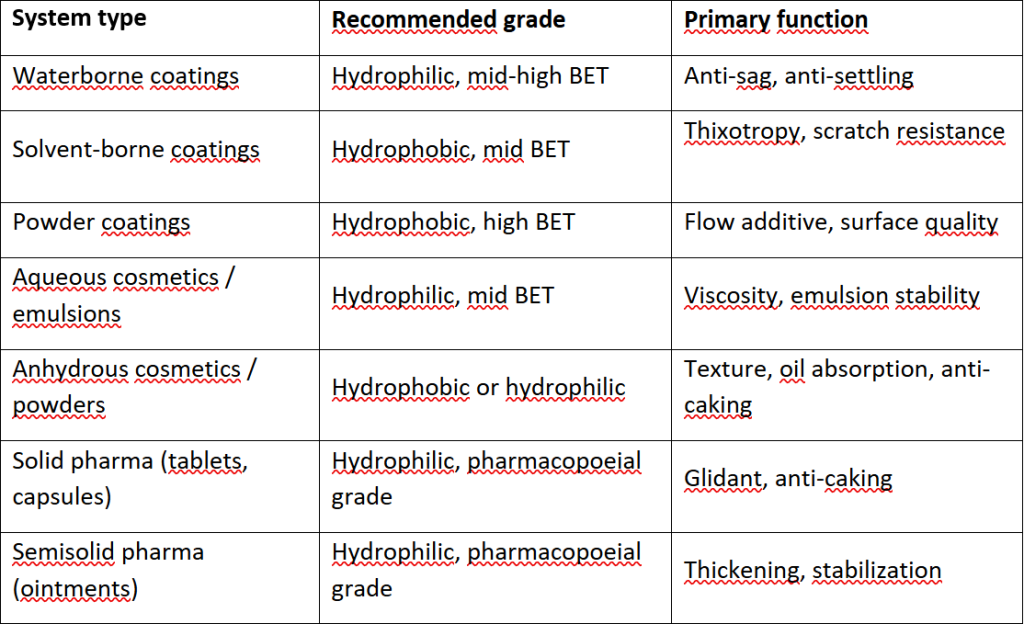
A key practical point: in every system, dispersion quality directly determines performance. Agglomerates that are not fully broken down during mixing reduce effective surface area, creating uneven rheological response, visible texture defects, or inconsistent flow in tablet presses. Selecting the right dispersing method — high-shear mixing, rotor-stator equipment, or bead milling — is as important as the grade choice itself.
Summary
Fumed silica is one of the few inorganic additives that genuinely crosses industry boundaries at a functional level. The same material that prevents paint from sagging on a wall stabilizes a cosmetic emulsion on a shelf and ensures a pharmaceutical tablet fills its die uniformly. What changes between applications is not the fundamental chemistry but the grade — primarily the surface treatment and specific surface area — and the care taken to disperse it correctly. Understanding those parameters is the starting point for any formulation decision involving this material.