



TL;DR — Natural thickeners (xanthan gum, guar, carrageenan, cellulose derivatives) offer biodegradability, clean-label appeal, and broad regulatory compliance but come with batch variability, higher use levels, and sensory compromises. Synthetic thickeners (carbomers, acrylate crosspolymers) deliver precision, efficiency, and predictable performance but face growing regulatory pressure — most notably EU Regulation 2023/2055, which classifies carbomers as synthetic polymer microparticles. The right answer is rarely one or the other: it is a system decision driven by pH, electrolyte load, sensory target, sustainability positioning, and the regulatory timeline of your market.
Ready to Work Together?
Get in touch with our team and discover tailored solutions for your industry
Why the natural vs synthetic debate matters more than ever
The cosmetic thickener market was valued at $2.7 billion in 2023 and is projected to reach $5.5 billion by 2030. The growth is not evenly distributed: natural polysaccharide thickeners held approximately 42.5% of the market in 2025, marking the first time naturally derived options have drawn level with synthetic types in volume share.
This shift is not purely marketing-driven. Three structural forces are reshaping thickener selection logic across the industry: tightening regulation on synthetic polymers in Europe and increasingly globally, consumer pressure for clean-label and biodegradable formulations, and a genuine improvement in the performance ceiling of natural and bio-fermented alternatives. Formulators who understand the real trade-offs — rather than the simplified "natural good, synthetic bad" narrative — are better positioned to make durable formulation decisions.
What do natural thickeners actually offer?
Natural thickeners are derived from plant, algal, or microbial sources. The main classes in cosmetic formulation are polysaccharide gums (xanthan, guar, carrageenan, sclerotium, locust bean), cellulose derivatives (HEC, HPMC, CMC), and starches. Their shared advantages are well documented.
- Biodegradability. Natural polysaccharides are broken down by environmental microorganisms, which means they do not accumulate in aquatic environments the way persistent synthetic polymers do. This is a genuine environmental benefit, not just a marketing claim, and it becomes increasingly material as microplastic regulations tighten globally.
- Regulatory positioning. Under EU Regulation 2023/2055 restricting synthetic polymer microparticles, natural polymers are explicitly excluded from the definition of restricted SPMs. Formulators building European product lines for 2027 onwards — the first enforcement deadline for rinse-off cosmetics — face no equivalent regulatory risk with xanthan gum, guar, or carrageenan that they do with carbomers.
- Consumer and certification appeal. COSMOS, Ecocert, and NATRUE certification frameworks require a high proportion of natural-origin ingredients. Natural thickeners are straightforwardly compliant; synthetic thickeners require case-by-case assessment and are frequently excluded. As over 62% of US consumers in 2024 reported actively checking ingredient lists before purchase, the INCI legibility of "xanthan gum" versus "carbomer" carries real commercial weight.
- Functional breadth. Several natural thickeners bring secondary benefits beyond viscosity. Hyaluronic acid is a humectant and active ingredient simultaneously. Carrageenan contributes film-forming properties. Guar gum provides conditioning in hair care. These multifunctional profiles can simplify formulations and reduce ingredient count.
- Synergistic combinations. The guar-xanthan synergy is one of the best-documented examples in cosmetic science: combining the double-helix structure of xanthan with the mannan backbone of guar produces synergistically enhanced viscosity and a more balanced texture profile than either alone. Similar synergies exist between xanthan and locust bean gum, and between sclerotium gum and xanthan.
Where natural thickeners fall short
The limitations are real and should not be glossed over. Formulators who have switched from synthetic to natural systems under commercial pressure — without adequate reformulation time — have learned these trade-offs the hard way.
- Higher use concentrations. Carbomers typically achieve target viscosity at 0.1–0.5%. Xanthan gum generally requires 0.5–1.5%, and higher concentrations risk introducing the characteristic stringy, ropy texture that consumers associate with poor-quality gels. This has direct cost implications when natural raw material prices are already higher than synthetic equivalents.
- Batch-to-batch variability. Natural polymers are agricultural or fermentation products. Molecular weight distribution, degree of acetylation, and viscosity-building capacity can vary between harvests, suppliers, and even production batches. Synthetic polymers are polymerized to specification — their batch consistency is reliably tighter. For industrial scale manufacturing, this variability translates into more frequent in-process viscosity adjustment and tighter incoming QC requirements.
- Electrolyte sensitivity in some grades. Standard xanthan gum is relatively electrolyte-tolerant, but not all natural thickeners share this property. Carrageenan performance can be significantly affected by the cation type and concentration in the formula. This limits direct substitution in high-salt systems without reformulation work.
- Microbial susceptibility. Natural polysaccharides are substrates for microbial growth. Formulations thickened with natural gums typically require a more robust preservation system, which can conflict with clean-beauty positioning goals and add cost and complexity.
- Sensory compromises. Research on eco-reformulated emulsions confirms that while natural polysaccharide combinations can replicate the structural and stability properties of synthetic acrylics, the sensory profile is not always identical. Consumers accustomed to the clean, cushioned feel of a carbomer gel may perceive natural alternatives as slightly heavier, stickier, or less elegant — particularly in lightweight serums and fluid emulsions.
What do synthetic thickeners actually offer?
Synthetic thickeners — primarily carbomers, acrylate crosspolymers, HASE polymers, and HEUR polymers — have dominated professional cosmetic formulation for decades for reasons that remain technically valid.
- Efficiency. Carbomers build extremely high viscosity at low concentrations. A 0.2–0.5% carbomer gel can achieve viscosities equivalent to 1.5% or more of a natural polysaccharide, which matters for both cost-in-use and sensory lightness.
- Formulation clarity. Carbomers produce exceptionally clear gels that are difficult to replicate with natural alternatives. For transparent vitamin C serums, clear eye gels, or hyaluronic acid ampoules, carbomers have long been the default because the optical clarity is part of the premium aesthetic.
- Batch consistency. Synthetic polymers are manufactured to precise molecular weight specifications. Viscosity, gel strength, and rheological profile are highly reproducible between production runs — a significant operational advantage at manufacturing scale.
- Rheological precision. HASE and HEUR associative thickeners offer a level of rheological tunability not available in natural systems. Hydrophobe size, acid content, and molecular weight can be adjusted to dial in specific shear-thinning profiles, yield stress values, and levelling behaviour — which is why they remain the dominant choice in sophisticated waterborne coatings and complex cosmetic emulsions.
- Processing ease. Synthetic thickeners are generally less prone to microbial contamination and do not require the same preservation burden as natural alternatives. They are also typically more straightforward to disperse and hydrate in standard manufacturing equipment.
The regulatory inflection point: carbomers and the microplastic classification
The most consequential recent development in thickener selection is the classification of carbomers as synthetic polymer microparticles under EU Regulation 2023/2055, which entered into force on 17 October 2023.
The technical reasoning is precise: the regulation's solubility test must be conducted at pH 7 on the material in its commercialised form. Carbomers are supplied as a dry acidic powder and only become soluble after the formulator neutralises them. In their supplied state at pH 7, they fail the solubility exclusion — and are therefore classified as restricted SPMs. Pre-neutralised solid polymers, supplied in a form that passes the pH 7 solubility test as-is, are excluded from this classification.
The enforcement timelines are phased by product category: rinse-off cosmetics must comply by October 2027, leave-on products (moisturisers, serums, creams) by October 2029, and colour cosmetics by October 2035 — though from 2031, colour products must already carry a label stating they contain microplastics. For R&D teams developing products with a 2–4 year launch window, the compliance deadline for leave-on products is already within the development horizon for formulations beginning now.
This does not make synthetic thickeners obsolete. Pre-neutralised acrylate polymers, HASE and HEUR systems, and acrylate crosspolymers supplied in soluble form may be outside the SPM classification depending on their specific chemistry and supplied form. But it does make carbomer in its conventional form a time-limited ingredient in the European market — and formulators who have not yet started their reformulation work are behind the curve.
The middle ground: hybrid and blended approaches
The most practically effective response to the natural-vs-synthetic dilemma is not a binary choice — it is a blended strategy. Combining a small amount of synthetic associative thickener with a natural polysaccharide base can deliver the stability and consistency of the synthetic component while achieving certification compliance at a natural ingredient ratio that meets COSMOS thresholds.
Carbomer-xanthan gum combinations have long been used to balance gel strength and electrolyte tolerance — carbomer contributes texture precision and clarity, xanthan gum contributes salt resistance and natural-origin credentials. As carbomer regulatory pressure increases, the pragmatic replacement is often not pure natural but rather a combination of a pre-neutralised synthetic (outside SPM classification) with a polysaccharide co-thickener.
Research on surfactant-free emulsion systems has confirmed strongly synergistic action when agarose-stearate is combined with carbomer, producing gel-like behaviour comparable to commercial cosmetic creams. The principle generalises: the most stable and sensorially elegant formulations often come from synergistic combinations, not from single-ingredient substitution.
A practical decision framework
The choice between natural and synthetic thickeners — or a blend — comes down to six variables that should be evaluated before bench work begins:
- System polarity and pH. Carbomers and HASE require neutralisation and underperform below pH 5. If you are formulating an AHA toner, vitamin C serum, or low-pH exfoliant, natural thickeners or pre-neutralised acrylates are the only viable options.
- Electrolyte load. High ionic strength systems — mineral sunscreens, formulations with electrolytic preservatives, salt-based toners — favour xanthan gum, HEUR thickeners, or modified cellulose over standard carbomers.
- Regulatory market and timeline. If your primary market is the EU and your product is a leave-on, you have until October 2029 to reformulate away from carbomer. That timeline should already be driving your pipeline decisions. If your market is the US, MoCRA does not currently include a carbomer SPM restriction, though REACH-driven reformulations from European operations are increasingly being applied globally for simplicity.
- Sustainability certification. COSMOS-certified formulations require a minimum natural-origin content. The certification pathway is straightforward with polysaccharide thickeners and impossible with conventional carbomers.
- Sensory target. For ultra-light transparent serums and clear gel formats, the carbomer aesthetic is still unmatched by natural alternatives. For cream emulsions, lotions, and rinse-off products, the performance gap between natural and synthetic has narrowed significantly — especially with well-designed polysaccharide blends.
- Manufacturing capability. Natural thickeners require careful hydration protocols, adequate shear equipment, and tighter batch-to-batch QC. If your manufacturing partner is not set up for this, switching from synthetic to natural without process adjustment will create quality problems.
Xanthan Gum vs Sclerotium Gum vs HEC: Which Natural Thickener for Cosmetics?
Choosing between natural thickeners is rarely a question of which is "best" — it is a question of which fits the system. Xanthan gum, sclerotium gum, and HEC cover different ground in terms of texture, pH range, and application context. The table below maps the key criteria.
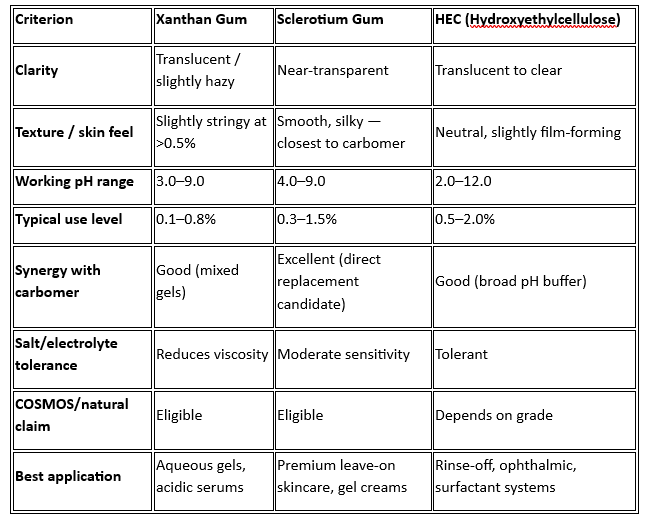
A few practical points worth noting. Sclerotium gum, produced by fungal fermentation of Sclerotium rolfsii, is the closest natural alternative to carbomer in terms of sensory profile — its smooth, non-stringy texture makes it the preferred option in premium leave-on formats where the ropy feel of xanthan at higher concentrations is not acceptable. HEC's exceptional pH range (2.0–12.0) and electrolyte tolerance make it the default choice in rinse-off and ophthalmic systems where other natural thickeners would destabilize. Xanthan remains the workhorse for aqueous gels and acidic serums, particularly where cost and availability are constraints.
Summary
Natural and synthetic thickeners are not competing on an even playing field anymore. Regulatory pressure in Europe has put a hard expiry date on conventional carbomers in the EU market. Consumer demand for transparent labelling and biodegradable formulas is tilting commercial preference toward natural alternatives across all price tiers. And the performance gap between best-in-class natural blends and synthetic systems has narrowed substantially over the past decade.
But "natural" is not a performance guarantee, and "synthetic" is not an environmental death sentence. The formulator's job is to match the right chemistry to the system, the sensory brief, the regulatory context, and the sustainability ambition — and to start that work early enough that the EU's phased deadlines do not become a crisis. For a deeper dive into how thickener choice affects emulsion stability specifically, see our articles on rheology modifiers in cosmetics and emulsion stabilisation.