


Quick answer: Preventol D7 is an isothiazolinone-based in-can preservative from Lanxess that protects water-based coatings from bacteria, mold, yeast, and algae while the product sits in the can. Safic-Alcan distributes the full Preventol portfolio, including Preventol WB, an isothiazolinone-free alternative for formulators managing EU labeling constraints, and Preventol MP 440-D for dry-film protection after the coating is applied.
Preventol D7 Protects Coatings in the Can, Not on the Wall
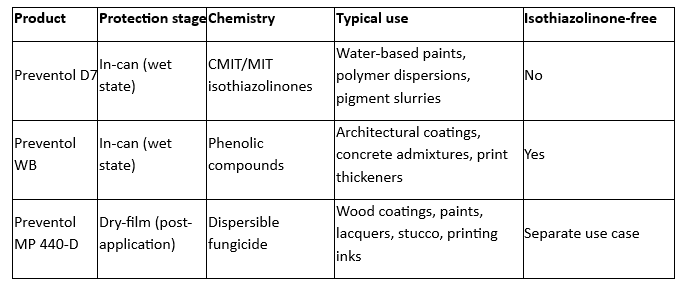
Preventol D7 is an in-can biocide: its job is to stop microbial growth inside the container, from the moment water is added to the formulation until the product is opened and applied. According to Lanxess technical documentation, the product is built around a blend of the isothiazolinones CMIT and MIT at roughly 1.5% active content, dispersed in a low-viscosity, water-soluble carrier. That formulation gives it activity against bacteria, including formaldehyde-resistant strains, along with mold, yeast, and algae, and it stays effective across a pH range of roughly 2.5 to 9.
Formulators use Preventol D7 in polymer dispersions, pigment slurries, filler suspensions, and architectural and industrial water-based paints, usually adding it early in the process once enough water is present to dissolve it. In the US, the Lanxess EPA-registered label for the product gives an in-can dosage window of roughly 425 to 1,675 ppm of product, equivalent to about 6 to 25 ppm of active isothiazolinones. Authorized dosage, wording, and even product availability shift from one country to another, so the current safety data sheet and label for your market remain the reference, not a figure copied from a different region's registration.
Isothiazolinone Labeling Is the Real Reason This Topic Keeps Coming Up
Isothiazolinones didn't get harder to use because they stopped working. They got harder to use because they're recognized skin sensitizers, and EU chemical safety rules have tightened around that fact. Under the CLP Regulation, methylisothiazolinone (MIT) and CMIT/MIT mixtures carry harmonized classifications that trigger sensitizer labeling on any mixture, including paints, once concentration passes a specific threshold, with a lower threshold that already requires an allergy warning statement on the label. ECHA tracks this class of substances specifically because of how often it shows up in downstream product labeling disputes.
None of this bans isothiazolinone preservation in coatings. It does mean two things for a formulator: the finished paint's label depends directly on how much active isothiazolinone ends up in the can, and a growing number of brand owners ask their suppliers for a documented isothiazolinone-free route before a reformulation even starts. For the full picture of how the BPR classifies and approves biocide chemistries beyond isothiazolinones, see our guide to industrial biocides. That's the practical opening for the rest of the Preventol range.
Preventol WB Removes Isothiazolinones From the Equation
Preventol WB is built on phenolic chemistry instead of isothiazolinones, and it covers the same core threats: bacteria, yeasts, and mold fungi in the can. It's positioned for concrete admixtures, print thickeners, and architectural coatings, the same territory where D7 operates, which makes it a direct substitution candidate rather than a niche product. Swapping to a phenolic in-can preservative doesn't remove every labeling consideration from a formulation (phenolics carry their own hazard profile), but it does take MIT and CMIT/MIT concentration out of the label conversation entirely.
The choice between the two isn't about one being "better." D7 has a broader and longer-documented track record across more substrate types; WB exists specifically for formulations where isothiazolinone-free is a stated requirement, whether that comes from a retailer specification, an eco-label, or a customer's own regulatory file.
In-Can Protection Ends Where Dry-Film Protection Begins
A biocide that stops bacteria in a wet can does nothing once that coating is on a wall, a facade, or a piece of wood exposed to humidity. That's a separate biocidal product type under EU rules, film preservation (PT 7) rather than in-can preservation (PT 6); our biocides overview breaks down all 22 BPR product types in detail. Mold and algae growth on a dried film is a dry-film problem, and it needs a fungicide built for that stage.
Preventol MP 440-D covers that second stage. It's a dispersible fungicide developed for water-based wood coatings, paints, lacquers, stucco and plaster, putty, pigment pastes, and printing inks, protecting the dried film against fungal growth once the in-can preservative's job is already done. A formulation that only addresses in-can protection can still fail on the wall months later; the two product types are complementary, not redundant.
Comparing the Three Products
Safic-Alcan Supplies the Full Preventol Range With Local Technical Support
As Lanxess's distribution partner, Safic-Alcan carries Preventol D7, Preventol WB, Preventol MP 440-D, and the rest of the range across multiple markets, alongside the current safety data sheets and technical documentation formulators need to confirm dosage and regulatory status before they commit a batch. Biocide selection is rarely the only variable in a waterborne system: formulators juggling foam and film defects at the same time may also find our piece on defoamers useful.
Frequently Asked Questions
What is Preventol D7 used for?
Preventol D7 is an in-can preservative for water-based industrial products, most commonly polymer dispersions, pigment slurries, filler suspensions, and paints and coatings, where it protects against bacteria, mold, yeast, and algae during storage.
Is Preventol D7 an isothiazolinone?
Yes. Preventol D7 is formulated around a blend of the isothiazolinones CMIT and MIT. Formulators who need to avoid isothiazolinones on the label typically look at Preventol WB, which uses phenolic chemistry instead.
What's the difference between in-can and dry-film biocides?
In-can biocides like Preventol D7 and Preventol WB protect the coating while it's still liquid, in the container. Dry-film biocides like Preventol MP 440-D protect the coating after it has been applied and dried, against fungal and algal growth on the finished surface. A formulation typically needs both, not one or the other.
Is there an isothiazolinone-free option in the Preventol range for coatings?
Yes, Preventol WB is the isothiazolinone-free in-can preservative in the range, built on phenolic chemistry, and it targets the same applications as Preventol D7.