


Why Polymer Processing Aids Exist
Processing polyolefins at high throughput exposes a fundamental tension in polymer physics: the faster you push a resin through a die, the more likely the melt is to fracture. This is not a material failure — it is a flow instability driven by shear stress at the die wall exceeding the cohesive strength of the polymer melt. The result, melt fracture, produces surface defects that render film, pipe, and molded parts commercially unacceptable. Pressure fluctuations increase energy consumption. Die build-up forces costly production stoppages.
Polymer processing aids (PPAs) — sometimes called polymer process aids — are additives incorporated at low concentrations into the polyolefin resin or compounded as a masterbatch, specifically to solve these problems without changing the fundamental nature of the resin. They improve processability, reduce or eliminate melt fracture, minimize die build-up, and in many cases allow processors to run at higher output rates than the unmodified resin permits.
This article covers the mechanisms behind melt fracture, the main families of polymer processing aids used in polyolefin extrusion and injection molding, and the current regulatory transition away from fluoropolymer-based additives.
Understanding Melt Fracture in Polyolefin Extrusion
Melt fracture is not a single phenomenon. It covers a progression of distinct flow instabilities that appear in polyolefin extrusion as output rate — and therefore shear rate at the die wall — increases. Research published in the Journal of Applied Polymer Science (Wiley, 2022) on LLDPE and LDPE characterizes these instabilities systematically: smooth extrudate at low shear rates transitions to sharkskin, then stick-slip, and finally gross melt fracture.
Sharkskin is a fine, periodic surface roughness originating at the die exit. Research confirms it results from rapid acceleration of the melt's surface layer as it exits the die, generating extensional stress that periodically tears the surface when it exceeds the cohesive strength of the entangled chains. It is an exit phenomenon: the die entry region plays no role in sharkskin formation.
Stick-slip (spurt) instability occurs at higher shear rates, characterized by alternating smooth and rough regions of the extrudate, accompanied by substantial pressure fluctuations. Research on polyethylene instabilities shows pressure oscillations ranging from 2 to 11 bars in capillary rheometer conditions at 500 s⁻¹.
Gross melt fracture appears at the highest shear rates and involves irregular distortions of the entire extrudate cross-section — a volume instability, not merely a surface one. It originates upstream at the die entry elongational flow field.
Susceptibility to these instabilities depends strongly on molecular weight and polymer architecture. Research on LLDPE and LDPE microstructure shows that narrow molecular weight distribution linear polymers — including LLDPE and metallocene polyolefins — are particularly prone to sharkskin and spurt, while long-chain branched polymers such as LDPE tend to develop gross melt fracture instead. High molecular weight increases melt viscosity and shear stress at the die wall, accelerating the onset of instabilities at any given throughput. This is why LLDPE blown film — low melt index, narrow MWD, linear chains — is the canonical application for polymer processing aids.
Fluoropolymer-Based Processing Aids: Mechanism and Performance
Fluoropolymer PPAs — fluoropolymer-based additives based on fluoroelastomers or fluoroplastics — have been the dominant solution for melt fracture elimination in polyolefin extrusion for decades. Originally developed for LLDPE blown film and tubing, they have since been extended to HDPE, polypropylene, and other polyolefins.
The mechanism is a surface-coating process, not a bulk modification of the resin. Research published in Polymer Engineering & Science (Wiley) on PPA fundamentals confirms that these additives function by depositing a thin fluoropolymer layer on internal die surfaces during an induction period, promoting slip at the fluoropolymer-polyethylene interface. Once the coating establishes, the polyolefin melt slips at the die wall rather than adhering — critical shear stress at the interface drops sharply, and melt fracture is eliminated or substantially delayed.
A key insight from research on coating kinetics: contrary to the earlier assumption that highly dispersed fine particles are most efficient, large-particle process aids are superior in practice. Fluoropolymer accumulates at the die entrance and flows toward the exit — the droplet size distribution in the PPA formulation directly determines how quickly this coating establishes and how reliably it eliminates melt fracture at low PPA use levels.
Common fluoropolymer chemistries used as PPA
Polyvinylidene fluoride (PVDF) and VF2/HFP copolymers are a well-studied family of fluoropolymer process aids for polyolefin blown film. The key evaluation metric is the minimum PPA concentration required to quickly reduce melt fracture, and the induction time before the die coating establishes.
Fluoroelastomers — copolymers of vinylidene fluoride with hexafluoropropylene and other monomers — are the most widely used family in commercial fluoropolymer-based PPA masterbatches. They are fluid at polyolefin processing temperatures, a requirement established in early PPA patent literature.
Low-melting fluoroplastics — TFE/HFP copolymers, or TFE/perfluoro(methyl vinyl) ether copolymers — are used where higher thermal stability is needed.
All these fluoropolymer chemistries function through the same surface-coating mechanism. The fluoropolymer is immiscible with the polyolefin resin at processing temperature, migrates to the die wall, and establishes the slip-promoting coating. Typical active PPA concentrations in the final resin are 50 to 500 ppm, and the additive is supplied as a PPA masterbatch in a polyethylene carrier at 1 to 3% loading for precise dosing.
The PFAS Regulatory Shift and Its Consequences for PPA Selection
The regulatory environment for fluoropolymer-based polymer process aids changed fundamentally in January 2023, when the national authorities of Germany, Denmark, the Netherlands, Norway, and Sweden submitted a proposal to ECHA under REACH to restrict per- and polyfluoroalkyl substances (PFAS) — covering an estimated 10,000 molecules including the fluoropolymers used as PPAs. ECHA's scientific committees began evaluating the proposal, with a public consultation running from March to September 2023.
The restriction, if adopted without specific derogations, would effectively end the use of fluoropolymer-based polymer processing aids across EU applications. During the consultation, stakeholders provided evidence that substitution away from PFAS in polymer processing aids used in flexible plastic film extrusion was not currently possible without performance compromise — a notable acknowledgment that has not halted the regulatory momentum.
The EU's PPWR (Regulation EU 2025/40) reinforces this direction by banning PFAS in food-contact packaging from August 2026. The combined effect is creating a hard timeline for the polyolefin film industry to qualify non-fluorinated alternatives.
In December 2022, 3M — one of the largest producers of fluoropolymers used in PPA applications (PTFE, PVDF) — announced its exit from the entire fluoropolymer business, with annual sales of approximately $1.3 billion. This supply-side withdrawal, combined with regulatory pressure, is accelerating the transition regardless of how quickly REACH restrictions are formally finalized.
Non-Fluorinated PPA Alternatives
The development of PFAS-free polymer processing aids is an active area of commercial R&D, with several distinct chemical approaches now available or in qualification.
Silicone-based PPAs
Silicone-based additives — including modified copolysiloxane structures — operate on a surface energy principle similar to fluoropolymers: low surface energy at the die wall promotes slip and reduces adhesion of the polyolefin melt. Dow's DOWSIL 5-1050 PPA, launched commercially as a fluoropolymer alternative, contains a silicone additive in a polyethylene carrier supplied as a masterbatch. Published performance data show reduced melt fracture and haze in film, die lip buildup reduction, and compliance with EU Regulation 10/2011 for food contact. The additive is compatible with dry or melt blending into existing extrusion processes.
Modified copolysiloxane structures combine the low surface energy of silicone with polar groups that actively migrate to metal die surfaces — designed to establish the die coating more quickly than standard silicone additives.
Polyamide-polyether block copolymers
Patent literature (EP4431563A1, WO2023241955A1) describes block copolymers with polyamide and polyether blocks that reduce die lip build-up during polyolefin extrusion in the absence of fluoropolymers. These are thermoplastic elastomers whose surface activity derives from the amphiphilic block structure rather than a fluorine-driven surface energy differential. Early commercial versions have shown effectiveness in blown film applications where sharkskin is the primary defect.
Boron nitride (BN)
Hexagonal boron nitride is the most technically distinctive non-fluorinated polymer process aid. Research published in Rheologica Acta (Kazatchkov et al., 2000) demonstrated that BN can eliminate gross melt fracture in polyolefin extrusion — a capability previously attributed exclusively to fluoroelastomers. Its mechanism involves covering the die surface with platelet BN particles, reducing shear stress at the wall. BN is less effective against sharkskin than fluoropolymers, but combinations of BN with fluoroelastomers have shown synergistic performance. Saint-Gobain's hBN powders hold FDA food-contact approval for polyolefin processing.
Research comparing PEG-based PPAs and fluoropolymer PPAs in HDPE extrusion found that PEG-based additives decrease primary die pressure immediately from process start, while fluoropolymers require an induction time of approximately 6 minutes before affecting die pressure — a practical distinction with real implications for startup efficiency and masterbatch dosing strategy.
Qualification challenges for non-PFAS PPAs
The transition is not straightforward. Processors have reported evaluating as many as 20 different non-PFAS PPA chemistries before finding one that works for their specific film structure and resin formulation. Sharkskin elimination studies must be followed by die build-up evaluations lasting days to weeks, and results must be validated across production lines and qualified with downstream customers. Interaction effects between different PPA chemistries — when a resin already contains a PPA and a converter adds a second additive from a different supplier — can produce suboptimal outcomes that require dedicated compatibility testing.
PPA Applications Beyond Blown Film
HDPE pipe and sheet
HDPE extrusion for pipe and sheet faces a different melt fracture profile than LLDPE blown film. High molecular weight HDPE resins exhibit stick-slip and gross melt fracture rather than sharkskin as primary instabilities. Fluoropolymer-based processing aids can restore surface gloss and reduce pressure fluctuations, but gross melt fracture in HDPE at industrial shear rates is harder to eliminate with PPA alone. Die geometry modification and processing temperature optimization are typically combined with additive addition.
Polypropylene and other polyolefins
PPA use in polypropylene is significantly smaller than in polyethylene. Research confirms that polypropylene's shear thinning behavior and tendency to thermally degrade under shear reduce its melt viscosity during processing, making it inherently less susceptible to melt fracture than LLDPE. Fluoropolymer-based processing aids are used in specific PP grades with narrow MWD or high molecular weight, or in applications requiring optical surface quality.
Injection molding
In injection molding, the process aid role shifts from melt fracture elimination to improving melt flow into thin-walled or complex cavity geometries. High molecular weight resins with high viscosity can develop surface defects from shear stress at gate and runner locations. PPA additives in injection molding applications reduce melt viscosity at the die entrance and improve surface finish. Patent literature describes fluoropolymer PPAs for injection molding of ethylene-alpha olefin copolymers across MFR ranges of 0.2 to 200 g/10 min.
Masterbatch Delivery and Dosing
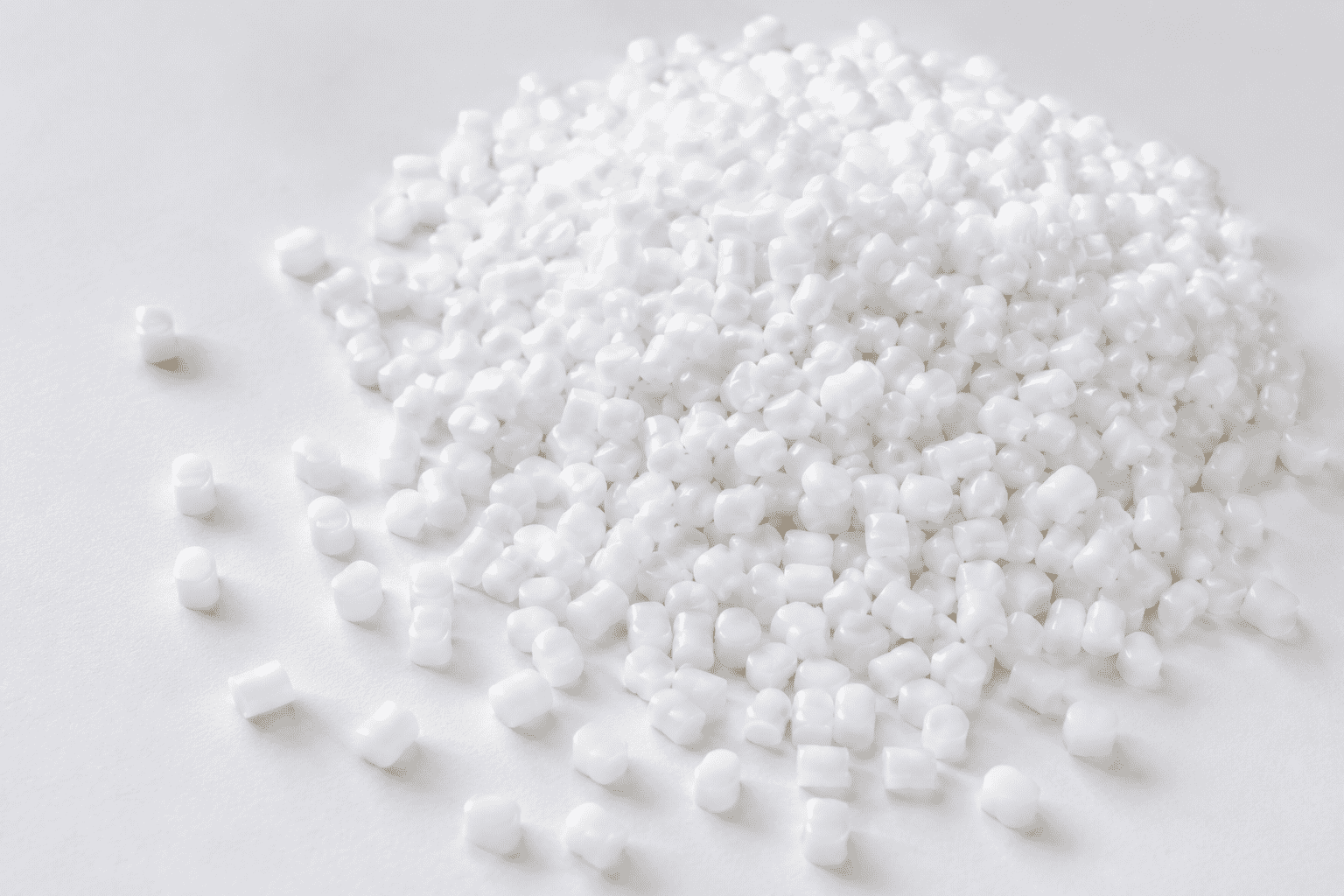
Polymer processing aids are almost universally delivered as masterbatches — the active additive dispersed in a polyethylene or polypropylene carrier at concentrations of 1 to 10%. This allows precise dosing at the extruder throat without weighing neat additive, maintains compatibility with the host polyolefin, and ensures uniform distribution through the melt before the die.
Active PPA concentration in the final extruded part is very low — typically 50 to 500 ppm. At these levels, the additive does not alter the bulk mechanical properties of the polyolefin product. Its action is entirely at the die wall interface.
For non-fluorinated PPAs, the masterbatch format is particularly important. Unlike fluoropolymers, which establish a persistent die coating that remains effective over extended production runs, some non-fluorinated alternatives require more consistent dosing to maintain the wall-slip effect. Understanding the coating kinetics of each PPA chemistry — including whether an induction period exists and its duration — is essential for designing an effective dosing protocol.
Selecting and Validating a Processing Aid
For process engineers evaluating PPAs for a polyolefin extrusion application, the selection process involves several steps.
Identify the defect type. Sharkskin, stick-slip, and gross melt fracture respond differently to different PPA chemistries. An additive optimized for sharkskin elimination may have limited effect on gross melt fracture.
Characterize the polymer resin. Molecular weight, MWD, and branching architecture determine the onset shear stress for each instability. High-MFI resins may not require a PPA; low-MFI, narrow-MWD resins such as LLDPE and metallocene polyethylene are the highest-need applications.
Account for regulatory constraints. In EU applications — particularly food-contact packaging subject to PPWR PFAS restrictions — fluoropolymer-based PPAs face a hard timeline. PPA chemistry selection must account for the regulatory direction, not only for current performance.
Test for die build-up, not just melt fracture. A PPA that eliminates sharkskin but deposits material at the die lip introduces a different production problem. Qualification must cover both defect modes over extended production runs.
Validate in production conditions. Laboratory capillary rheometry confirms instability onset and PPA effect. But blown film and pipe extrusion lines introduce variables — die geometry, screw profiles, melt temperature distribution — that capillary data cannot fully predict. Production line validation is the required final step before process adoption.