


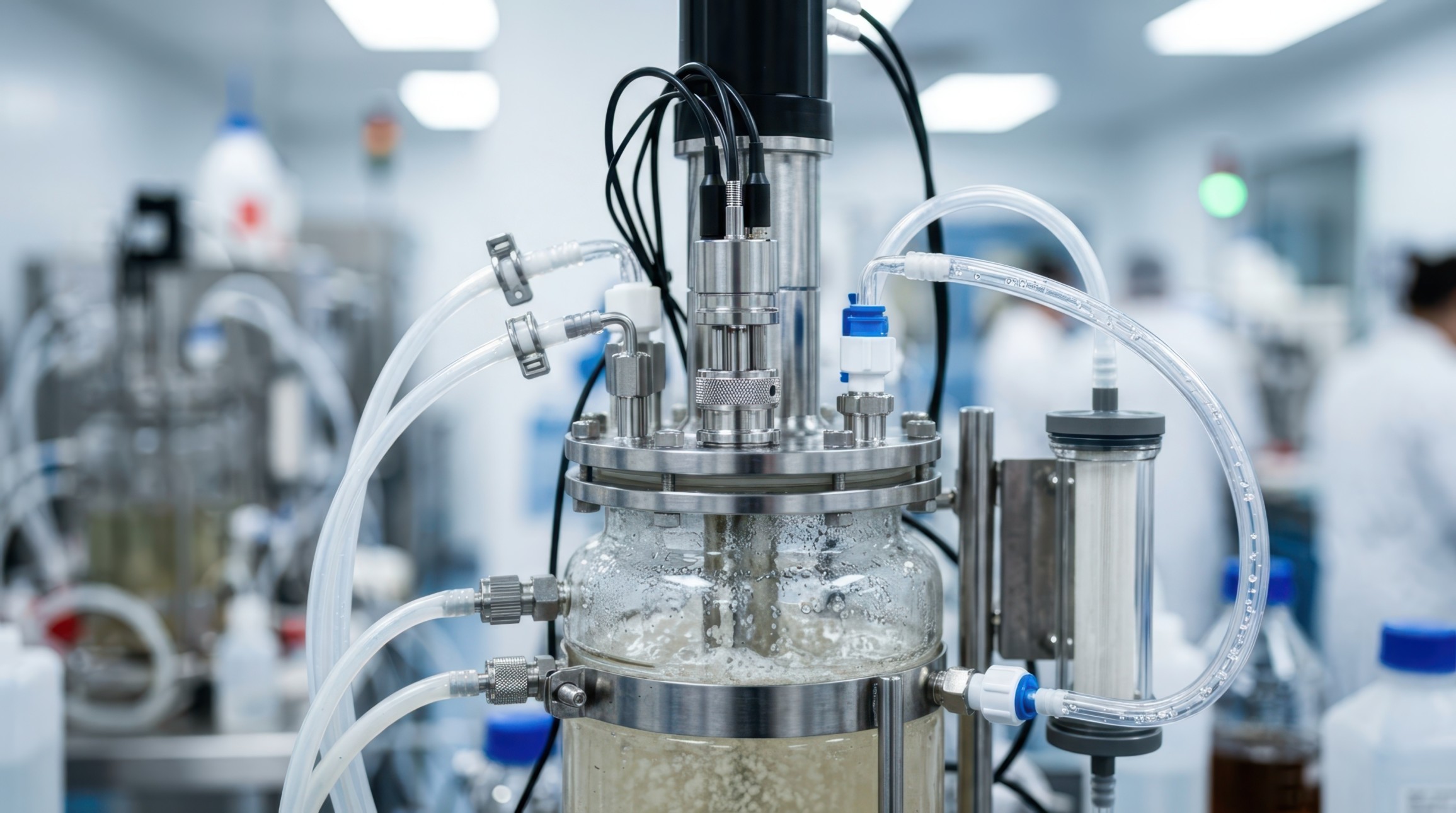
A defoamer for fermentation is evaluated in the vessel and paid for after it. Filter capacity, separation behaviour and residual levels are all decided by a choice usually made on knockdown speed alone.
Compatibility testing stops at the end of fermentation. Your process does not.
The antifoam that controlled your foam is still in the broth when the vessel is emptied. It is designed to be poorly soluble and surface-active, which is exactly why it worked, and exactly why it does not quietly disappear at harvest. It travels into cell separation, into filtration, through purification, and in some cases into the product.
Most of the cost of a defoamer for fermentation is not the price per litre. It is the filter changes, the flux decline and the analytical work that follow it downstream.
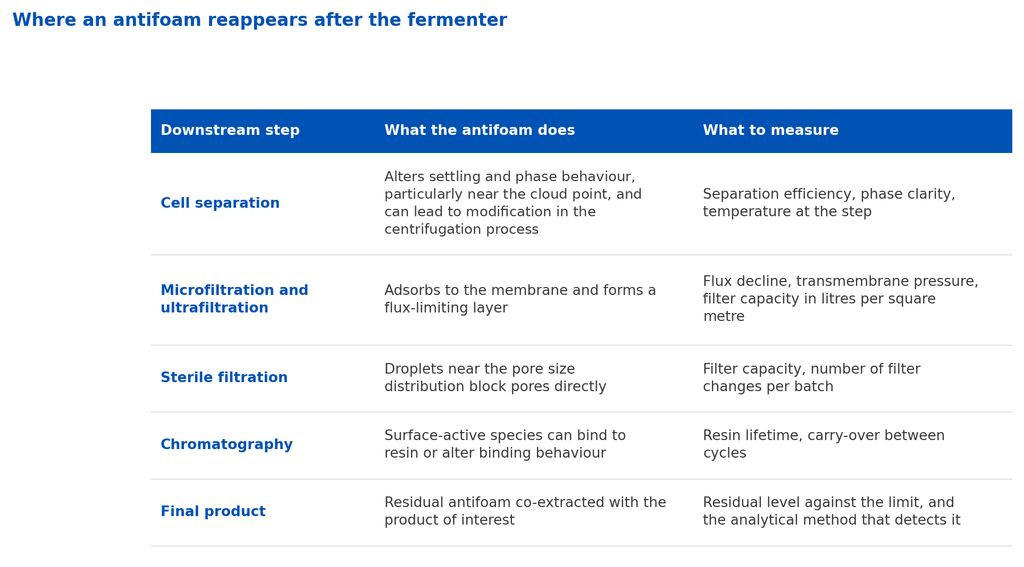
The literature on this is blunt. A 2024 study of foam control in mammalian cell culture, published in Biotechnology Progress, notes that antifoam addition can lead to undesirable effects both upstream and downstream, and that certain silicone-based antifoams have been shown to clog filtration apparatus during downstream processing.
A broader review of the field puts it more directly still: chemical antifoams will often create difficulties in downstream processing or contaminate the final product. They can clog filtration membranes or reduce their filtration rate, or be co-extracted with the product of interest.
Can an antifoam foul a filtration membrane?
Yes, and the size of the effect is chemistry-dependent rather than marginal.
The clearest published comparison comes from Liew and colleagues in Biotechnology and Bioengineering, who measured microfiltration flux with two antifoams in the absence of broth, so the antifoam itself was the only variable.
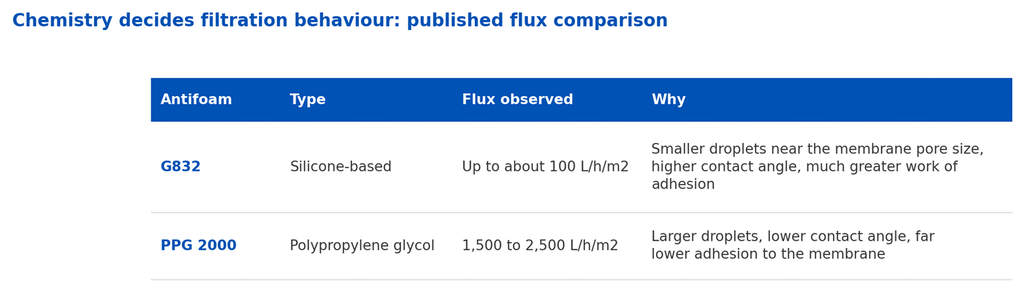
Chemistry decides filtration behaviour: published flux comparison
The silicone-based antifoam gave a flux up to twenty-five times lower than the polypropylene glycol antifoam under the same conditions. The authors attributed the difference to a combination of factors: a smaller average oil droplet size, 0.28 micrometres against 0.65, which sat within the membrane pore size distribution of 0.26 to 0.62 micrometres; a higher contact angle, 98 degrees against 51; and a work of adhesion of 26.0 mN/m against 0.81.
That last figure is the one to hold onto. The silicone antifoam adhered to the membrane roughly thirty times more strongly. This is not a foam control difference. It is a materials difference that only appears after the vessel.
The cloud point, and why temperature matters downstream
Many non-silicone antifoams are temperature-dependent in a way that silicone antifoams generally are not. Above the cloud point, the antifoam phase separates out of solution.
This cuts both ways, and the literature has gone back and forth on it. Filtering above the cloud point was long thought to foul the membrane with precipitated antifoam, so the conventional advice was to filter below it. More recent process work has used the opposite approach deliberately, separating the antifoam phase above its cloud point and removing it before the main filtration step.
The practical point for a pharmaceutical process is narrower: if your antifoam has a cloud point anywhere near your downstream operating temperatures, that transition is a process parameter you need to know about, and it will not appear in a foam knockdown test.
A related detail that surprises people: in enzyme manufacture, antifoam remaining with the product solution after biomass separation has been described as forming a slimy layer on ultrafiltration membrane surfaces and greatly slowing filtration, to the point that a dedicated heat step before ultrafiltration became standard practice to precipitate and remove it.
Emulsion or concentrate: what else travels downstream
An emulsion antifoam is not only the active. Emulsion formulations necessarily contain surfactants, coagulants and thickeners to stabilise them, and those chemicals are themselves a recognised contributing factor in membrane fouling and flux inhibition.
If your process is sensitive downstream, this is a reason to look closely at a 100% active concentrate rather than a diluted emulsion, and to ask the supplier what the emulsion system actually contains. It is also a reason to read a compatibility study carefully: a result obtained with a concentrate does not transfer to an emulsion of the same active.
Of the grades Safic-Alcan supplies for pharmaceutical fermentation, SAG 471 and Esca Ferm-S are 100% active concentrates, while BC Simethicone PD30S is a 30% active simethicone emulsion whose technical data sheet positions it for pharmaceutical applications including cell culture. Which is right for a given process depends on the sterilisation regime and the downstream train, not on the foam test.
What residue documentation will an inspector expect?
This is where the downstream question becomes a regulatory one. European guidance on quality documentation for biological investigational medicinal products names antifoam agents explicitly as an example of process-related impurities for which control is expected and asks for justification where only qualitative data are provided.
In practice that means one of two positions, documented:
- The process clears it. You can show where it is removed and what remains, with an analytical method that can detect it at the relevant level.
- A residual limit applies. You have set one, and you can justify it.
Our companion article on what an inspector will ask about your antifoam sets out the full documentation pack behind both positions.
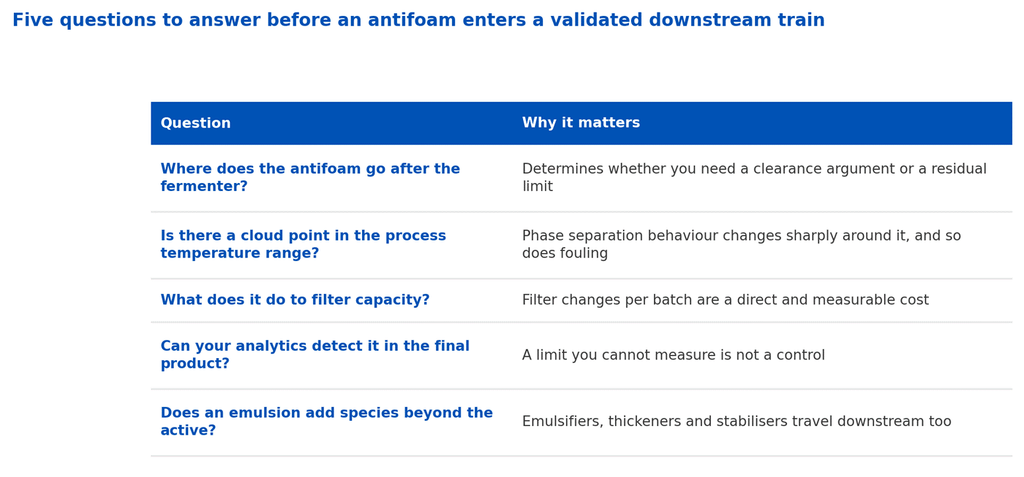
Five questions to answer before an antifoam enters a validated downstream train
How this changes the selection decision
The usual sequence is to select on foam performance, then discover the downstream cost during scale-up or, worse, during a filter capacity investigation. Reversing it is not expensive.
- Shortlist on foam control at the dose you will use, as covered in our article on antifoam agents in fermentation.
- Run a small-scale filterability test on broth containing each candidate at that dose. Flux decline and filter capacity in litres per square metre are enough to separate the shortlist.
- Confirm the analytical method can see the material in the final product before you need it to.
- Only then fix the grade in the process description.
A filterability screen takes a day. A filter capacity investigation in a validated process takes considerably longer, and happens under pressure.
Frequently asked questions
Does antifoam carry through into the final product?
It can. Published reviews record chemical antifoams creating difficulties in downstream processing or contaminating the final product, including being co-extracted with the product of interest. Whether yours does depends on the chemistry, the dose and the purification train, and it is a question the process has to answer with data rather than assumption.
Can silicone antifoam foul a sterilising-grade filter?
Yes. In a published microfiltration comparison, a silicone-based antifoam gave a flux up to about 100 L/h/m2 against 1,500 to 2,500 L/h/m2 for a polypropylene glycol antifoam under identical conditions, attributed to droplet size close to the membrane pore size and a far greater work of adhesion.
How do you remove antifoam from a fermentation broth?
Common approaches include exploiting the cloud point so the antifoam phase separates and can be filtered off, a dedicated heat step before ultrafiltration, and adsorption onto mineral clay. Which applies depends on the chemistry, and each adds a unit operation that has to be validated.
Does an emulsion antifoam add more than the active?
Yes. Emulsion antifoams contain surfactants, coagulants and thickeners to stabilise them, and these have been identified as contributors to membrane fouling and flux inhibition in their own right.
What residue documentation will an inspector expect?
Either evidence that the process clears the antifoam, or a justified residual limit, supported by an analytical method capable of detecting it. European guidance names antifoam agents as process-related impurities for which control is expected.
Talk to our technical team
Safic-Alcan distributes the Momentive antifoam range across Europe and supports pharmaceutical customers through grade selection, filterability screening and the documentation required for qualification, backed by our global pharmaceutical applications laboratory in Étampes.
A trusted partner for cutting-edge Pharmaceutical innovation across continents
Sources
- Liew, M.K.H., Fane, A.G. and Rogers, P.L. (1997). Fouling of microfiltration membranes by broth-free antifoam agents1097-0290(19971005)56:1%3C89::AID-BIT10%3E3.0.CO;2-5). Biotechnology and Bioengineering, 56(1): 89-98.
- Flynn, J. et al. (2024). Measurement and control of foam generation in a mammalian cell culture. Biotechnology Progress. DOI: 10.1002/btpr.3450
- Routledge, S.J. (2012). Beyond de-foaming: the effects of antifoams on bioprocess productivity. Computational and Structural Biotechnology Journal, 3(4): e201210014.
- European Medicines Agency. Guideline on the requirements for quality documentation concerning biological investigational medicinal products in clinical trials, EMA/CHMP/BWP/534898/2008 rev. 1.
- US Patent 5,024,937, Method for processing aqueous fermentation broths, on emulsion stabilisers as a contributing factor in membrane fouling.
- US Patent 9,115,349, Hydrophobin solution containing antifoam, on cloud point separation of antifoam before filtration.