



Quick answer
Plant-based drinks separate because their proteins are weaker emulsifiers than dairy casein, and their dispersed particles differ in density from the water around them. Formulators stabilise them in two layers. Emulsifiers such as lecithins (E322) and mono- and diglycerides of fatty acids (E471) lower interfacial tension and keep oil droplets small and coated. Stabilisers, meaning the hydrocolloid thickeners and gelling agents such as gellan gum (E418), acacia gum (E414), carrageenan (E407), guar gum, locust bean gum, xanthan gum and cellulose derivatives, either raise viscosity or build a weak network that holds particles in suspension. Which class fits depends on pH, protein source, fat level, heat treatment (UHT versus pasteurised) and the label the brand wants to carry. In practice, robust systems combine one emulsifier with one stabiliser rather than relying on a single ingredient.
Why plant-based drinks lose stability
Instability in a plant-based drink is the visible endpoint of several distinct colloidal processes that a formulator has to tell apart, because each one calls for a different fix. A plant-based drink is a thermodynamically unstable oil-in-water dispersion: fat globules, protein aggregates, fibre and starch fragments sit in a watery continuous phase and, left alone, always drift toward the lowest-energy state of two separated layers. The job of formulation is not to make the system thermodynamically stable, which is not possible, but to make it kinetically stable for the length of its shelf life.
Colloid science separates the routes to failure into gravitational separation (creaming when droplets rise, sedimentation when solids sink), flocculation (droplets clump together without merging), coalescence (droplets fuse irreversibly into larger ones) and Ostwald ripening (large droplets grow at the expense of small ones through the continuous phase). A nanoemulsion review sets out this taxonomy and maps each mechanism to the class of stabiliser that counters it, and a companion methods review lists the droplet properties that decide the outcome: concentration, size, surface charge, interactions and rheology. For plant drinks specifically, the three dominant levers are particle size, the quality of the emulsion formed at homogenisation and protein solubility, as set out in a peer-reviewed review of plant-based beverages. Naming the mechanism first is what makes class selection rational rather than trial and error: creaming and sedimentation respond to droplet size and viscosity, coalescence responds to the strength of the interfacial film, and each points to a different additive.
Droplet size and Stokes' law
Droplet size is the first and most powerful lever, because gravitational separation comes down to geometry. The rate at which a droplet creams or settles is described by Stokes' law, and the physics is unforgiving: the velocity rises with the square of the droplet radius and with the density gap between the droplet and the surrounding water, and falls in proportion to the viscosity of the continuous phase (in shorthand, velocity scales as r²Δρ/η). A 2024 review of food-emulsion stability states this relationship explicitly and draws out its three practical levers: shrink the droplets, close the density difference between the phases, or thicken the continuous phase.
That single equation explains why the whole toolkit works. Homogenisation attacks the radius term, reducing dispersed particles into roughly the 0.5 to 30 µm range, and because the term is squared, halving droplet size cuts the creaming rate to a quarter. A 2024 review of plant-based milk analogues reports that ultra-high-pressure homogenisation of almond milk cut the surface mean droplet diameter from 1.4 µm to 0.29 µm at 200 MPa, close to a fivefold reduction. Stabilisers, meanwhile, attack the viscosity term, and weighting or density matching would attack Δρ. Homogenisation buys a large head start on shelf life, but on its own it rarely holds a fortified, heat-treated drink for months, which is where the additive classes come in.
Plant proteins at the interface
The gap comes down to surface chemistry. Dairy casein is a flexible, disordered protein that adsorbs quickly at the oil-water interface and builds a thick, viscoelastic film that resists coalescence. Many plant proteins are compact globular structures (the legumins and vicilins of pea and soy, for example) that reach the interface more slowly and unfold less readily, so the film they form is thinner and weaker.
Charge is the second problem. A protein carries no net charge at its isoelectric point, and near that pH electrostatic repulsion between droplets collapses, solubility drops and aggregation follows. Several plant storage proteins sit close to their isoelectric point in the mildly acidic to neutral window where these drinks are formulated, which is exactly where they are least soluble. The stabilising force that has to be preserved is the droplet surface charge, measured as zeta potential: the higher its absolute value, the stronger the repulsion holding droplets apart. A chickpea study makes the link concrete, reporting that ultrasound partially denatured the proteins, raised protein solubility by 86%, drove zeta potential to between roughly minus 37 and minus 40 mV, and delivered 100% creaming stability over 14 days, while a conventional high-shear homogeniser failed to stabilise the same system.
Two conclusions follow for class selection. Plant proteins alone rarely provide a robust interface, so an added emulsifier does more work in a plant matrix than in cow's milk. And because solubility and charge both swing with pH, the pH of the finished drink is not a detail but a primary constraint on which proteins and which stabilisers will function.
Emulsifiers versus stabilisers: two different jobs
An emulsifier is a surface-active molecule that works at the interface, not in the bulk. It carries a water-liking head and an oil-liking tail, so it adsorbs at the droplet surface with each part in its preferred phase. From there it does two things at once: it lowers the interfacial tension between oil and water, which makes it easier to break the oil into fine droplets during homogenisation, and it forms an interfacial layer that keeps those droplets apart afterwards, through a mix of charge and physical bulk, so they do not immediately re-merge (coalesce).
Which emulsifier suits which system is guided by the HLB scale, the hydrophilic-lipophilic balance that ranks a surfactant by how water-loving or oil-loving it is. Oil-in-water systems such as plant-based drinks generally call for a higher-HLB, more water-soluble emulsifier, whereas low-HLB emulsifiers favour water-in-oil systems. All of this is short-range work at the droplet surface. It does nothing to slow a dense particle sinking through a thin liquid, which is a separate job for a stabiliser.
How an emulsifier works
An emulsifier is a surface-active molecule that works at the interface, not in the bulk. It carries a water-liking head and an oil-liking tail, so it adsorbs at the droplet surface with each part in its preferred phase. From there it does two things at once: it lowers the interfacial tension between oil and water, which makes it easier to break the oil into fine droplets during homogenisation, and it forms an interfacial layer that keeps those droplets apart afterwards, through a mix of charge and physical bulk, so they do not immediately re-merge (coalesce). Which emulsifier suits which system is guided by the HLB scale, the hydrophilic-lipophilic balance that ranks a surfactant by how water-loving or oil-loving it is. Oil-in-water systems such as plant-based drinks generally call for a higher-HLB, more water-soluble emulsifier, whereas low-HLB emulsifiers favour water-in-oil systems. All of this is short-range work at the droplet surface. It does nothing to slow a dense particle sinking through a thin liquid, which is a separate job for a stabiliser
What does a stabiliser do?
A stabiliser works in the bulk water phase, on the viscosity and network terms rather than the interface. It acts by one of two routes. The first is thickening: raising the viscosity of the continuous phase, the η term in Stokes' law, so particles move too slowly to settle within the shelf life. The second, and more powerful for suspending dense particles, is building a weak, pourable gel network throughout the liquid, a three-dimensional structure with a small yield stress that physically traps cocoa, calcium or protein particles and holds them almost indefinitely, while still pouring like a drink when shaken or sheared. Gellan gum is the classic example of the second route, guar and xanthan of the first. The trade-off is sensory: overdose either mechanism and the drink turns slimy, gummy or gel-like in the mouth, so stabiliser levels are tuned tightly against texture.
The main emulsifier classes
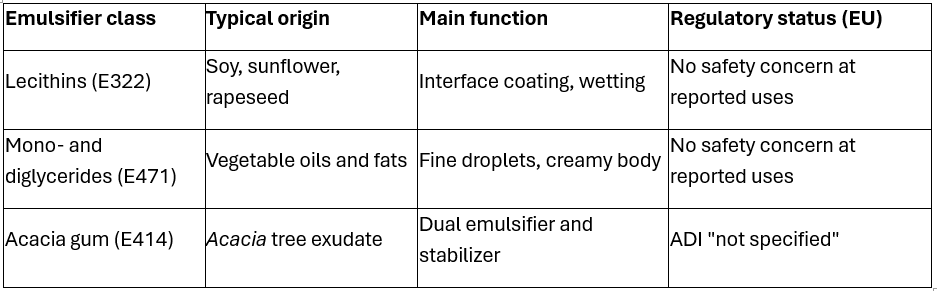
Emulsifiers for plant-based drinks fall into two workhorse families: lecithins and mono- and diglycerides. Both are widely permitted and both have been through the EU re-evaluation programme.
Lecithins (E322) are phospholipid mixtures from soy, sunflower or rapeseed. The EFSA opinion on lecithins raised no safety concern for the general population at reported use levels. Sunflower lecithin is often chosen where an allergen-lean, non-GMO label is the goal.
Mono- and diglycerides of fatty acids (E471) are the most common emulsifier in processed food. E471 is not a single molecule but a mixture that can contain more than 50 different mono- and diglycerides, and EFSA's re-evaluation of E471 found the substances hydrolyse to glycerol and fatty acids and raised no safety concern at reported uses. They give fine droplets and a creamy texture, which suits barista-style drinks.
The main stabiliser and hydrocolloid classes
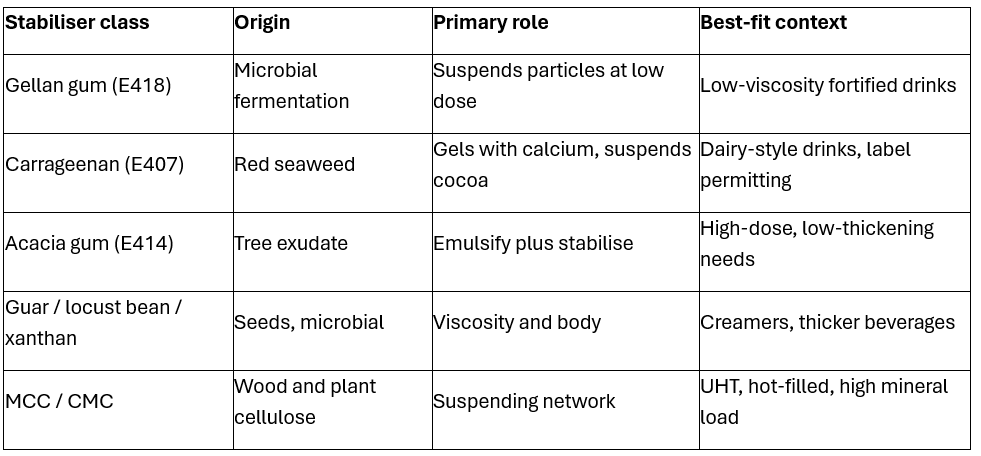
Stabilisers for plant-based drinks are natural hydrocolloids that either gel or thicken the water phase. The right one depends on how much suspension power the drink needs, how it is heat-treated, and how the ingredient reads on a label.
Gellan gum (E418) is a microbial polysaccharide used at very low doses. Its low-acyl form builds a fragile fluid-gel network that suspends dense particles like cocoa and added calcium in low-viscosity drinks. EFSA's gellan gum opinion concluded there was no need for a numerical acceptable daily intake and no safety concern at reported uses, with refined exposure estimated up to 72.4 mg/kg body weight per day in toddlers.
Carrageenan (E407) is a seaweed extract long used in dairy and dairy-alternative drinks, where the kappa type gels with calcium and stabilises cocoa suspension. It carries a regulatory caveat: EFSA's carrageenan opinion kept the group acceptable daily intake of 75 mg/kg body weight per day but flagged it as temporary pending better data. That status, plus consumer sensitivity, pushes some brands toward alternatives.
Acacia gum (E414) is a low-viscosity gum that emulsifies and stabilises at once, with an ADI "not specified" under its EFSA review, useful where high dosing must not thicken the drink.
Galactomannans and microbial gums (guar gum, locust bean gum, xanthan gum) are viscosity builders. In plant-based cream systems guar gum hydrates in the water phase and restricts particle movement to give long-term physical stability, and it is frequently paired with locust bean gum or xanthan for a fuller body.
Cellulose derivatives, chiefly microcrystalline cellulose (MCC) and carboxymethyl cellulose (CMC), build a suspending network well suited to hot-filled and UHT drinks with calcium or cocoa loads.
How to select the right class
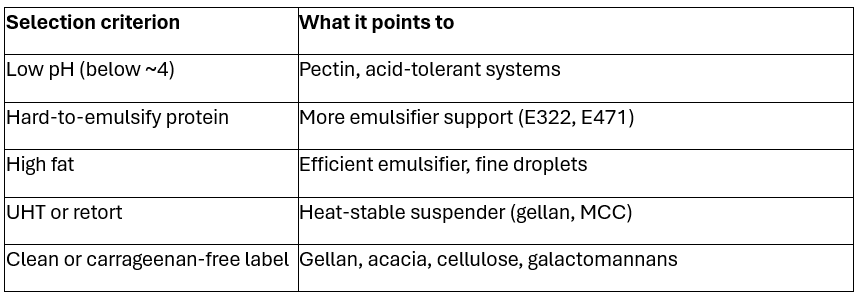
Class selection is a matching exercise between the drink's physical constraints and what each additive family does best. Five criteria usually decide it.
The first is pH. Below about pH 4 many proteins near their isoelectric point and some gums lose function, so acidified plant drinks lean on pectin or high-methoxyl systems, while neutral drinks have the full hydrocolloid range available.
The second is protein source, since soy, pea, oat, almond and coconut differ in solubility and interfacial behaviour, which sets how much emulsifier support is needed.
The third is fat content: higher fat means more droplet surface to cover and a stronger case for an efficient emulsifier like E471.
The fourth is heat treatment. UHT and retort processes stress the system and reward heat-stable suspending networks such as gellan or MCC, whereas a chilled pasteurised drink can rely more on simple viscosity.
The fifth is label positioning, where a clean-label or carrageenan-free brief narrows the options before any technical trade-off is weighed.
The practical lesson from the literature is that combinations outperform single additives. A review of emulsifiers for plant-based milk alternatives reports that a system combining microcrystalline cellulose, gellan gum, glycerol monostearate and sucrose ester reached the lowest change in backscattering, under 0.5%, meaning the beverage stayed close to fully stable. Pairing an interface-active emulsifier with a bulk-phase stabiliser covers both failure modes at once.
Regulatory and label context
Every additive class here is governed by a defined regulatory framework, and checking it is part of selection, not an afterthought. Internationally, permitted uses and levels sit in the Codex General Standard for Food Additives, organised by functional class and food category. In the European Union, additives are re-assessed under the Commission's re-evaluation programme, which is why several opinions cited above date from the 2017 to 2018 wave and why carrageenan's temporary status matters for forward-looking formulation.
Label expectations now shape class choice as much as function. Brands pursuing shorter ingredient lists often drop carrageenan on perception grounds even though it remains authorised, favour sunflower lecithin over soy for allergen reasons, and prefer gums that can be declared by common name. None of that changes the physics, so the safest route is to select on function first, then confirm the choice reads acceptably on pack.
FAQ
What is the difference between a stabiliser and an emulsifier in a plant-based drink?
An emulsifier is surface-active and coats oil droplets to stop them merging, while a stabiliser works in the water phase to thicken it or build a network that suspends particles. Codex treats them as separate functional classes.
Which emulsifier is most used for plant-based drinks?
Mono- and diglycerides of fatty acids (E471) and lecithins (E322) are the two workhorses. EFSA raised no safety concern for either at reported use levels in its E471 opinion.
Is carrageenan safe in plant-based drinks?
It remains authorised, but EFSA classed its group acceptable daily intake of 75 mg/kg body weight per day as temporary in its 2018 opinion, pending further data. Many brands substitute it for label reasons.
Why does gellan gum work at such low doses?
Its low-acyl form builds a fluid-gel network that suspends dense particles without thickening the drink, and EFSA's gellan opinion found no need for a numerical ADI at reported uses.
Can homogenisation replace stabilisers?
It helps a lot by shrinking droplets, with ultra-high-pressure homogenisation reaching sub-micron diameters in one analogue review, but it rarely gives full shelf-life stability on its own in a heat-treated, fortified drink.
Should I use one additive or a blend?
Blends usually win. Pairing an emulsifier with a stabiliser covers both creaming and sedimentation, and a four-way system reached near-total stability in a published emulsifier review.