


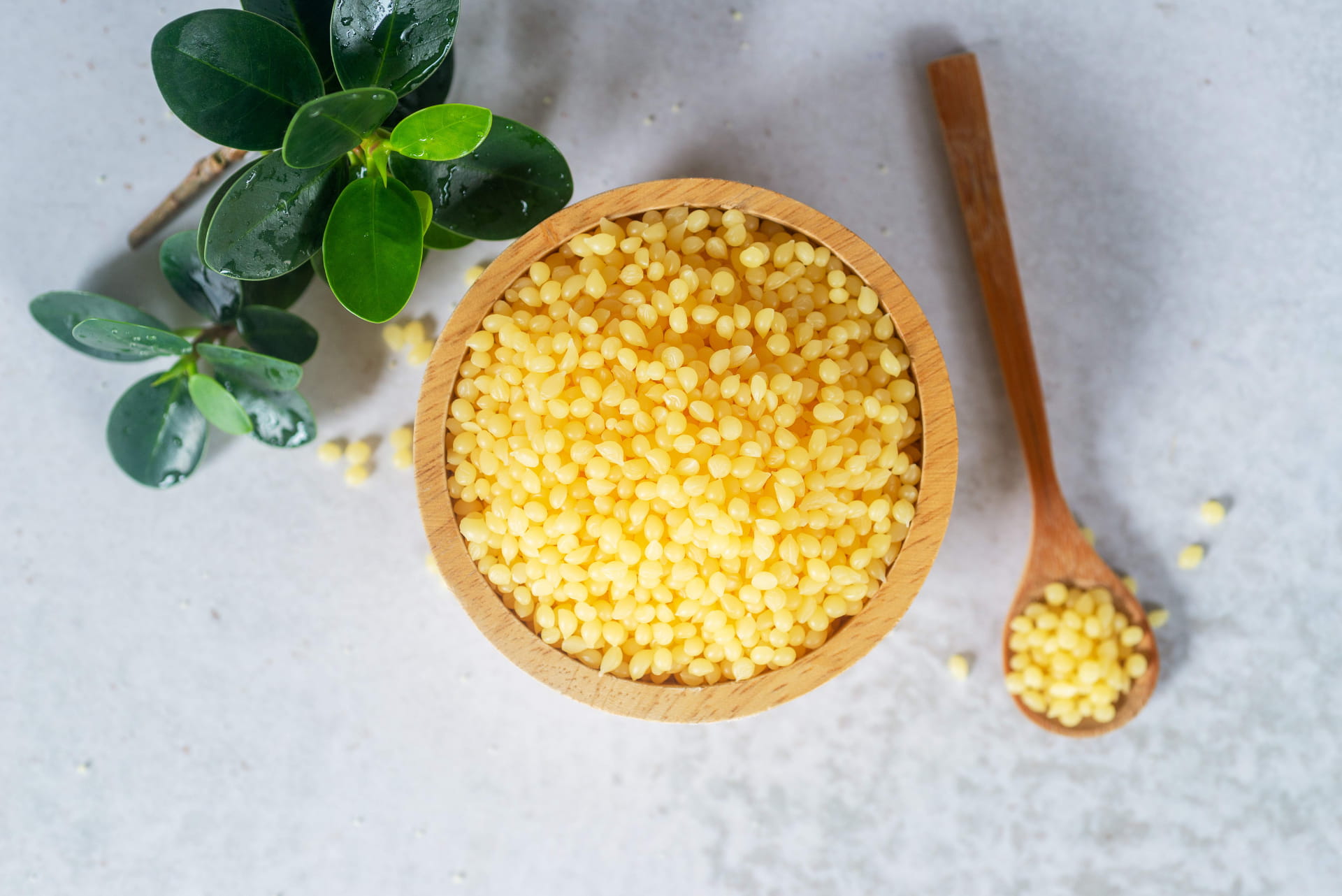
Natural waxes and vegetable oils are among the most structurally and functionally versatile ingredients available to cosmetic formulators. Whether the objective is a firm lipstick, a stable balm, a skin-feel-optimized body butter, or a vegan alternative to animal-derived ingredients, the choice of wax and how it interacts with the liquid oil phase determines a significant portion of the product's sensory profile, stability, and shelf life. This guide covers the physicochemical principles behind natural wax behavior, the key wax types used in modern cosmetic formulation, and the practical formulation strategies needed to work with them effectively.
What Natural Waxes Are and How They Function
Natural waxes are complex mixtures of long-chain compounds, primarily wax esters (esters of long-chain fatty acids and fatty alcohols), hydrocarbons, free fatty acids, and fatty alcohols, the proportions of which vary considerably between wax types. This chemical composition directly determines functional properties: the ratio of wax esters to hydrocarbons governs hardness, melting point, oil binding capacity, and surface finish. Waxes differ from fats and oils in that they are not composed primarily of triglycerides; instead, the wax ester linkage between a long-chain acid and a long-chain alcohol produces a molecule that is harder, less prone to hydrolysis, and more thermally stable than a typical vegetable oil triglyceride.
In a cosmetic formulation, natural waxes serve several simultaneous functions: they structure the oil phase at room temperature, modulate viscosity in anhydrous and emulsion systems, control skin feel by adjusting drag and occlusion on application, and inhibit oil migration or syneresis in stick products. At higher concentrations, waxes build a crystalline network within the liquid oil that physically immobilizes it — a mechanism directly analogous to the oleogelation extensively studied in food science, where rice bran wax, candelilla wax, carnauba wax, and sunflower waxare the most commonly used plant waxes for forming solid-like, self-standing gel networks from liquid oils.
Key Natural Waxes: Properties and Formulation Roles
Beeswax
Beeswax (INCI: Cera Alba) is produced by Apis mellifera honeybees and consists of a complex mixture of wax esters, hydrocarbons, free fatty acids, and fatty alcohols. Its melting point ranges from approximately 62°C to 65°C, making it thermally stable enough for stick and balm formulations while soft enough to melt on skin contact. Beeswax is the historical reference for cosmetic waxes and provides excellent emulsifying properties that help prevent oil-water phase separation in creams and lotions. It confers a characteristic skin feel — slightly tacky, protective, and emollient — that remains a benchmark against which vegan alternatives are assessed.
From an oil binding standpoint, beeswax is highly effective: research comparing beeswax and rice bran wax oleogels in safflower oil found that beeswax oleogels achieved oil binding capacity of 99.93–99.98% outperforming rice bran wax at equivalent concentrations. Its limitation for modern cosmetic formulation is its animal origin, which excludes it from vegan cosmetics and, in some markets, from products marketed as plant-based.
Carnauba Wax
Carnauba wax (INCI: Copernicia Cerifera Cera) is derived from the leaves of the Brazilian palm Copernicia cerifera. It is the hardest of the commonly used cosmetic waxes, with a high melting point typically between 82°C and 86°C, and is characterized by a high ester content — notably aliphatic esters of long-chain acids and alcohols — with a comparatively low hydrocarbon fraction. This ester-rich composition gives carnauba wax its distinctive gloss and hardness in cosmetic formulations: it imparts a firm, durable texture and a high-shine surface finish that makes it indispensable in lip products, mascaras, and hair styling products.
In lipstick formulations, carnauba wax raises the melting point of the stick and helps prevent softening under warm conditions such as direct sun exposure. It is also used as a stabilizer and viscosity modifier in water-in-oil (W/O) emulsions and, in more recent applications, as a nano-carrier to disperse inorganic UV filters in aqueous systems. At higher concentrations, carnauba can be challenging to process: its very high melting point means the oil phase must be heated thoroughly before incorporation, as contact with a partially cooled wax-oil mixture can cause immediate localized solidification, producing grainy shock crystals that are difficult to reverse. A published comparison of carnauba-based and beeswax-based oleogels confirmed that carnauba wax-based oleogels require greater crystallization enthalpyand maintain a more stable solid fat content across a wider temperature range, making them better suited for products that need to retain structure at elevated temperatures.
Candelilla Wax
Candelilla wax (INCI: Euphorbia Cerifera Cera ) is extracted from the stems of the Mexican shrub Euphorbia cerifera. Its chemical composition differs substantially from carnauba: hydrocarbons represent up to 45–50% of its content, with real long-chain wax esters accounting for only 20–35%. This higher hydrocarbon fraction gives candelilla wax a lower density of ester linkages, making it slightly softer than carnauba but still considerably harder than beeswax. Its melting point sits between approximately 68°C and 73°C.
Candelilla wax is the closest plant-based functional substitute for beeswax and is the most widely used vegan wax in lip products. It imparts gloss and hardness in cosmetic formulations, and its high oil binding capacity combined with lower stickiness compared to beeswax makes it particularly attractive for lipstick formulations where shine, hardness, and clean wear-off are all priorities. Candelilla wax is also used to adjust viscosity in W/O emulsions and contributes to barrier function by reducing transepidermal water loss. A standard substitution ratio when replacing beeswax with candelilla wax is approximately 1:0.75 (three parts candelilla replacing four parts beeswax) due to its higher hardening efficiency, though this ratio should always be adjusted empirically based on the specific formulation.
Sunflower Wax
Sunflower wax (INCI: Helianthus Annuus Seed Cera) is produced by the full hydrogenation of sunflower oil and consists predominantly of very long-chain wax esters derived from C20–C26 fatty acids. It has a relatively high melting point (approximately 76–82°C) and is an effective oil structuring agent even at lower concentrations compared to other plant waxes — a property relevant to formulators seeking to minimize wax content while maintaining product consistency. Sunflower wax is fully plant-based and vegan, and its origin from sunflower oil gives it a clean natural positioning. Research on olive oil oleogels found that sunflower wax is a highly effective gelling agent capable of providing satisfactory gel structures at low concentrationswith textural properties tunable by combining it with monoglycerides or other co-structurants.
Rice Bran Wax
Rice bran wax (INCI: Oryza Sativa Bran Wax) is obtained by de-waxing virgin rice bran oil and is composed primarily of long-chain wax esters. It has a melting point in the 77–86°C range and produces a hard, brittle texture at higher concentrations. Rice bran wax is valued for its fast crystallization kinetics — studies have shown crystallization times as short as 3 minutes in oleogels at 10% concentration — and for its ability to produce stable wax crystal networks. It is fully vegan and is increasingly used as a structuring agent in natural balms, body butters, and solid cosmetics where carnauba's very high processing temperature is a constraint.
Hydrogenated Oils and Butters
Hydrogenated oils such as hydrogenated jojoba oil and hydrogenated vegetable oil occupy a position between liquid oils and hard waxes. Full hydrogenation converts the unsaturated double bonds in the fatty acid chains into saturated bonds, raising the melting point and producing a solid or semi-solid texture at room temperature. Shea butter and cocoa butter — while not waxes in the strict chemical sense — contribute fatty alcohols, triglycerides, and minor wax ester fractions that participate in crystal network formation alongside harder waxes, influencing final texture and skin feel. Their lower melting point compared to hard waxes makes them useful for softening the overall texture of balm and stick formulations, and for preventing the brittleness that results from using carnauba or rice bran wax at high concentrations.
Jojoba oil is technically a liquid wax rather than an oil: it consists predominantly of long-chain wax esters rather than triglycerides, making it exceptionally stable against oxidative rancidity. This chemical similarity to skin sebum contributes to its excellent skin feel and non-comedogenic profile.
Formulation Principles: Working with Wax-Oil Systems
Melting Point and Processing Temperature
The melting point of the wax blend is the primary thermal constraint in formulation. All waxes must be fully melted before oils are incorporated, and the combined oil phase must be maintained above the highest melting point wax in the blend throughout mixing. Carnauba wax, with its high melting point above 82°C, requires the oil phase to be heated to at least 85–90°C; failure to do so can cause shock crystallization on contact with lower-temperature oils, resulting in grainy or uneven texture in the final product. For wax blends combining carnauba or rice bran wax with softer waxes such as candelilla and a liquid vegetable oil, a single-phase hot melt process is standard: all waxes are melted together first, liquid oils are added to the melt and mixed thoroughly, then the combined phase is cooled under controlled conditions (static or with stirring depending on crystal structure target).
Cooling rate directly affects the crystal morphology of the final product. Rapid cooling (shock cooling) produces smaller, more numerous crystals and a smoother, more homogeneous texture; slow cooling produces larger crystals, sometimes causing graininess in shea butter- or cocoa butter-containing formulations. A classic problem in natural balm formulation is cocoa butter graininess: the different fatty acid fractions (primarily stearic acid and oleic acid) can recrystallize at different rates over time, causing a sandy or waxy surface texture to develop in the days after production. Incorporating a small proportion of candelilla or carnauba wax at 1–3% can stabilize the crystal network and prevent this effect.
Oil Binding Capacity and Stability
Oil binding capacity (OBC), which is the ability of the wax crystal network to retain liquid oil without exudation, is a critical stability parameter in anhydrous formulations. A lip balm or solid perfume with insufficient oil binding will develop oily sweating on the surface over time, particularly at elevated storage temperatures. OBC is determined by wax type, wax concentration, and the polarity and chain length of the liquid oil. Research on binary wax blends found that beeswax-candelilla wax oleogels showed oxidative and physical stability comparable to conventional fatswith physical stability dependent on storage temperature: gel strength at 25°C was more durable than at 4°C in some formulations, where large oil crystals can disrupt the wax crystal network.
Oxidative stability of the liquid oil phase is a parallel concern for shelf life. Oils rich in polyunsaturated fatty acids such as rosehip seed oil (high in linoleic acid, C18:2) or hemp seed oil (high in both linoleic and alpha-linolenic acid) are more prone to oxidative rancidity than oils dominated by monounsaturated oleic acid (such as argan oil or high-oleic sunflower oil) or saturated fatty acids. Incorporating natural antioxidants (tocopherols, rosemary extract) helps extend the shelf life of formulations containing high-linoleic-acid oils. Storage conditions should avoid high temperatures and light exposure, as both accelerate the oxidation of unsaturated fatty acids in the liquid oil fraction.
Wax Blending Strategy
No single wax delivers all required functional properties simultaneously, which is why most cosmetic formulations use wax blends. A typical approach for a natural vegan lip balm might combine candelilla wax (3–6%) for hardness, oil binding capacity, and gloss; carnauba wax (0.5–2%) to raise the overall melting point and improve heat resistance; and shea butter or cocoa butter (10–20%) to soften the texture and provide emollient skin feel. The liquid oil fraction — sunflower oil, jojoba oil, or a seed oil selected for its fatty acid profile and skin feel — fills the remainder of the anhydrous phase.
For formulators targeting specific skin feel attributes: higher concentrations of carnauba wax increase drag on application and produce a more waxy, protective feel; candelilla wax at lower concentrations gives a lighter, less tacky skin feel; sunflower wax at moderate concentrations (4–8%) produces a smooth, powdery after-feel that is valued in lip and eye cosmetics. Varying the ratio of hard to soft waxes while keeping total wax content constant allows systematic adjustment of hardness, melting point, and skin feel without reformulating the entire oil blend.
Emulsion Applications
In W/O emulsions such as cold creams, protective hand creams, and certain sunscreen formulations, natural waxes contribute to emulsion stability by forming a semi-solid continuous oil phase that physically prevents coalescence of water droplets. Candelilla wax is specifically used to adjust viscosity in W/O emulsion systems; carnauba wax functions as a stabilizer at low concentrations (1–3%) and contributes to the smooth, non-greasy skin feel desirable in modern emulsion cosmetics. The demand for vegan cosmetics has driven formulation development in this area, as beeswax, historically the primary emulsifying wax in cold cream type formulations, is replaced by combinations of plant waxes and synthetic or natural emulsifiers.
Regulatory and Safety Considerations
Candelilla wax, carnauba wax, and beeswax have been subject to formal safety assessment by the Cosmetic Ingredient Review (CIR) Panel, which concluded in its original assessment — and is currently reviewing for updated literature — that these waxes are safe for cosmetic use based on documented toxicological data. They are listed as approved cosmetic ingredients under EU Cosmetics Regulation (EC) No 1223/2009 and appear in the INCI dictionary with established usage history in thousands of formulations. Candelilla wax INCI: Euphorbia Cerifera Cera; carnauba wax INCI: Copernicia Cerifera Cera; rice bran wax INCI: Oryza Sativa Bran Wax; sunflower wax INCI: Helianthus Annuus Seed Cera.
Natural waxes present no significant sensitization or irritation risk at typical cosmetic use levels. Stability testing of finished products containing natural wax-oil blends should include accelerated stability protocols at elevated temperature (40°C/75% RH for 12 weeks minimum) to detect oil exudation, graininess development, and oxidative degradation of the liquid oil phase before finalizing a formulation for commercial production.
Conclusion
Formulating with natural oils and waxes requires understanding how wax chemistry, particularly the balance between wax esters and hydrocarbons, and the associated melting point and oil binding capacity, determines both processing requirements and final product performance. Candelilla and carnauba are the workhorses of vegan cosmetic wax formulation, each bringing complementary properties to lip products, balms, and anhydrous sticks. Sunflower wax and rice bran wax extend the toolkit with efficient gelling at lower concentrations. The choice of liquid oil, selected for its fatty acid profile, skin feel, and oxidative stability, completes the formulation alongside the wax blend, and the two must be optimized together to achieve the texture, stability, and skin feel profile required by the end application.