



The email arrives without warning: the grade you have used for years will no longer be produced. It is happening more often. According to the European Chemical Closures and Investments Radar commissioned by Cefic, announced plant closures in Europe rose sixfold between 2022 and 2025, reaching 37 million tonnes of capacity, about 9% of European chemical production capacity. This guide sets out what to do in the first week, how to judge whether an alternative really is one, and how to plan the switch without stopping production.
Quick answer
- Confirm the facts first: last order date, last delivery date, and whether the discontinuation covers all grades or only one.
- Write down what the grade actually does in your formula or process before looking at alternatives.
- Separate specification equivalence from performance equivalence. A matching data sheet is not a matching result.
- Plan the bridging stock from your own consumption and your own qualification time, not from a rule of thumb.
- Requalification timelines vary widely by industry and by application. Treat any figure you are given as a starting estimate to be confirmed.
Why this keeps happening
The pressure is structural, not accidental. The Cefic radar records that closure announcements rose from 2.9 million tonnes in 2022 to 17.2 million tonnes in 2025, with upstream petrochemicals accounting for 48% of the announced capacity and specialty chemicals for 5% (Cefic and Roland Berger). The same report notes that annual announced investment capacity fell from 2.7 million tonnes in 2022 to 0.3 million tonnes in 2025 (Chemical Processing). An earlier Cefic study had already identified more than 11 million tonnes of announced closures for 2023 and 2024, across 21 major sites (Cefic).
For a buyer, the practical consequence is simple: a discontinuation notice is no longer a rare event to be handled ad hoc. It is worth having a method ready.
Week one: confirm the facts
Before anything else, get these five answers in writing from your supplier or distributor.
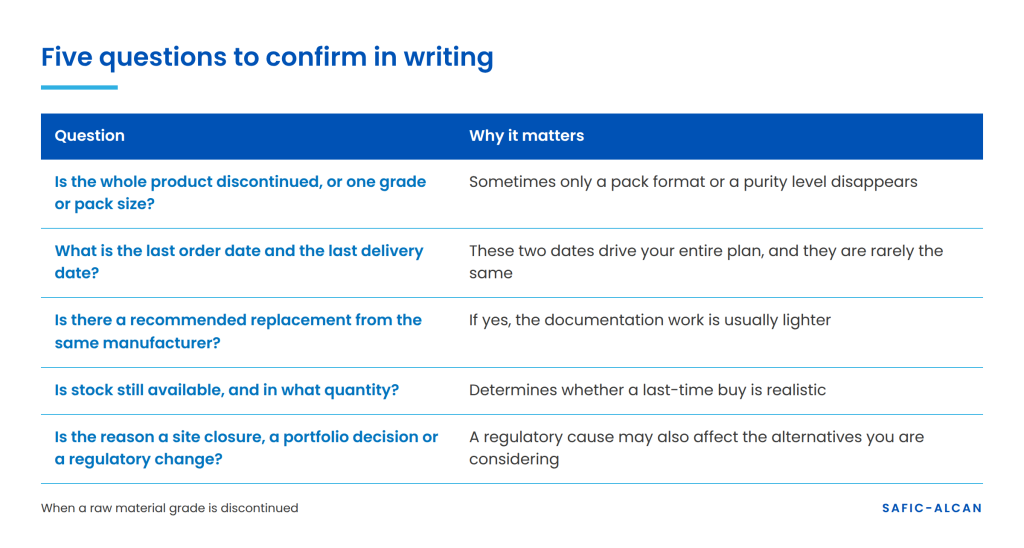
Ask for the answers by email, not by phone. Your safety assessor, your quality team and your customers may all need to see them later.
Need an alternative to a discontinued grade?
Tell us the product, the grade and what it does in your formulation. Safic-Alcan will come back with the options available in your market.
Describe the function, not the product
The most common mistake is to look for the same molecule. What you need is the same result. Write down, in one page:
- What the raw material does in the formula or process, and at what level.
- The properties you actually control on it: the specification lines that matter, and the ones that are simply inherited from the data sheet.
- The constraints around it: regulatory status, customer approvals, claims that depend on it, and processing conditions.
- What would tell you the replacement has failed: the test, the limit, the defect.
This page is what turns a shopping list into a shortlist. It also makes the difference between specification equivalence and performance equivalence visible, which is where most switching projects go wrong. A matching certificate of analysis says the two materials look alike. Only a trial says they behave alike. Our article on how a specialty distributor adds value covers how that shortlist is usually built.
Plan the switch on four tracks at once
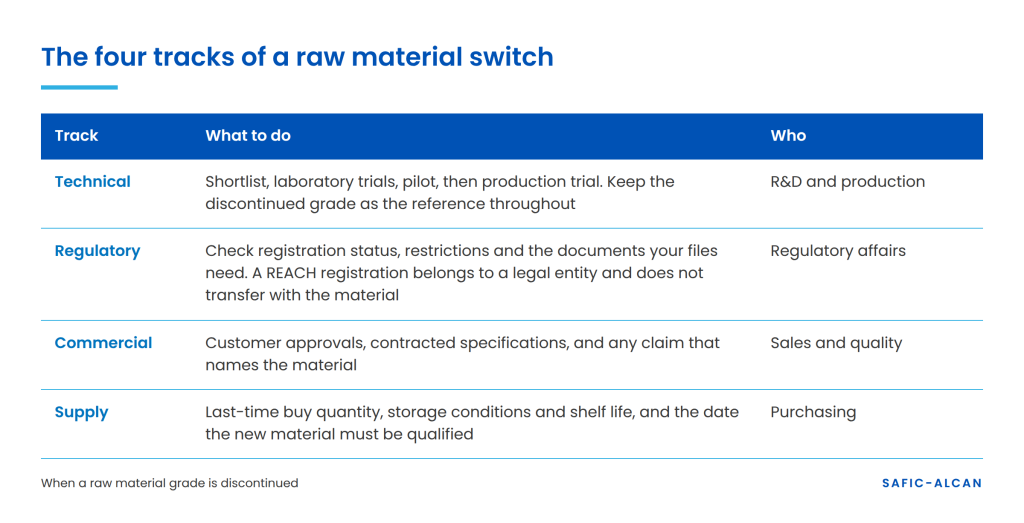
On the regulatory track, remember that obligations follow roles, not goods: a non-EU manufacturer can appoint an only representative, and the EU importer then becomes a downstream user (Your Europe, European Commission). Changing supplier can therefore change who holds which obligation in your chain. If you work in cosmetics, our CPSR documents checklist lists what the new supplier has to provide before your safety assessor can close the file.
How much bridging stock, and for how long
There is no universal coverage figure, and any supplier who gives you one without asking questions is guessing. Build it from four numbers of your own:
- Your consumption rate for the grade, including seasonal peaks and any campaign production.
- Your qualification time, from first sample to approved production batch, based on what similar switches took in your own company.
- The shelf life and storage constraints of the material: bridging stock that expires is not stock.
- A margin for the trial that fails, because the first candidate often does.
Qualification times differ enormously: a lubricant additive and a pharmaceutical excipient do not live in the same world. Use your own history, not an industry average.
Planning a last-time buy?
Safic-Alcan can check availability, pack sizes and lead times on the grades we distribute, and help you phase the switch.
What to keep for the file
Keep the discontinuation notice, the trial results including the failed ones, the documentation of the new material, and the date each customer was informed. When an auditor or a customer asks why the formula changed, that file is the answer. For the wider context on European supply, see our article on sourcing specialty chemicals in Europe and our overview of the structural shifts reshaping the European market.
Frequently asked questions
How much notice do suppliers usually give for a discontinuation?
It varies widely, from a few months to more than a year, and it is a commercial decision rather than a regulated one. Ask for the last order date and the last delivery date in writing as soon as you hear about it.
Is a product with the same specification a drop-in replacement?
Not necessarily. A specification describes what is measured, not everything that matters. Impurity profiles, particle size distribution and process history can all change the result while every specification line still passes.
Does the REACH registration transfer to the new supplier?
No. Registration belongs to a legal entity. When you change supplier, you need to confirm that your new supplier, or its only representative, holds the relevant registration.
Should I qualify a second source at the same time?
Often yes, but not always. A second source costs qualification work and splits your volume, which can affect price. Decide case by case, based on how critical the material is.
What if no alternative performs the same?
Then the project becomes a reformulation, not a substitution, and the timeline changes. Say so early: it is cheaper to plan a reformulation than to discover one three months in.