



The performance requirement does not change because the chemistry does. An anti-graffiti system has to reach a defined cleanability standard, whether it gets there through organofluorine chemistry or through an alternative. This article compares the two approaches at chemistry level: how each handles the water repellency and the resistance to oil-based graffiti that anti-graffiti performance depends on, where they differ in durability and substrate interaction, and what a pathway without intentionally added PFAS looks like in practice. For a broader view on PFAS, you can read our guide to the EU PFAS restriction for anti-graffiti coatings.
Evaluating a reformulation pathway?
The PFAS Transition Guide covers the restriction timeline, which formulation types are affected, the technical pathway, and a specification clause template.
The two performance requirements: what anti-graffiti systems must deliver
Anti-graffiti performance is not simply water repellency. It rests on two distinct surface properties, which are two different chemistry problems.
- Water repellency (hydrophobicity): the treated surface repels water, rain and water-borne contaminants. A hydrophobic surface shows a water contact angle above 90 degrees; strongly hydrophobic surfaces exceed 120 degrees. Water repellency is measured by the water absorption coefficient (DIN 52617, Karsten tube method: a calibrated tube is sealed to the treated surface and the volume of water absorbed over time is recorded) and by vapour permeability (EN ISO 7783). It controls rain penetration, chloride ingress, freeze-thaw resistance and efflorescence.
- Resistance to oil-based graffiti: the treated surface reduces the adhesion of oil-based media such as spray paint, permanent marker and aerosol adhesive, so that graffiti can be removed by cleaning rather than by aggressive solvent attack. The surface is not oil-repellent in the strict sense; it is engineered so that spray paints bond weakly enough to be lifted during cleaning.
Anti-graffiti performance for these systems is evaluated under the German TL/TP AGS Beton standard from the Federal Highway Research Institute (BASt), combined with the performance requirements of the Gütegemeinschaft Anti-Graffiti e.V. (Quality Association Anti-Graffiti). Products are tested against both. The association rules (ReGG) derive from the Technical Regulations first issued on 18 May 1998, and BASt approval under TL/TP AGS Beton is required for use on federal infrastructure.
In the test, graffiti-protected substrates are coated with three defined paint systems; once dry, the paint is removed with an approved graffiti cleaner; the cleaning is repeated ten times on the same location; after each cycle the result is evaluated visually and documented; and performance is expressed as a Ci value reflecting the degree of paint removal. Samples are tested unweathered and after both artificial and natural weathering. For a permanent system, the requirement is ten cleaning cycles after artificial weathering equivalent to ten years of outdoor exposure, which corresponds to 3,000 hours of QUV. Semi-permanent systems are designed for a lower number of cycles.
Water repellency on its own is not enough. A surface that repels water but lets spray paint bond firmly cannot be cleaned without aggressive solvent, which usually damages the substrate. Delivering both properties without fluorinated chemistry is the formulation challenge the PFAS restriction creates.
How organofluorine chemistry achieves both properties
The C-F bond has the lowest surface energy of any common functional group in organic chemistry. PTFE has a critical surface tension of about 18 to 20 mN/m, below the surface tension of virtually all common liquids, including water (about 72 mN/m) and the carriers used in spray paint and aerosol adhesives (about 25 to 35 mN/m). A surface whose critical surface tension falls below that of the applied liquid cannot be wetted by it.
The relationship between critical surface tension and wettability was formalised by Zisman, 1964 in foundational work on low-energy surface wetting. Plotting the cosine of contact angle against liquid surface tension for a series of liquids determines the critical surface tension of the solid, and any liquid with surface tension above this value will not spread on it. This remains the reference framework for comparing fluorinated and non-fluorinated coating systems.
An important note on context: fluorinated anti-graffiti systems on the market today are technically high-performing and fully compliant with all applicable regulations. The EU PFAS restriction is not yet in force. Many suppliers, including within the Evonik and Safic-Alcan portfolios, produce or have produced high-performing fluorinated systems. The comparison here is forward-looking: which chemistry will remain unrestricted once the restriction enters into force.
In anti-graffiti formulations, fluorinated chemistry was delivered mainly through two approaches:
- Fluoropolymer film-forming coatings: PTFE or similar fluoropolymers applied as a surface film. High initial oil repellency from the low surface energy of the CF2 and CF3 groups. Vulnerable to surface abrasion and UV degradation over time.
- Fluorinated silane modifiers: fluoroalkylsilane compounds where a fluorinated group is grafted onto a silane coupling-agent backbone, combining the substrate adhesion of the silane with the oil repellency of the fluoroalkyl end-group. These fluorosilanes hardly penetrate mineral surfaces; they act at the surface. This was the most common approach in premium anti-graffiti systems for masonry and facade applications.
The restriction covers both approaches. Fluoropolymer coatings contain intentionally added PFAS. Fluorinated silane modifiers, where the fluoroalkyl group meets the OECD definition (any substance with at least one fully fluorinated methyl or methylene carbon atom), are equally within scope regardless of chain length. C4 and C6 fluoroalkylsilanes are within scope alongside C8 compounds.
The silane-siloxane mechanism and its durability
Organosilane chemistry works through a different mechanism from film-forming coatings. The common case is an alkoxysilane, which cures in three stages:
- Hydrolysis: contact with moisture causes the alkoxy groups to react. For a trimethoxysilane, R-Si(OCH3)3 + 3H2O converts to R-Si(OH)3 + 3CH3OH. The silane becomes a reactive silanol.
- Condensation and substrate bonding: the silanols react with surface hydroxyl groups on mineral substrates such as concrete, brick, stone, tile and render. R-Si(OH)3 reacts with HO-substrate to form R-Si-O-substrate bonds plus water, producing covalent Si-O-Si bonds between the treatment and the substrate. The organic R group orients outward, presenting its hydrophobic character at the surface.
- Crosslinking: further condensation between adjacent silanols creates a crosslinked siloxane network within the treated zone, reinforcing the treatment and improving its chemical and mechanical resistance.
Protectosil® is supplied as a silanol, not as an alkoxysilane. The silanol is already formed, so the first stage does not apply: there is no hydrolysis and no alcohol is released during cure. On this product the process runs in two stages, condensation and substrate bonding followed by crosslinking.
Some systems are supplied as silanols rather than alkoxysilanes. Protectosil® ECO-TRETE ANTIGRAFFITI is one of them. Because the silanol chemistry is already formed, it does not go through the hydrolysis step and releases no alcohol, so its cure follows two stages rather than three.
Penetration depends on product type. For water repellents, durability is closely tied to how deeply the active molecules penetrate the substrate. Depending on molecule size, substrate porosity and application method, penetration for silane water repellents is typically 3 to 15 mm in concrete, with peer-reviewed studies confirming 3 to 7 mm for brush and immersion application. This does not apply to surface protection systems such as easy-to-clean and anti-graffiti products. Neither the legacy PFAS products nor the PFAS-free technology penetrate deeply. Their durability comes from strong covalent bonding at the surface, which keeps them from being washed out by rain and weathering, not from a deep treatment zone.
- Vapour permeability: because silane treatment lines pore walls rather than blocking pores, the treated substrate keeps its moisture vapour transmission. The Sd value (EN ISO 7783) stays well below 0.1 m for validated silane treatments, meeting the breathability requirement standard in facade and masonry specifications, classified under EN 1504-2. Dense film-forming coatings can produce higher Sd values, creating vapour barriers that cause spalling, carbonation and freeze-thaw damage over time.
- Substrate selectivity: silanes rely on the alkaline pH of cementitious substrates to catalyse condensation, making them most effective on concrete and render. Siloxanes react via atmospheric moisture and work across a broader range including brick, natural stone and clay-based materials. Combined silane-siloxane formulations cover the full substrate range relevant to facade and masonry.
How Protectosil® ECO-TRETE ANTIGRAFFITI reduces graffiti adhesion
Standard alkylsilane chemistry does not by itself resist oil-based graffiti. The alkyl groups presented at an alkylsilane-treated mineral surface give a surface energy of about 20 to 25 mN/m, enough to repel water but not enough to keep oil-based media such as spray paint (surface tension about 25 to 35 mN/m) from bonding. A surface energy above the surface tension of the applied liquid will be wetted by it, so the paint bonds and needs solvent to remove.
Protectosil ECO-TRETE ANTIGRAFFITI from Evonik addresses this differently. It relies on a balanced combination of hydrophobic and hydrophilic properties in the impregnation layer, which generates a surface structure that reduces the adhesion of spray paints. The result is a silane-based system that delivers the water repellency and the graffiti cleanability required by the TL/TP AGS Beton and Gütegemeinschaft requirements for a semi-permanent system, without intentionally added PFAS.
Performance comparison
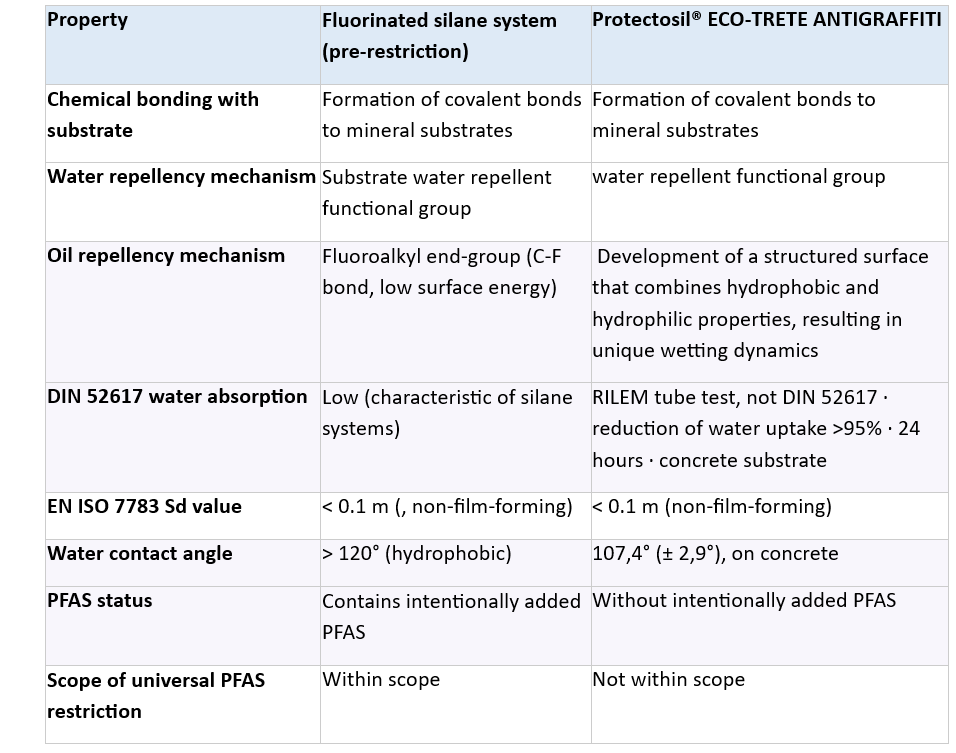
Protectosil® ECO-TRETE ANTIGRAFFITI is a semi-permanent, PFAS-free system. It is not positioned as a performance match for a permanent system. The trade-off for removing intentionally added PFAS is a lower number of cleaning cycles and a shorter service interval.
Durability under weathering
Once the condensation reaction is complete and the siloxane network is formed within the pore walls of the mineral substrate, three primary degradation mechanisms are significantly reduced:
- UV: the siloxane backbone (Si-O-Si) has substantially higher UV resistance than carbon-chain polymers. The organic R group in a alkylsilane -treated concrete is shielded by overlying substrate material, not exposed at the surface.
- Alkaline attack: cementitious substrates are strongly alkaline (pH 12 to 13). Silane treatments form covalent bonds in the same alkaline environment that would attack a surface film; the alkalinity catalyses bond formation rather than degradation.
"Without intentionally added PFAS": what the claim means
"Without intentionally added PFAS" is the correct claim language for Protectosil® ECO-TRETE ANTIGRAFFITI and for any formulation using it. It states that no PFAS compound has been deliberately introduced to achieve a functional property. It is defensible under REACH because it reflects a documented formulation decision rather than an absolute zero-detection guarantee.
For formulators incorporating it into their own products, carry the same precision into the product data sheet and customer documentation. "This formulation does not contain intentionally added PFAS" is the correct statement. Obtain written PFAS status confirmation from Evonik for the raw material and retain it as part of your REACH compliance documentation.
Reformulation: practical considerations
- Substrate-specific validation: silane performance is substrate-dependent. Results on concrete do not automatically predict results on brick, render, natural stone or tile. Test the specific substrates in your specification under TL/TP AGS Beton and the Gütegemeinschaft requirements.
- Application method review: penetrating silane systems have different application requirements from film-forming fluoropolymer coatings. Coverage rate, substrate preparation (dry and free of existing surface treatments) and application method should be confirmed with Evonik.
- Product data sheet update: review and update all PFAS-related language in data sheets, SDS documents and marketing literature. Replace any instance of "PFAS-free" with "without intentionally added PFAS."
- Customer specification equivalence: where existing approvals reference a permanent fluorinated formulation, a semi-permanent PFAS-free system will not reproduce the permanent system's cycle count or service life. Re-test under TL/TP AGS Beton to document the actual performance level of the reformulation rather than assuming equivalence.
- Supply chain documentation: request written PFAS status statements from Evonik referencing the OECD universal PFAS definition, and retain them in your REACH compliance file.
Frequently asked questions
What is the chemistry difference between organofluorine and silane-based anti-graffiti systems?
Organofluorine chemistry gives oil repellency through the very low critical surface tension of the C-F bond (about 18 to 20 mN/m for PTFE, per Zisman, 1964), below the surface tension of both water and oil-based media. Silane chemistry gives water repellency by forming covalent bonds with the mineral substrate. Standard alkylsilane chemistry does not by itself resist oil-based graffiti. Protectosil® ECO-TRETE ANTIGRAFFITI uses a balanced hydrophobic and hydrophilic surface structure to reduce spray-paint adhesion, meeting the requirements for a semi-permanent system without intentionally added PFAS.
How is anti-graffiti performance evaluated?
Not under ISO 11998, which describes the wet-scrub resistance of a coating rather than an impregnation system. Performance is tested under the German TL/TP AGS Beton standard (BASt) together with the Gütegemeinschaft Anti-Graffiti e.V. requirements. Substrates are coated with three defined paint systems, cleaned with an approved graffiti cleaner, and the cleaning is repeated ten times on the same spot, with a Ci value recording the degree of paint removal. Permanent systems must pass ten cycles after weathering equivalent to ten years outdoors (3,000 hours QUV); semi-permanent systems target a lower cycle count.
Why do silane treatments behave differently from film-forming coatings?
They form covalent bonds with the substrate rather than sitting on top as a film, so they keep the substrate vapour-permeable and resist alkaline attack. For water repellents this is reinforced by penetration into the pore structure, as confirmed in peer-reviewed studies. For surface protection systems such as anti-graffiti products, durability comes from surface bonding rather than deep penetration, and abrasion remains a limit for all of them, PFAS-based or not.
What is the Sd value and why does it matter for facade treatments?
The Sd value (equivalent diffusion thickness), measured under EN ISO 7783, represents resistance to water vapour transmission. A low Sd value (below 0.1 m is the usual requirement for facade treatments) means moisture vapour can diffuse through the substrate. For concrete, masonry and natural stone facades, vapour permeability prevents internal pressure build-up that causes cracking, spalling and accelerated carbonation. Penetrating silane treatments achieve low Sd values because they line pore walls rather than blocking pores.
Does the universal PFAS restriction cover short-chain fluorinated silane modifiers?
Yes. The universal PFAS restriction submitted to ECHA in January 2023 applies the OECD universal PFAS definition: any substance containing at least one fully fluorinated methyl or methylene carbon atom is within scope. C4 and C6 fluoroalkylsilanes are within scope alongside C8 compounds. Moving from long-chain to short-chain fluorinated chemistry did not resolve the regulatory exposure.
What performance testing is needed when reformulating to Protectosil® ECO-TRETE ANTIGRAFFITI?
Testing under TL/TP AGS Beton and the Gütegemeinschaft requirements on the specific substrates in the product specification. DIN 52617 (water absorption coefficient) and EN ISO 7783 (vapour permeability) provide additional confirmation. For facade panels, precast concrete tiles and materials exposed to freeze-thaw cycling, EN 12371 is also relevant.
What claim language should appear on a product data sheet for a formulation using Protectosil® ECO-TRETE ANTIGRAFFITI?
"Without intentionally added PFAS." This reflects a documented formulation decision and is the defensible wording under REACH. "PFAS-free" should not be used as a product claim because it implies a zero-detection guarantee that cannot be substantiated. Retain Evonik's written PFAS status statement for the raw material as part of the REACH compliance file.