


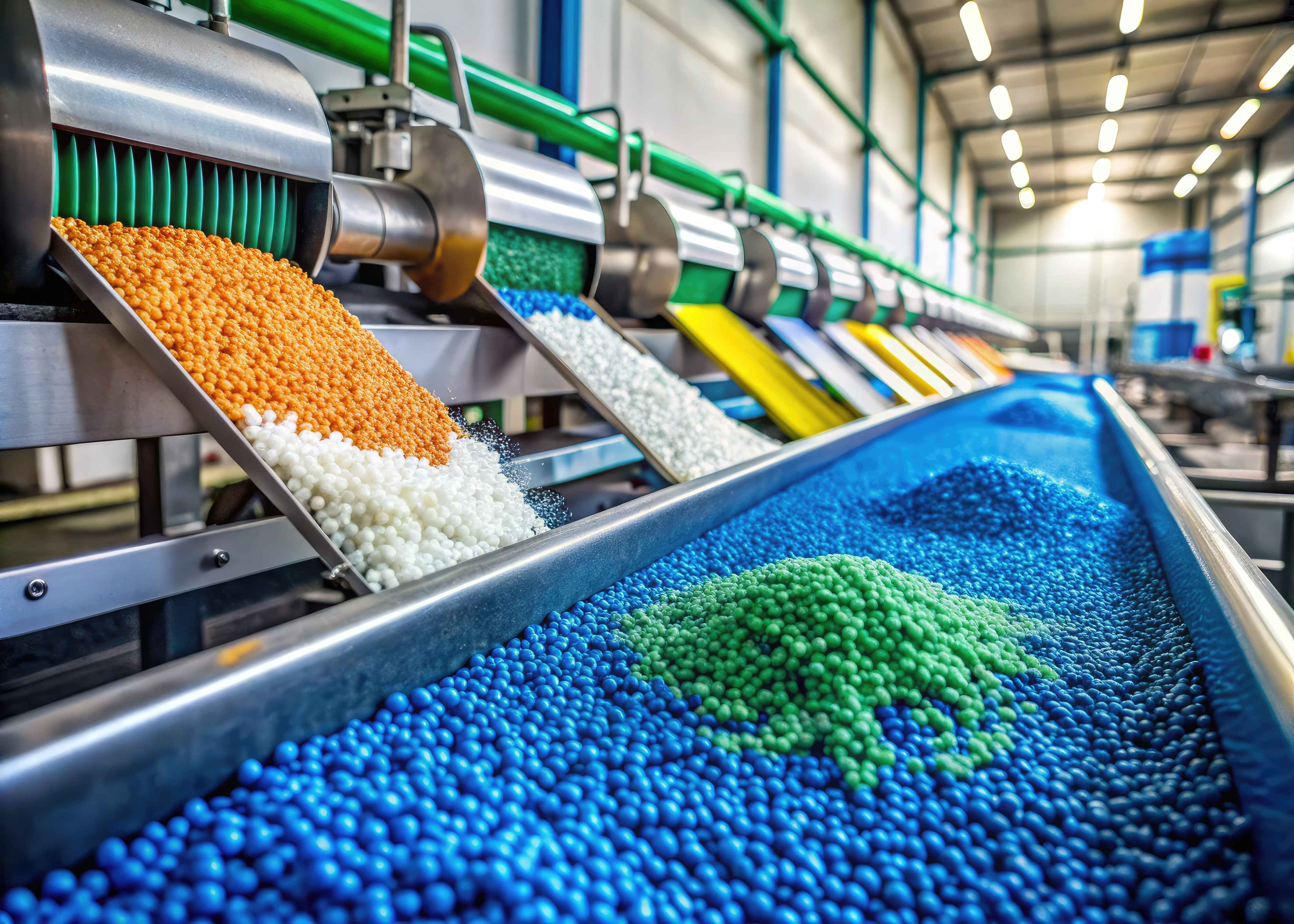
The integration of recycled polypropylene (rPP) into premium applications is no longer a voluntary sustainability signal. Under the EU Packaging and Packaging Waste Regulation (PPWR, Regulation EU 2025/40), mandatory minimum post-consumer recycled content targets for plastic packaging take effect from January 2030 — ranging from 10% for contact-sensitive packaging to 35% for other plastic packaging types. Brands that have spent years positioning PP as a performance material for cosmetics packaging, food-contact adjacent products, and durable goods are now confronting a fundamental tension: recycled content targets are set in regulation, but rPP batch variability makes process consistency unpredictable without active intervention.
The market is responding. Converters are increasingly sourcing solutions that standardize rPP rheology — not as an upgrade, but as a prerequisite for hitting recycled content targets without downgrading product specifications.
What the PPWR Actually Requires
The PPWR, adopted on 19 December 2024 and entered into force on 11 February 2025, replaces the Packaging and Packaging Waste Directive (94/62/EC). Unlike the directive it replaces, the PPWR is a regulation — directly applicable in all EU member states without national transposition. The mandatory recycled content targets under Article 7 are binding minimums verified through audited documentation. From January 2030: 30% PCR for single-use plastic beverage bottles, 10% for contact-sensitive packaging made from plastics other than PET, and 35% for all other plastic packaging. Only post-consumer recyclate (PCR) counts — post-industrial recyclate does not satisfy Article 7 requirements, which matters for brands currently counting PIR in sustainability reporting. A second round in 2040 pushes these thresholds significantly higher.
For rPP used in food-contact applications, the regulatory framework adds another layer: recycled PP must be processed through an EU-authorized recycling process under Regulation (EU) 2022/1616, with migration and contamination risks controlled per Regulation (EU) No 10/2011. Extended Producer Responsibility (EPR) compounds the pressure further: under the PPWR, producers bear financial responsibility for the full packaging lifecycle, and recycled content data directly affects EPR fee calculations from 2030 under eco-modulation rules.
The Core Problem: Batch Variability Kills Process Control
The reason rPP has historically been excluded from premium applications is process engineering, not ideology. Post-consumer recycled polypropylene arrives at converters with variability in MFI, viscosity, contamination level, and mechanical properties that virgin PP simply does not have. This variability originates from several concurrent sources.
Mechanical recycling of PP induces chain scission from the first reprocessing cycle. Research published in ScienceDirect (2023) on degradation indicators across multiple recycling loops found that chain scission phenomena in impact copolymer PP becomes visible as early as the first reprocessing loop, reflected in increasing MFI values and decreasing viscosity. Thermal degradation is identified as the primary driver — elevated processing temperatures accelerate molecular weight reduction by increasing kinetic energy and thermal stress.
A 2025 study published in Polymer Engineering & Science (Wiley) examining rPP variability across different waste origins found that conventional post-consumer rPP shows inconsistencies in rheological behavior due to feedstock heterogeneity. Blends with higher content of low-viscosity rPP showed significantly higher in-mold viscosity variation, which translates directly to dimensional inconsistency, surface defects, and increased reject rates.
The batch-to-batch fluctuation in MFI is the operational manifestation of this. A converter running a mold calibrated for 20 g/10 min may receive consecutive rPP batches at 14 and 28 g/10 min from the same nominal grade. At 14 g/10 min, short shots and incomplete fill occur. At 28 g/10 min, flash and dimensional overrun appear. Neither produces acceptable parts without process adjustment — and continuous process adjustment defeats the purpose of standardized tooling.
Vis-Breaking as a Rheology Standardization Tool for rPP
The technical solution converters are deploying is controlled rheology — specifically, peroxide-mediated vis-breaking applied to rPP to bring variable incoming MFI to a consistent target. If a batch arrives at MFI 14 g/10 min when the target is 25 g/10 min, a calibrated peroxide addition in the extruder drives chain scission to close that gap.
Research published in Applied Sciences (MDPI, 2025) on reactive degradation of recycled PP with peroxide additives confirms that doubling peroxide content increased MFI by 19 to 66% depending on the rPP grade, with a corresponding decrease in melt viscosity. The study identifies a controlled degradation window within which the material exhibits enhanced processability while maintaining sufficient structural integrity — beyond which extensive chain scission causes mechanical property deterioration. Stabilizer packages are essential to anchor the system within this window.
A 2022 study in Polymers (MDPI) demonstrated that a small amount of stabilizing additive significantly improves the rheological properties of recycled PP up to the 20th reprocessing cycle, acting as a hardener that additionally crosslinks recycled polymer chains and arrests the degradation cascade. The practical formulation principle: vis-breaking masterbatches for rPP must incorporate both the peroxide and an appropriate stabilizer system in a single, dosable package. Applying them separately introduces process variability that defeats the purpose.
The 2025 paper in Polymer Engineering & Science on in-mold rheology and automated process control found that pressure-controlled injection molding with closed-loop viscosity feedback substantially reduced part-to-part variability when processing rPP blends — a complementary approach to pre-process rheology standardization that converters are beginning to combine with masterbatch solutions.
Premium Applications: The Stakes Are Higher
Cosmetics packaging is the most demanding end-use. Brands have historically avoided rPP in primary and secondary packaging due to concerns about color consistency, odor from volatile contaminants, and surface finish variability — all of which worsen with high MFI variability, because inconsistent melt flow generates inconsistent crystallization patterns and surface morphology. Brands integrating rPP at 10 to 35% to meet PPWR requirements must demonstrate that recycled content does not affect perceived quality — which requires rPP rheology indistinguishable from virgin at the point of molding.
Food-contact adjacent packaging — caps, closures, and secondary containment — faces the regulatory overlay of Regulation (EU) 2022/1616 on top of PPWR Article 7. The migration risk profile of rPP is sensitive to contamination carried from post-consumer waste. Rheology standardization through vis-breaking does not by itself address contamination, but it does allow processors to run more consistent extrusion conditions, reducing the risk of thermal peaks that can mobilize migrant substances.
Durable goods — household appliance components, storage systems, outdoor furniture — face lower surface quality requirements but tighter dimensional tolerances driven by assembly fit. A 10% MFI shift in incoming rPP can move a critical dimension outside of tolerance. Rheology standardization allows tool-setting to remain fixed across rPP batches, which is the practical enabler of rPP upcycling at industrial scale.
The Supply Chain Dimension
Virgin PP arrives with a technical data sheet specifying MFI within a narrow range, typically ±2 g/10 min. Post-consumer rPP specifications are wider by design, reflecting feedstock heterogeneity that mechanical recycling cannot fully resolve. Research published in Polymer Engineering & Science (Wiley, 2025) found that higher-purity rPP grades with reduced contamination variability show more predictable processing characteristics, comparable to virgin polymers — implying a quality segmentation emerging in the rPP supply market: standardized grades commanding a premium, commodity rPP with wider MFI tolerance at lower cost.
Converters running premium applications need to assess which supply tier they can work with and what rheology correction is required for each. The masterbatch approach provides leverage: the same vis-breaking masterbatch, dosed appropriately, can bring different rPP batches to the same processing target — provided incoming MFI is characterized and the dose is adjusted accordingly.
What Converters Need to Implement Now
The 2030 mandatory targets under PPWR Article 7 are closer than they appear. Reformulating materials, qualifying rPP suppliers, validating rheology correction protocols, and updating product information files take time measured in months to years.
The immediate priorities: characterize incoming rPP batches by MFI and viscosity before processing rather than relying on supplier data sheets; identify the MFI target for each application and the correction magnitude required; and select a vis-breaking masterbatch system that includes both the peroxide chain scission agent and the stabilizer package, tested specifically on recycled PP rather than virgin.
The technical case for rheology standardization of rPP is clear. The regulatory case — under PPWR mandatory recycled content, EPR eco-modulation, and food-contact compliance — makes it urgent. For converters who treat rPP variability as a process problem to be managed rather than a structural barrier, the premium application market for recycled polypropylene is opening, not closing.