



TL;DR — REACH regulation continues to tighten in 2026 across multiple fronts simultaneously. The SVHC Candidate List reached 253 entries in February 2026 with the addition of n-hexane and Bisphenol AF. The CMR Annex XVII update adds 22 new carcinogenic, mutagenic or reprotoxic substances with compliance obligations expected later in 2026. The PFAS broad restriction is advancing through ECHA's scientific committees with a European Commission decision anticipated post-2026. And the microplastic SPM restriction is already in force, with rinse-off cosmetics facing a 2027 deadline. For manufacturers and importers supplying the EU market, 2026 is not a year to wait for final texts — it is a year to act on what is already confirmed.
Ready to Work Together?
Get in touch with our team and discover tailored solutions for your industry
What is REACH and why does the 2026 update matter?
REACH — Registration, Evaluation, Authorisation and Restriction of Chemicals, Regulation (EC) No 1907/2006 — is the foundational EU chemicals regulation governing the safe use of substances on the European market. Its scope is broad: it applies to chemical substances on their own, in mixtures, and in articles, and it affects manufacturers, importers, distributors, and downstream users across virtually every industrial sector.
The regulation is not static. ECHA — the European Chemicals Agency, the Helsinki-based body responsible for implementing REACH — continuously updates its restricted substances lists, candidate lists, and authorisation requirements based on new scientific assessments, risk evaluations, and proposals from EU Member States and the European Commission. 2026 is particularly dense: several restriction proposals are converging simultaneously, with deadlines falling across cosmetics, coatings, specialty chemicals, electronics, and consumer goods manufacturing.
Understanding where each restriction sits in the regulatory process — and what it means practically — is the starting point for any supply chain compliance strategy.
The REACH regulatory architecture: three lists that matter
Before reviewing the 2026 updates, it is useful to map the three core instruments under REACH that trigger direct obligations for companies.
Annex XVII — the Restricted Substances List. This is the most operationally consequential list. Substances on Annex XVII cannot be manufactured, placed on the market, or used in the EU except under the conditions specified in the restriction entry. Some entries impose concentration limits; others impose outright bans; others restrict use to professional or industrial contexts. Compliance is mandatory and enforced at national level by Member State authorities.
The SVHC Candidate List. Substances of Very High Concern are chemicals identified by ECHA as posing serious risks to human health and the environment — due to carcinogenicity, mutagenicity, reproductive toxicity, persistence and bioaccumulation, or equivalent concern. Inclusion on the Candidate List triggers immediate information obligations (Article 33 REACH) but does not constitute a ban. It is, however, the precursor to inclusion on Annex XIV.
Annex XIV — the Authorisation List. Substances on this list cannot be used after a sunset date unless the specific use has been granted authorisation by the European Commission. Authorisation is time-limited, use-specific, and increasingly difficult to obtain as ECHA's committee workload grows. The 13th recommendation round was published in February 2026, adding further substances under evaluation for Annex XIV inclusion.
REACH 2026 update: the SVHC Candidate List reaches 253 entries
The first significant REACH update of 2026 came on 4 February, when ECHA officially added two new substances to the SVHC Candidate List, bringing the total to 253 entries.
n-Hexane (CAS 110-54-3) was added due to specific target organ toxicity after repeated exposure — the neurotoxicity pathway under Article 57(f). This is a landmark inclusion: it is the first SVHC identified based on neurotoxicity as an equivalent level of concern, rather than the traditional CMR criteria. n-Hexane is a widely used solvent in formulation processes, polymer processing, coatings, adhesives, and cleaning agents. Companies using it as a cleaning or extraction solvent in chemical manufacturing will need to screen their products urgently.
4,4'-[2,2,2-trifluoro-1-(trifluoromethyl)ethylidene]diphenol and its salts (Bisphenol AF / BPAF) — a group of 9 substances — was added due to reproductive toxicity under Article 57(c). BPAF is used as a process regulator and crosslinking agent in high-performance fluoroelastomers, specialty coatings, and adhesive applications.
Immediate obligations triggered by the February 2026 addition:
For any article containing either substance above 0.1% w/w, suppliers must inform customers and provide safe use information. Producers and importers of affected articles must notify ECHA via SCIP within six months — the notification deadline is 4 August 2026. Safety data sheets for substances and mixtures containing these SVHCs must be updated immediately.
REACH 2026 update: Annex XVII CMR expansion
Beyond the Candidate List, a significant Annex XVII amendment is advancing through the European Commission's processes in 2026. A draft proposal published in January 2026 adds 22 substances to Entries 28, 29, and 30 of Annex XVII — the entries covering carcinogenic, mutagenic, and reprotoxic (CMR) substances in consumer products.
This periodic update aligns REACH restrictions with the latest CLP Regulation hazard classifications. Concentration limits for the newly added substances range from 1,000 to 3,000 ppm depending on the CMR classification category. Final adoption and publication in the EU Official Journal are expected later in 2026, with a transition period for affected companies.
The sectors most directly impacted include chemical manufacturers and formulators, cosmetics and personal care, textiles, consumer goods, and specialty industrial chemicals. Companies manufacturing articles or mixtures containing any of the 22 newly listed substances sold to general consumers will face direct compliance requirements. Among the notable substances in the proposal, trimethyl phosphate — used in flame retardant formulations and as a plasticizer intermediate — appears across multiple appendix entries and will require supply chain tracing.
REACH 2026 update: the PFAS broad restriction — where it stands
The most sweeping restriction proposal currently advancing through REACH is the universal PFAS restriction — a proposal to restrict per- and polyfluoroalkyl substances across the entire REACH scope. The proposal was jointly submitted in January 2023 by Denmark, Germany, the Netherlands, Norway, and Sweden, and covers 231 identified major use sectors including cosmetics, coatings, food contact materials, textiles, electronics, and medical devices.
Where the process stands in 2026:
ECHA's Risk Assessment Committee (RAC) adopted its opinion on the restriction proposal on 3 March 2026, completing a comprehensive evaluation of PFAS hazards, emissions, and risks. ECHA's Socio-Economic Analysis Committee (SEAC) agreed its draft opinion on 11 March 2026, with a 60-day public consultation running from 26 March to 25 May 2026. Once SEAC finalises its opinion, the European Commission will prepare a draft restriction decision in consultation with EU Member States — a process that is unlikely to produce a final Annex XVII entry before 2027 at the earliest.
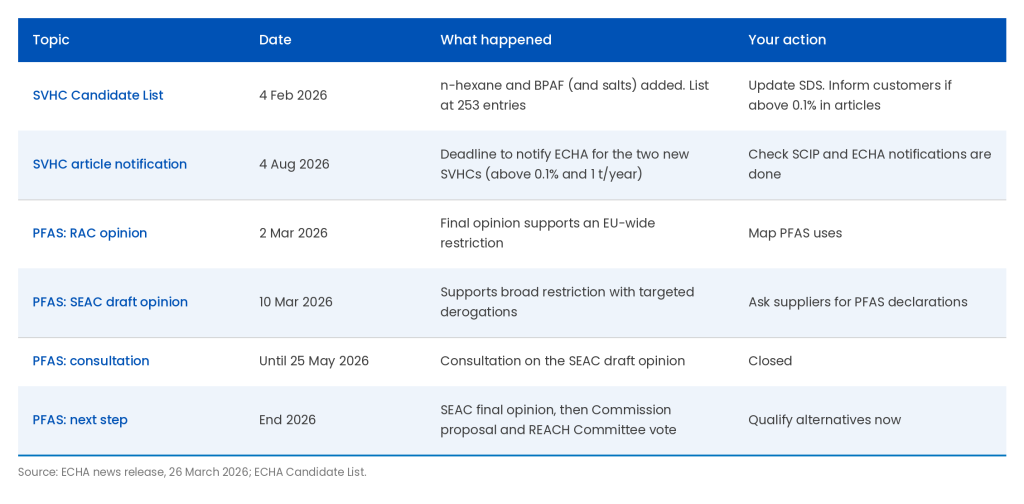
PFAS restriction: what the March 2026 ECHA opinions say
On 26 March 2026, ECHA announced that its two scientific committees support an EU-wide restriction of PFAS, with targeted derogations. The Risk Assessment Committee (RAC) adopted its final opinion on 2 March 2026. The Committee for Socio-Economic Analysis (SEAC) agreed its draft opinion on 10 March 2026.
SEAC supports derogations only where alternatives are not yet available and the cost-benefit balance justifies it. RAC recommends that any derogation comes with emission controls: site PFAS management plans, supply-chain communication, labelling and reporting.
The consultation on the SEAC draft opinion closed on 25 May 2026. SEAC is expected to adopt its final opinion by the end of 2026. The Commission will then propose the restriction text for a vote by Member States in the REACH Committee.
What to do now: map where PFAS are intentionally used in your products, ask suppliers for written PFAS declarations, and start qualifying alternatives for uses unlikely to get a derogation.
What this means for industries using PFAS in 2026
The broad PFAS restriction is not yet law, but the scientific opinions are now largely complete. Industries relying on PFAS for functional coatings, surfactants, processing aids, or specialty chemical applications should be treating this as a confirmed regulatory direction — not a possibility. The window for orderly reformulation and supply chain transition is open now; it will close rapidly once the Commission decision is published.
Specific PFAS sub-groups are already restricted or imminently restricted under REACH independently of the broad proposal. Undecafluorohexanoic acid (PFHxA) and its related substances face restrictions starting April 2026. Long-chain perfluorinated carboxylic acids (C9-21 PFCAs) are being incorporated into the EU's POPs Regulation with a global ban applying from December 2026.
REACH 2026 update: the microplastic SPM restriction — enforcement deadlines approaching
Commission Regulation (EU) 2023/2055 — restricting synthetic polymer microparticles intentionally added to products — entered into force on 17 October 2023, but its most commercially significant deadlines fall in 2026–2029. On 17 October 2025, the first information and reporting obligations came into force: suppliers must now provide use and disposal instructions, compliance statements, and polymer identity information in SDSs and labelling.
The upcoming enforcement deadlines for cosmetics are:
- 17 October 2027 — rinse-off cosmetics (shampoos, shower gels, body washes, cleansers)
- 17 October 2029 — leave-on cosmetics (moisturisers, serums, creams, hair gels, sunscreens)
- 17 October 2035 — colour cosmetics, lip and nail products (with mandatory labelling from 2031)
The key practical consequence for formulators: carbomers are classified as restricted SPMs under this regulation. The solubility test must be conducted at pH 7 on the material in its commercialised form. Carbomers are supplied as dry acidic powders and only become soluble after in-situ neutralisation — they therefore fail the solubility exclusion in their supplied state. Pre-neutralised synthetic polymers, supplied in a form that passes the pH 7 solubility test, are outside the SPM classification.
What to switch to: alternatives across the key restriction areas
Replacing carbomers (SPM restriction)
The most viable alternatives depend on the formulation context:
Pre-neutralised acrylate polymers supplied as aqueous dispersions or sodium salts pass the pH 7 solubility test as supplied and are outside the SPM classification. They can replicate many of the rheological and textural properties of conventional carbomers with modifications to the formulation process.
HASE and HEUR associative thickeners are outside the SPM scope for most grades and offer precise rheological control in emulsion systems. They require more formulation work to match carbomer texture but are technically fully capable substitutes in cream and lotion formats.
Natural polysaccharide combinations — xanthan-sclerotium gum, xanthan-guar blends — are COSMOS-compliant, SPM-free, and technically mature alternatives for most leave-on and rinse-off formats, with the sensory and concentration trade-offs detailed in our natural vs synthetic thickeners guide.
Replacing PFAS-containing substances
PFAS perform multiple distinct functions — surface tension reduction, hydrophobic and oleophobic coatings, thermal stability, lubrication — and no single alternative chemistry covers all uses.
In surface coatings, fluorine-free water-repellent chemistries based on wax emulsions, dendrimers, silicone, and bio-based C6 chemistry are advancing as alternatives, though performance at extreme conditions (high temperature, prolonged moisture exposure) remains a gap for some industrial applications.
In cosmetics, PFAS are used primarily for film-forming, texture enhancement, and water-resistance in colour cosmetics and sunscreens. Alternatives include silicone-based film formers, polyacrylate crosspolymers, and bio-derived esters — with each requiring careful stability and performance testing in the target formulation.
In specialty industrial applications, the alternatives are highly use-specific and often still in development. ECHA's SEAC consultation running until May 2026 is specifically gathering socioeconomic impact data on the availability of alternatives across all 231 identified sectors.
Replacing n-hexane in formulation and cleaning processes
The addition of n-hexane to the SVHC Candidate List in February 2026 does not constitute an immediate ban, but triggers information and notification obligations that signal regulatory direction. Alternative solvents — heptane, isoparaffins, ethyl acetate, bio-based alcohols — are available for most cleaning and extraction applications, with solvent selection depending on the polarity of the substrate and the required evaporation profile.
How companies should manage REACH compliance in 2026
Map your substances against the current lists. The SVHC Candidate List, Annex XVII, and the authorisation list are all live documents. ECHA CHEM, ECHA's new chemicals database live since September 2025, is now the authoritative single source. Any substance present in your products, mixtures, or articles at above 0.1% w/w needs to be screened against all three instruments.
Update safety data sheets proactively. The February 2026 SVHC additions require SDS updates for all substances and mixtures containing n-hexane or BPAF. Waiting for enforcement is not a defensible compliance posture — EU and EEA suppliers of substances and mixtures must update SDSs immediately upon Candidate List inclusion.
Submit SCIP notifications on time. The notification deadline for the February 2026 SVHC additions is 4 August 2026. SCIP submissions must be made through ECHA's REACH-IT and IUCLID systems. Companies producing or importing articles containing SVHCs above 0.1% w/w in quantities exceeding one tonne per year are legally required to notify.
Engage your supply chain. REACH compliance cannot be managed in isolation. Under Article 33 REACH, the information obligation flows downstream through the supply chain. If your suppliers have not updated their substance disclosures to reflect the February 2026 additions, their silence is your compliance gap.
Begin reformulation planning now for SPM-restricted substances. The 2027 deadline for rinse-off cosmetics is within a standard product development cycle for formulations beginning now. Teams developing new rinse-off products for the EU market should be treating carbomers as unavailable from the design stage — not as an existing ingredient to be replaced later.
For a detailed breakdown of how the microplastic regulation specifically affects cosmetic thickener selection, including which synthetic polymers fall inside and outside the SPM classification, see our dedicated article on rheology modifiers and emulsion stabilisation.
FAQ
How many substances are on the SVHC Candidate List in 2026?
253 entries after the 4 February 2026 update, which added n-hexane and bisphenol AF and its salts.
Is the EU PFAS restriction adopted?
Not yet. ECHA's committees support it with targeted derogations. SEAC's final opinion is expected by the end of 2026, then the Commission proposes the text and Member States vote.
What are the obligations when a substance joins the SVHC list?
Suppliers must update SDS, inform customers when an article contains more than 0.1% w/w, and notify ECHA within six months if above 1 tonne per year.
What can replace n-hexane?
See our alternatives section. Solvent substitution depends on the process: check solvency, evaporation rate and flash point with our technical team.