


Formulators looking to replace conventional petroleum-based emollients or volatile silicones increasingly turn to the same two molecules: squalane and hemisqualane. Both are derived from renewable feedstocks, both deliver exceptional skin feel, and both carry a body of dermatological evidence that most bio-based alternatives cannot match. Understanding what differentiates them — chemically, functionally, and from a sourcing standpoint — is essential before making a formulation or sourcing decision.
The Biological Starting Point: Squalene in Human Skin
The relevance of squalane to skin care is not incidental — it is structural. Its precursor, squalene (C₃₀H₅₀), is a triterpene that forms a significant fraction of human sebum. NIH research on epidermal surface lipids identifies it as one of the predominant non-polar lipids secreted by sebaceous glands alongside triglycerides and wax esters. More specifically, the PMC review on squalene biology quantifies squalene at approximately 13% of total sebum composition — making it the single largest peroxidable fraction in skin surface lipids.
Its functional role is protective. Research on skin surface lipids as environmental mediators demonstrates that squalene's presence in human sebum, which is absent in the sebum of non-human primates, likely represents an evolutionary adaptation: its capacity to neutralize reactive oxygen species generated by UV irradiation positions it as a natural endogenous antioxidant and indirect photoprotective agent.
The problem with squalene in topical formulations is chemical instability. The 2025 dermatological study on squalane in fibroblasts notes that squalene carries six double bonds and oxidizes readily upon exposure, limiting its shelf life and generating comedogenic peroxides in formulated products. Hydrogenation saturates those bonds, producing squalane (C₃₀H₆₂) — chemically inert, non-comedogenic, and stable under normal storage conditions.
From Shark to Sugarcane: The Sourcing Shift
For most of the twentieth century, commercial squalane was derived from shark liver oil, which can contain squalene at concentrations far exceeding those found in plant sources. This dependency raised serious sustainability and ethical concerns, given the volume of deep-water shark catch required to supply the cosmetic industry.
Two plant-derived routes have since become dominant:
Olive-derived squalane is produced by hydrogenating squalene extracted from olive oil deodorizer distillate, a by-product of olive refining. It carries ECOCERT credentials and is well established in European markets. However, the squalene content of olive oil is relatively modest — precision fermentation research notes that even amaranth oil, one of the richest botanical squalene sources, contains only around 5.9% of the compound.
Sugarcane-derived squalane, pioneered by Amyris, relies on precision fermentation. As described in Cosmetics & Toiletries, the yeast Saccharomyces cerevisiae is programmed to convert sugar into β-farnesene, a sesquiterpene that then undergoes chemical conversion into squalane. The output is essentially odourless, highly pure (>99% C₃₀ hydrocarbon), and consistent lot-to-lot — characteristics difficult to guarantee with plant extraction. Research on precision fermentation for cosmetics notes that engineered yeast strains have achieved squalane yields 3 to 115 times higher than wild-type organisms, making the process commercially scalable.
The PMC review on microbial squalene confirms that fermentation-derived squalane is functionally indistinguishable from shark-derived material, while supporting environmental sustainability and enabling vegan certification.
Skin Functionality: What the Evidence Shows
Skin Functionality: What the Evidence Shows
Squalane's biomimetic structure allows it to integrate into the stratum corneum lipid matrix without triggering immune response or disrupting the skin microbiome. Its low molecular polarity gives it rapid, non-greasy spread across the skin surface, making it suitable for a wide range of leave-on formulations.
The ScienceDirect study on squalane-based emulsions demonstrates that squalane enhances the skin penetration of co-formulated actives, increasing compound diffusion through the stratum corneum and improving interaction with deeper skin layers — a relevant property when squalane is used as a carrier phase for polyphenols, vitamins, or lipophilic active ingredients.
The 2025 study on UV protection and collagen biosynthesis published in PMC found that squalane protects human dermal fibroblasts from UV-induced inhibition of collagen synthesis, suggesting a functional role beyond simple emolliency.
Transepidermal Water Loss Reduction
The Polymers cyclic compression review aside, the strongest clinical signal for squalane remains its effect on skin hydration. A 2023 study published in CosmoDerma documented statistically significant TEWL reductions at 7, 14, and 28 days of daily application, with progressive improvement over time consistent with cumulative barrier strengthening rather than surface-level occlusion.
Hemisqualane: The Silicone Replacement
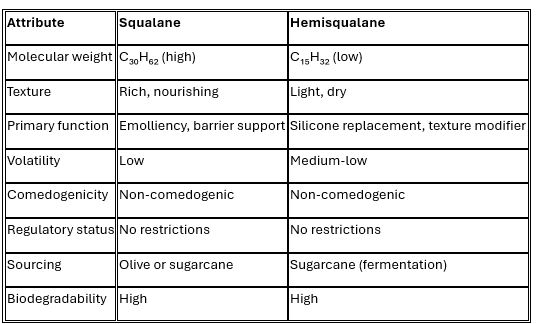
Hemisqualane (INCI: C13–C15 Alkane) is structurally half the size of squalane — a 15-carbon branched hydrocarbon. It is produced via the same β-farnesene fermentation pathway developed by Amyris, but the chemical conversion stops earlier. The result is a lighter, more volatile molecule designed to replicate the sensory profile of cyclic silicones.
Why Silicone Replacement Is Now a Formulation Priority
The regulatory context makes this transition urgent. Commission Regulation (EU) 2024/1328 extended restrictions under REACH Annex XVII to D4, D5 (cyclopentasiloxane), and D6 (cyclohexasiloxane). D5, formerly the most widely used volatile silicone in cosmetics, is now capped at 0.1% in rinse-off products and subject to expanding restrictions in leave-on applications. The environmental basis is clear: PMC research on cyclomethicone confirms that D5 does not biodegrade readily in aquatic systems, accumulates in fish liver tissue, and has been classified as a very persistent, very bioaccumulative (vPvB) substance by ECHA.
What Hemisqualane Delivers
Biocosmetics research published in PMC describes hemisqualane explicitly as "a sustainable and naturally derived alternative to cyclomethicone," produced via sugarcane fermentation and inherently biodegradable. It carries ECOCERT approval and USDA Certified Biobased Product designation.
In formulation, hemisqualane provides rapid spreadability, a silky dry finish, and short playtime on skin — sensory characteristics that traditionally required volatile silicones. Formulation analysis comparing hemisqualane and D5 replacements notes that it excels in delivering initial slip and lightness, making it well suited to facial serums, primers, and light-texture body products.
Its limitation is that it does not fully replicate silicone volatility: unlike D5, hemisqualane does not evaporate from the skin surface, so in formulations that rely on evaporation for texture change or pigment setting, performance adjustments may be required. ScienceDirect research on bio-based D5 alternatives recommends blending hemisqualane with other light bio-alkanes or esters to reconstruct a complete volatile profile.
Formulation Positioning
Summary
Squalane and hemisqualane occupy distinct but complementary positions in sustainable formulation. Squalane addresses the emolliency and barrier-support function with a body of dermatological evidence spanning TEWL reduction, collagen protection, and active delivery enhancement. Hemisqualane targets the regulatory gap left by the restriction of cyclic silicones, offering a biodegradable, bio-based alternative with a sensory profile close enough to D5 to allow meaningful reformulation.
Both benefit from the same fermentation platform that has resolved the supply, consistency, and sourcing challenges that historically limited plant-derived squalane. For formulators operating under the EU REACH framework — or anticipating equivalent restrictions in other markets — the case for integrating these molecules into the emollient toolkit is now as much regulatory as it is scientific.